N.J. declares drought warning
Some parts of the state are running up to eight inches below normal for precipitation over the past 365 days.
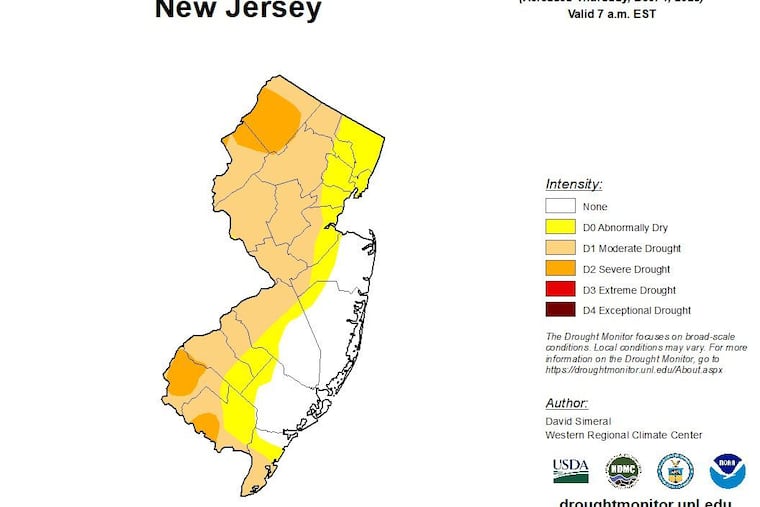
New Jersey is parched top to bottom.
In some regions, rainfall has plunged as much as eight inches below average for the past year, straining reservoirs, streams, and aquifers enough that the state Department of Environmental Protection has issued a drought warning — a notch shy of an emergency.
As a result, officials are asking residents to voluntarily curtail water use. Should conditions deteriorate, officials may impose mandatory restrictions on certain uses of water, though such measures are rarely invoked.
DEP Commissioner Shawn LaTourette said in a statement on Friday’s announcement that there is an “urgency of the need to conserve water.”
“The precipitation and water supply uncertainty we’ve experienced over the past year is a symptom of the impacts of climate change here in New Jersey,” LaTourette said.
It’s the second year the state is looking at a drought.
The last drought warning was issued in November 2024. That declaration came as firefighters had fought multiple simultaneous wildfires, one deadly, that broke out across the state amid dry, windy conditions.
» READ MORE: Multiple wildfires across N.J. leave one dead.
That warning was lifted in June following record rainfall for some parts of the state in May.
Up to 8 inches below normal
However, the state overall has experienced below-average precipitation for more than a year, officials said.
New Jersey officials cited data from the Middle Atlantic River Forecast Center operated by the National Weather Service.
That data shows that Burlington, Camden, and Gloucester Counties are all running nearly four inches below average over the past 90 days.
Burlington County is running more than seven inches below normal for the past 365 days, and Camden County is running more than six inches below normal for the same period.
Northwestern New Jersey is running more than eight inches below normal over the past year.
Likewise, the U.S Drought Monitor, a partnership of the University of Nebraska-Lincoln’s National Drought Mitigation Center and multiple federal agencies, shows the South Jersey counties along the Delaware River in either a moderate or severe drought.
About 3.5 million residents of New Jersey live in a drought-impacted area.
Officials said recent rains have not made much difference, considering the size of the gap. Ocean County is one of the few areas of the state with near-normal precipitation levels.
An update on rainfall and drought data is expected Wednesday.
State officials use multiple sources to determine the impact of rainfall on water supplies. Those include reservoir levels, stream flows, and groundwater (aquifers).
South Jersey counties, such as Burlington, Camden, Gloucester, and Salem, rely primarily on groundwater but also use water from the Delaware River and other rivers and streams.
Drought indicators for groundwater levels in South Jersey are designated as extremely dry while precipitation and stream flows are severely dry.
Officials say the persistent dryness has resulted in “observable stress across all specific indicators.” Nearly all regions of the state are classified as being severely or extremely dry.
Pennsylvania is also dry. Last week, the Commonwealth Drought Task Force said 37 counties are under a drought watch, although none in Southeastern Pennsylvania. A drought watch means an area has received 25% less rain over three months than normal. It is the lowest of three levels of drought declarations in Pennsylvania.
How to conserve
In New Jersey, officials have issued some tips on conserving water, such as:
Run dish and clothes washers only when full.
Turn off and winterize outdoor pipes and irrigation systems.
Check pipes for leaks.
Use a commercial car wash that recycles water.
Compost vegetable food waste instead of running the garbage disposal.
Installing a low-flow toilet can save up to 1,000 gallons per year.
Installing a low-flow shower head can save 7,700 gallons per year.
Installing newer faucets and aerators can save 16,000 gallons per year.