The Jersey Shore gets $73 million in federal beach replenishment money, after no funds last year
New Jersey’s share is more than 85% of the total funding.
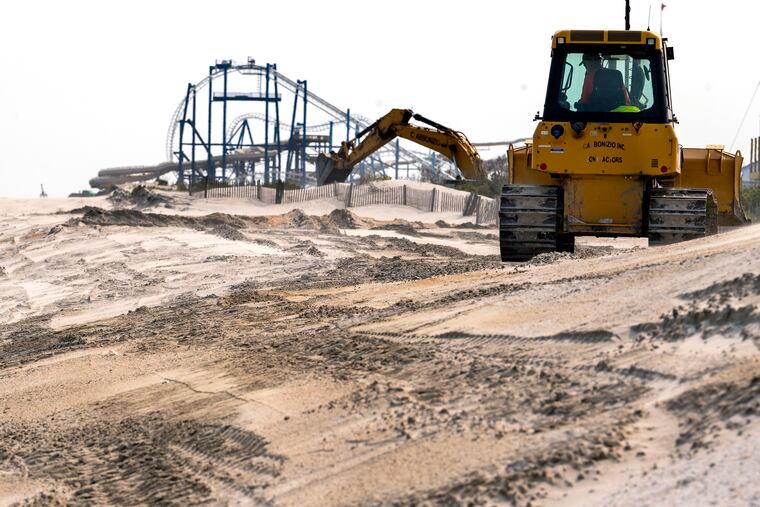
After enduring seasonal assaults that included a tropical storm and a blizzard, three Jersey Shore barrier island towns will be the major beneficiaries of federal beach fill money that is back for the first time in two years.
Of the $83.8 million for sand replenishment in the federal fiscal 2026 budget, $73 million will be used for ongoing projects in Sea Isle City and Strathmere, Avalon and Stone Harbor, and Ocean City, according to Howard Marlowe, one of the nation’s most prominent coastal lobbyists.
The remaining $10 million will go to refill projects on beaches in Delaware and Ocean City, Md.
First up will be a one-mile stretch of Strathmere — one of the few remaining free beaches on the Jersey coast — and the areas of Sea Isle City near 29th and 30th, and 54th and 55th Streets. The U.S. Army Corps of Engineers has awarded a $21.6 million project for dredging and sand pumping to a Virginia company.
The Corps said it expects work to begin in early June, said George J. Savastano, the Sea Isle business administrator.
The project is 50% federally funded, with the state paying 37.5% and the other 12.5% coming from Sea Isle and Upper Township, of which Strathmere is a part. (Perhaps contrary to popular perception, Strathmere is not a town.)
It is not known when the Ocean City or Avalon and Stone Harbor fills would begin.
Sea Isle and Upper Township officials said the beaches badly need the repairs. Erosion led to the ocean consuming Strathmere’s beach-patrol station, making the pending demolition moot, said James Van Zlike, Upper Township’s administrator.
“We are extremely grateful to see this project moving forward,” he said.
Last fiscal year, for the first time in three decades, no federal money was allocated for beach nourishment, long a source of controversy and debate.
Historically, New Jersey is a national leader in sand replenishment
Historically, New Jersey beaches have received just over $800 million in federal appropriations for beach fill since 2000, according to Marlowe, founder of the American Coastal Coalition and president of Warwick Group Consultants.
That would be tops in the nation for regular appropriations, just edging Florida, which has 10 times the coastline.
However, the calculation doesn’t include emergency funding for beach fills, and Florida’s total well exceeded New Jersey’s as of 2025, according to data assembled by Western Carolina University’s Program for the Study of Developed Shorelines.
New Jersey, with some of the oldest and most heavily visited shore towns in the nation, has 110 miles of shoreline. That constitutes about 0.1% of the nation’s total, but the state has received about 12% of all sand pumped on the nation’s beaches, according to the Western Carolina survey.
The debate over beach fill lives on
Beach fill indisputably has blunted the effects of storm waves, and with rising seas as the planet warms, the nation needs to invest more in shore protection, Marlowe argues.
Traditionally, the federal appropriations ranged from $100 million to $200 million.
Jersey’s beaches front an estimated $80 billion worth of property, and whether taxpayers and the U.S. Army should be involved in protecting beachfront investments long has been a source of longstanding debate.
Beaches, said Andy Coburn, associate director of the Western Carolina program, are among “the most unpredictable, most dynamic, powerful environments in the world.”
Unbuilt upon, barrier islands — such as the ones that host Jersey Shore towns from Barnegat to Cape May Point — naturally would migrate, but over time most of them likely would be located about where they are today, said Coburn.
They just wouldn’t be venues for boardwalks, hotels, vacation homes, Belgian waffle houses, pizza shops, and the like.
Beach towns with serious erosion issues should look at an “array” of options, “including a proactive retreat strategy,” said Coburn.
However, he said, “Nobody is advocating that we abandon all barrier-island development.”
Staff writers Frank Kummer and Amy S. Rosenberg contributed to this article.