With no rain in the forecast, N.J. officials are wary of wildfires as the season hits its peak
New Jersey fire officials say the start of wildfire season has been mild so far, but they are preparing for an "active fire year."
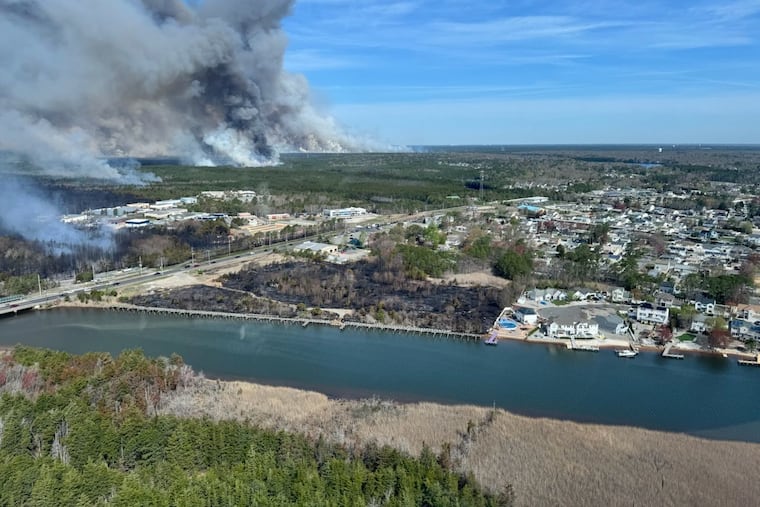
Spring may green New Jersey’s forests, but it also primes them for wildfires and state officials are watching to see if it flares into another intense season.
“We are anticipating another active fire year,” Greg McLaughlin, the state’s Administrator for Forests and Natural Lands, said Tuesday at a press briefing on the wildfire season.
New Jersey Forest Fire Service Chief William Donnelly said officials can’t predict how bad this wildfire season will be, but it typically peaks from mid-March through mid-May.
So far, it has been mild compared to 2025.
To date this year, 201 wildfires have been reported, burning through 154 acres, Donnelly said.
By this time in 2025, the state had already experienced 537 wildfires, including the massive Jones Road Wildfire that burned 15,000 acres in Ocean County and took 20 days to contain.
In all, 1,322 wildfires burned through 27,230 acres in 2025.
In a typical year, 1,100 wildfires will burn 5,000 acres.
Wildfire season is growing
Spring is prime time for fires because there are so few leaves on trees, which contain moisture that can slow the spread of a blaze. At the same time, low humidity and dry air masses tend to dominate with strong wind gusts.
This past winter was marked by snow cover that helped suppress fires, and kept people inside. People are the number one cause of wildfires.
Donnelly said the length of wildfire season is increasing in the state.
He cited a 2025 analysis by the research nonprofit Climate Central found the number of annual wildfire weather days has increased over the past 50 years by 11 days in the northern part of New Jersey and five days in the southern.
“Despite the snow we had over the winter, the forest remains dry, and the risk is real,” Donnelly said. “Ultimately, Mother Nature will have the final say on what this spring fire season will hold.”
Donnelly noted that the forecast is calling for little or no rain for the next week or longer.
Camden, Burlington, and Gloucester Counties were listed as in moderate drought by the U.S. Drought Monitor before Sunday’s rain. Most of the rest of the state was listed as abnormally dry. The U.S. Drought Monitor, a joint effort of the federal government and University of Nebraska-Lincoln, produces a map each Thursday.
Fire officials say the state’s first new fire tower in 78 years will help monitor hot spots in Ocean County. Veterans Tower in Jackson, Ocean County, is 133 feet tall and designed to act as a sentinel for 516,000 residents and 200,000 homes.
Pinelands at risk
New Jersey is more prone to wildfire than some other states because of its vast tracts of unbroken forest, such as in the 1.1 million-acre Pinelands regions.
Pinelands soils are acidic and forest debris accumulates without readily decomposing. The highly permeable acidic soils in the Pinelands also have a low capacity to hold water, often resulting in dry soil.
Highly flammable pitch pine thrive under those conditions. Together, the presence of highly flammable vegetation, accumulation of dry leaves and branches, and dry soil conditions make the area a tinder box.
Not only that, but pitch pines have adapted to the environment and depend on periodic wildfires to release seeds for reproduction.
New Jersey fire officials use controlled burns in winter to get rid of tinder that’s built up on the forest floor. They use handheld torches to set smaller fires to burn away fallen leaves, pine needles, fallen branches and other debris.
But they are limited at times because of weather, especially during droughts. Normally, they target 20,000 to 25,000 a year. After a long drought in 2024, fire crews were only able to complete about 4,000 acres, the lowest amount in 25 years.
This year, only about 8,600 acres have gotten controlled burns due to snow.