Rutgers introduces a new sweet tomato, years in the making
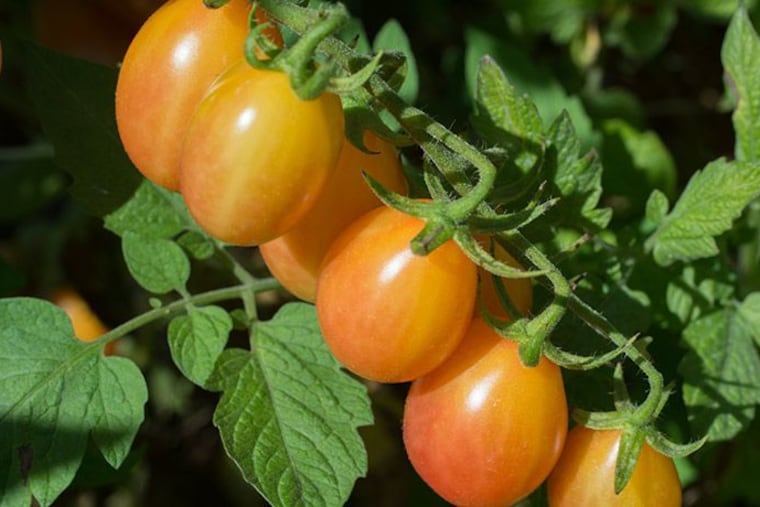
Meet ‘Scarlet Sunrise,’ a new, sweet, crack-resistant, golden grape tomato nearly a decade in the making.
In the 1930s, Camden-based Campbell Soup Co. and Rutgers University collaborated to breed a tomato for the company’s wildly popular tomato soup.
That Rutgers tomato once dominated the U.S. market, making up 72% of all commercially grown tomatoes. The university, and New Jersey itself, became synonymous with the tomato.
Rutgers has continued to produce various large and medium-size tomatoes over the years. Now, it’s venturing into grape tomatoes.
This month, Scarlet Sunrise, a sweet, crack-resistant, golden grape tomato with a touch of red, makes its debut, nearly a decade in the making after being developed by Rutgers researchers Pete Nitzsche and Tom Orton.
“There were some good-tasting red grapes and some poor-tasting red grapes,” said Nitzsche, an associate professor and agricultural agent for Rutgers Cooperative Extension, a part of the university that provides technical help to farmers. “We were able to find this bicolor trait from another heirloom variety and get it into a good-tasting grape tomato that also has some crack resistance.”
Typically, Rutgers produces larger tomatoes. But the researchers believe many grape tomatoes on the market don’t taste great or might crack on the vine. Their goal: Create a grape tomato with exceptional flavor with a look that sets it apart from competitors.
They crossed a commercial red grape tomato with a Rutgers heirloom that yielded a bicolor tomato described as having “a golden hue and a reddish blush.”
Scarlet Sunrise will appear in public at a Rutgers Open House and Tomato Tasting event Aug. 27 at the university’s Clifford E. and Melda C. Snyder Research and Extension Farm in Pittstown, Hunterdon County. The university retains the intellectual property rights of the tomato through the U.S. Department of Agriculture.
A painstaking process
“I kind of lost count,” Orton, an emeritus professor of plant biology, said of how many times he crossbred tomatoes before producing the Scarlet Sunrise.
The process is painstaking. For each cross, Orton grasped tiny tweezers to extract pollen from the flower of one plant, and used a small paintbrush to transfer it to another plant’s flower.
“Small fruited types are more difficult,” Orton said. “The flowers of grape and cherry tomatoes are so small and fragile … they just disintegrate. It is delicate work. I wish I was trained as a surgeon. For a couple of months period I might do five to 20 crosses a day. … There are probably at least a couple of hundred crosses that are made.”
Orton said he would find the flower of a plant he wanted to use as the female, because that’s the one that produces the most seeds. Then, he would find a male to cross it with. Both need to mature about the same time.
It can take 50 or more days for fruit to mature. When a plant’s fruit ripened, the seeds were removed and separated from the gel-like substance and “hairs” that surround them.
“That’s a bit of a painstaking process,” Orton said.
Then the seeds had to be sterilized and allowed to germinate, flower, and produce fruit.
The process took place over winters at Rutgers Agricultural Research and Extension Center in Upper Deerfield, Cumberland County, and in summers at the Snyder Farm, halting a bit during the pandemic.
It took years of crosses as combinations of colors, taste, or crack resistance failed. Finally, they hit on Scarlet Sunrise.
Rutgers’ sports teams are the Scarlet Knights. The researchers were told the yellow fruit with its hint of red resembled a sunrise, hence Scarlet Sunrise.
Too tall
“The hope is that some local growers will adopt it, and the seed will become available to growers, but then also gardeners, too,” Nitzsche said of Scarlet Sunrise. “It’s probably always going to be a little bit of a specialty market and production.”
However, a stumbling block remains. The Scarlet Sunrise is too tall.
It can grow up to 8 feet high because it is an indeterminate variety of tomato plant, meaning its vines can continue to grow and produce fruit up to the first frost. Determinate varieties generally have a shorter growing season.
As a result, the Scarlet Sunrise needs to be staked and tied.
“It’s a lot of labor for growers,” Nitzsche said.
The researchers are working on a shorter, more compact plant.
They know they will also face some resistance to grape tomatoes from local growers because their fruits are small and more intensive to harvest. That can mean higher labor cost.
‘Consumer appeal’
Scarlet Sunrise still has to be marketed and sold, and Rutgers faces competition from commercial tomato plants produced in California and Mexico.
Ultimately, people have to like the taste, the researchers say, and commercial and home gardeners have to want to plant the seeds.
The pair believes Scarlet Sunrise delivers.
“We evaluate flavor. We look at consumer appeal,” Orton said. “There are certain aspects that contribute to flavor, such as acids and sugars. We select for those.”