Beach replenishment project for Wildwoods has collapsed as two towns refuse to share sand
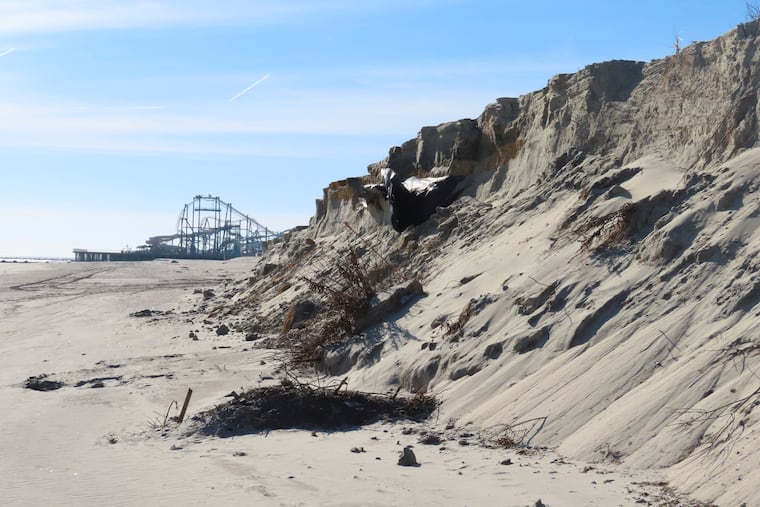
The Army Corps plan called for sand to be taken from the wide beaches of Wildwood and Wildwood Crest and brought to North Wildwood.
A major federal beach replenishment and dune building project for the Wildwoods has collapsed after years of planning because two key communities have withdrawn support.
That’s bad news for North Wildwood, which desperately needs reinforcement for its battered beaches. And it marks another blow to erosion projects at the New Jersey Shore, which received zero federal dollars for replenishment projects this year — the first time since 1996.
The New Jersey Department of Environmental Protection (DEP) announced Friday that the Hereford Inlet to Cape May Inlet Storm Risk Management Project for Five Mile Island has been officially suspended and that federal funds reserved for the project will be redirected.
The DEP said that because it had lost the cooperation of Wildwood and Wildwood Crest, a federal deadline imposed by the U.S. Army Corps of Engineers, which was to manage the project, had passed.
“Unfortunately, after years of costly engineering work and many attempts by DEP to help resolve local disagreements, the project reached an impasse necessitating its termination,” said a letter from the office of DEP Commissioner Shawn LaTourette to the mayors of Wildwood, Wildwood Crest, North Wildwood, and Lower Township.
» READ MORE: Wildwood and Wildwood Crest don’t want to share sand with North Wildwood
The DEP said that the impasse occurred after both Wildwood and Wildwood Crest had previously committed to the project.
The Army Corps plan called for sand to be taken from the wide beaches in Wildwood and Wildwood Crest and brought to North Wildwood. But earlier this year, the two resort communities said they enjoyed their wide beaches and no longer wished to participate.
Adjustments ‘could’ve been made’
Wildwood Crest Mayor Don Cabrera said in a statement to The Inquirer that Wildwood Crest, “requested revisions to the proposed plan without withdrawing from it and that “adjustments to the plan could’ve been made.”
Wildwood Crest already has a strong dune system, and “the proposed approach does not offer a sustainable long-term solution and fails to address the erosion problems in North Wildwood,” Cabrera said.
He noted that recent major storms, including Hurricane Erin in August and a nor’easter in October, demonstrated that the width of that community’s beach had effectively protected it and existing dunes.
“Destroying part of our existing dune system doesn’t make sense,” he continued, adding that interference in nature “could lead to unintended consequences such as altered slopes and wave action.”
Cabrera said he is hopeful that some resolution can still be reached.
“We are very disappointed in the DEP,” said North Wildwood Mayor Patrick Rosenello, who vowed to continue pursuing legal remedies. In the past, North Wildwood has sued the state over beach erosion projects.
Wildwood Mayor Mayor Ernie Troiano could not be reached immediately for comment.
Details of the project
The communities involved are on a barrier island known as Five Mile Beach that contains the Wildwoods: North Wildwood, Wildwood, West Wildwood, Wildwood Crest, and Diamond Beach. All are separate municipalities; Diamond Beach is part of Lower Township.
In 2013, a year after Superstorm Sandy devastated the Jersey Shore, the state and U.S. Army Corps began talking about a complex plan to address erosion on the island from Hereford Inlet to Cape May Inlet.
State and federal officials agreed to an action plan in 2017.
North Wildwood, once the largest beach in the state, has suffered “significant erosion of its berm and dune” and gets flooded repeatedly, according to the Army Corps.
Meanwhile, Wildwood and Wildwood Crest are seeing more sand washed onto their shorelines, “causing extensive maintenance problems and health hazards with their stormwater management system,” the Army Corps said.
To solve both problems at once, the Army Corps planned to pump 1.3 million cubic yards of sand from the ocean floor off Wildwood, Wildwood Crest, and Diamond Beach to create engineered dunes in those communities, as well as engineered dunes and a further protective berm in North Wildwood.
In all, the Army Corps planned to create almost five miles of sloped protection from nor’easters and hurricanes. North Wildwood would have gotten the most protection: 16-foot-high by 25-foot-wide dunes fronted by 75-foot-wide berms.
The plan called for the federal government to pay 65% of the cost, and the state to pay 35%.
Beach erosion risks remain
It took years for the DEP to get all the towns to sign off on the project.
In announcing the project’s suspension, LaTourette, the DEP commissioner, said that the coast needs to be treated holistically.
“Unfortunately, without this project in place, each community on Five-Mile Island will remain susceptible to coastal dynamics, erosion, and storm events,” LaTourette said in his letter.
LaTourette wrote that because the coast is a contiguous ecosystem, storms and erosion “do not abide or discriminate between municipal boundaries.”
He said the project would cost less than 50 cents for every dollar of benefit.
“Without this project in place, each community on Five-Mile Island will remain susceptible to coastal dynamics, erosion, and storm events,” the letter said.
However, LaTourette was hopeful some resolution could be reached. He said the DEP and Army Corps will evaluate an alternative source of sand offshore and the economics of using it.
He cautioned that sand from offshore would be “significantly more expensive” than sand taken from beaches, and that there is no guarantee Congress will authorize more funds.
“Although this study is already underway,” LaTourette wrote, “there is no guarantee that the effort will result in a viable new project.”