A Wednesday northern lights encore is ‘possible’ around Philly. If the clouds don’t interfere.
The most-intense of the solar storms that set off the aurora may arrive later Wednesday, NOAA says. But it's always a long shot.
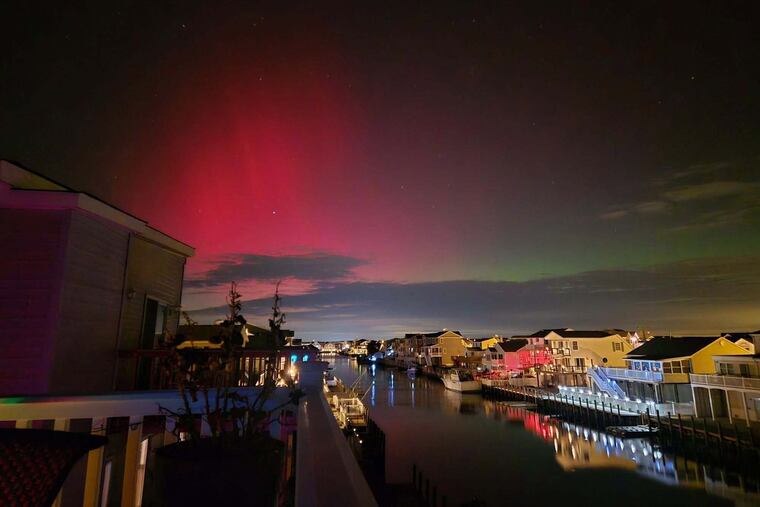
Those elusive northern lights that electrified the skies over parts of the region — and as far south as Mexico — on Tuesday night could make a return appearance Wednesday as massive solar storms continue.
The green and reddish aurora hues, which had to compete with cloud cover over the Philly area Tuesday, were ignited by two “coronal mass ejections” — massive quantities of charged particles.
The storms were rated as powerful and rare G4s on the NOAA Space Weather Prediction Center’s 1-to-5 scale, and the center said “the final and most energetic” disturbance could arrive later Wednesday.
In its morning update, the center foresaw “a chance” that the storm could approach the G5 level.
“It is difficult to predict with a high degree of certainty or precision,” said the center’s Mike Bettwy, “but it is possible this will be as impactful” as Tuesday night’s, which is something that may happen only once or twice every 20 years.
When might the aurora be visible over Philly?
Unfortunately, that is impossible to predict. They showed up almost without notice in October 2024.
The skies have to be right — and clouds might not vacate the Philly region until about 9 p.m., said Patrick O’Hara, meteorologist with the National Weather Service Office in Mount Holly.
The region had a real shot at seeing them back in June, when even some areas well to the south of the region were entertained with vivid auroral displays, but clouds and smoke snuffed out the show around here.
This time around, at least the sky conditions should be welcoming. The forecasts call for relatively cloudless skies, plus the waning moon isn’t due to make an appearance until just before midnight.
However, the aurora outlooks are a bit more complex, involving the movements of masses of materials traveling through space and interacting with Earth’s outer atmosphere.
“We used to say we’re about 50 years behind the meteorologists,” said William Murtagh, longtime program coordinator at the space weather center. “I remind the meteorologists, ‘You guys got the first 10 miles. I’ve got the other 93 million.’”
The particles are the products of solar storms, commonly called “sunspots,” that can eject incredible massive quantities of charged particles and magnetic fields that stream toward Earth at ultrahigh speeds.
Sometimes all that high-dosage material can miss Earth entirely or arrive in a place that won’t do all that much for the light shows.
Philly did get a piece of the aurora action Tuesday night
Clouds were an issue Tuesday night, but they did get out of the way in some places to allow the lights to be visible.
Social media lighted up with brilliant photographs, and Inquirer readers shared images that they captured, quite an impressive portfolio of a rare event.