Spring’s bizarre weather caused up to $200 million in lost crops in Pa. N.J. farmers also suffered.
The freeze likely means pickings may be slimmer this summer, and prices higher, for apples, peaches, and other crops.
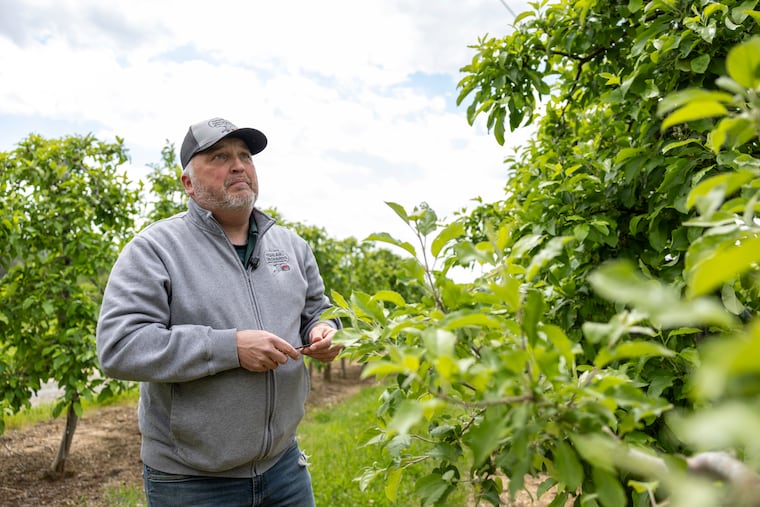
The peach, apple, and other pickings may be slimmer this summer — and the prices heftier — as the result of what by any measure was a heat-freeze ambush of rare intensity in April that likely has resulted in hundreds of millions of dollars in crop losses.
“I’m not going to be a complete prophet of doom,” said Lisa Specca, owner of the popular Specca Farms in Burlington County, “but farmers are pretty upset right now.”
Farmers have been warning that the surviving local peaches and apples are going to cost more when they appear later in the summer.
It’s not just Specca’s.
Officials in both New Jersey and Pennsylvania say they are seeking federal disaster aid. The damage was “unparalleled,” said Pennsylvania Gov. Josh Shapiro, who toured a freeze-decimated orchard in Lancaster County on Friday. His secretary of agriculture, Russell Redding, said state growers suffered $150 million to $200 million in losses. New Jersey officials still were working on estimates, a state spokesperson said.
And it’s not just around here.
April’s surreal summer-winter turnabout turned out to be a challenge for growers from Virginia to New York, said Samantha Borisoff, climatologist with the Northeast Regional Climate Center in Ithaca, N.Y.
With the midmonth hot spell, “All the blooms opened up, it was beautiful,” said Art Whitehair, a crop specialist at Highland Orchards in West Chester. “We thought, ‘Oh boy, this is going to be great.’”
Then, zap! The freeze came four mornings later. “We pretty much wiped out the peach crop,” he said. “We’ll probably have a few here and there, but not what we need. And the same thing with apples.”
Said Jeff Stoltzfus, an educator with the Penn State agricultural extension in Lancaster County, “The impact for consumers in the Mid-Atlantic will be significant, especially if you love local fruit.”
For peach production, Pennsylvania and New Jersey rank No. 4 and No. 5 in the nation, with crops valued at more than $70 million combined, according to government and industry figures. Pennsylvania is one of the top five apple-producing states.
While late freezes are the cost of doing business, some growers and bureau members can’t recall damages “this bad, this extensive,” said Ben Casella, national policy director at the New Jersey Farm Bureau.
Which fruit crops took hits from the freeze
The results are going to vary widely among farms and even among individual plants. As the owners of Duffield’s Farm Market in Sewell, Gloucester County, posted on Facebook last week, “It’s still too early” to assess the damage precisely.
“Some immediate damage is recognizable, some takes weeks to determine,” said New Jersey Secretary of Agriculture Ed Wengryn.
Across New Jersey, “blueberries got wiped out pretty good,” said Bob Andrzejczak, state executive director of the U.S. Department of Agriculture’s Farm Service Agency. “Grapes were demolished.”
In both states, the peach and apple losses have been staggering.
At Highland Orchards, it’s already clear the freeze chilled its popular pick-your-own business, which typically draws thousands. “You look at a row of apple trees, you’ll see a couple blossoms on the trees,” Whitehair said, then “you won’t see another blossom for another 10 or 15 trees.”
Specca said the tree-flowering process was accelerated by the record heat of April 15 and 16, when temperatures across the region approached or exceeded 90.
Unfortunately, the heat made the trees particularly susceptible to the freezes, Casella noted. Those freezes occurred April 20 and 21, about two months before the peaches would be expected to make their first appearances, in mid-to-late June.
The peach seasons in Pennsylvania and New Jersey typically are on similar timetables and continue through the summer. Apples generally make a first appearance in mid-July in Jersey, and a few weeks later in Pennsylvania and remain available through the fall.
On the Pennsylvania side, in addition to peaches and apples, “nectarine and cherry crops have mostly been lost,” said Stoltzfus.
Early strawberry plants were damaged, said Andrzejczak, but some have begun to “rebud.”
And in the case of strawberries, which should be available in the next week or two, the condition of the crops would depend on “how hard the growers worked to prevent damage,” Stoltzfus said.
Which crops are likely to be OK
It was a war-on-freeze morning, but the strawberries escaped the carnage, Stecca said. The weapon of choice was water. When it’s that cold, the water turns to ice, which actually protects the fruit as the change of state from liquid to solid releases latent heat.
“We were out doing strawberry protection on both those nights,” she said. “We watered them all night, and everyone came in looking like an ice man.”
Duffield’s said its strawberries also emerged in decent shape.
As for the vegetables, some of the early corn plantings may have been damaged, said Casella, who grew up on a farm in Woolwich Township, Gloucester County.
But overall, said Stoltzfus, “Impacts on annual vegetable production was not as significant since most of that crop was not in the ground yet, and what was can still be replanted if necessary.”
How unusual was that April hot-cold spell?
Post-winter freezes are not unusual in the Pennsylvania and New Jersey growing regions, but “this was a rare event,” said Wengryn. Based on the available data, the circumstances were at the very least extraordinary.
Shapiro described the losses as “tragic and devastating.” He said he would ask the legislature to approve using some of the $75 million earmarked for helping farmers contend with the avian-flu outbreak.
He also said he would seek emergency assistance from the U.S. Department of Agriculture.
Why was the freeze so destructive?
Highs of 90 degrees or above have occurred in Philadelphia in April about once every seven years in the period of record, dating to the 1870s, but what made this so unusual was what happened four days later. Usually, such highs are not followed by freezes, especially ones this vigorous.
While 34 was the coldest it got at Philadelphia International Airport, destructive freezes occurred outside the city on the 20th, and especially the 21st. That morning, on either side of Philly, it dropped into the 20s from Lancaster to the Atlantic City Airport, in Egg Harbor Township.
Given the wide variety of terrain and microclimates, it may have been considerably colder away from the measuring stations. Whitehair said he believed it fell into the teens at Highland Orchards, a perception shared at Linvilla Orchards, in Delaware County. Linvilla also reported losing most of its apples and peaches.
Inspired by the warm spell, spring all but erupted this year as grasses greened, blossoms burst open, and trees went from bare branches to creating shade.
For the incipient peaches and apple crops, it was a fool’s spring with impacts that will lap into fall.
“If you notice higher prices on homegrown produce this year, we ask for a little grace,” Duffield’s said in its Facebook post.
Specca said peach and apple prices won’t be an issue at her place. “We’re not going to have a crop,” she said.
Staff writer Denali Sanger contributed to this article.