More Pennsylvania police agencies are signing up to help ICE enforce immigration laws
Nationally, these types of alliances have helped produce 19,918 arrests since Trump was inaugurated in January 2025.

The number of local police agencies that have signed up to help ICE enforce federal immigration laws has surged in Pennsylvania, increasing more than 70% since the end of last year, new data show.
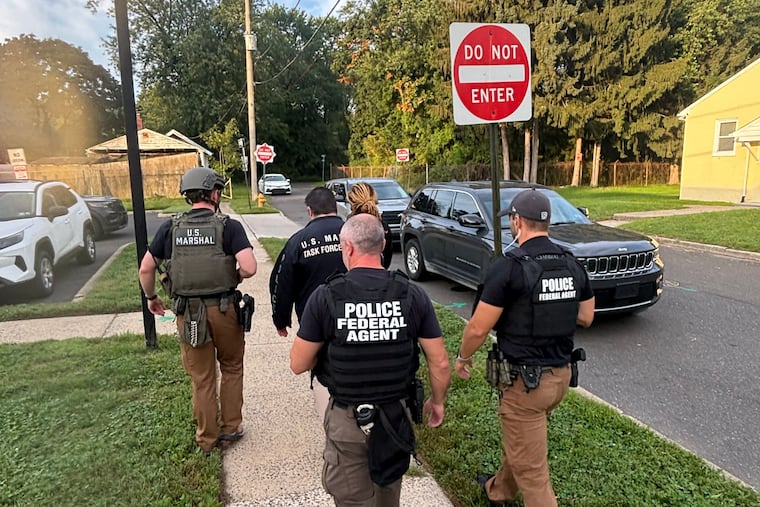
Nearly all have joined the ICE “Task Force” model, the most permissive of the three main types of partnerships. It enables local officers to act as an extension of U.S. Immigration and Customs Enforcement during routine policing, such as making traffic stops.
Today in Pennsylvania, 78 municipal police departments, county sheriffs, and constables’ offices actively and officially work with ICE, up from an earlier 45.
Figures show those alliances are producing increasing numbers of arrests.
In Pennsylvania, there have been 225 immigration arrests through the partnerships since President Donald Trump took office in January 2025. The monthly peak came in February with 67 arrests.
Nationally, the collaborations have helped make 19,918 arrests since Trump was inaugurated.
When former President Joe Biden was in office, an average of 261 monthly arrests occurred through the program during the last year of his presidency. During Trump’s tenure, the average has increased fivefold, to 1,422 a month.
Many of the participating Pennsylvania agencies are in the central and Western parts of the state, and include the York County Regional Police Department, the Center Township Police Department in Beaver County, and the Butler County Sheriff’s Office.
The alliances are part of a controversial ICE initiative known as 287(g), named for a section of a 1996 immigration act, in which state and municipal police departments assist the agency in its job of identifying, arresting, and deporting undocumented immigrants.
ICE says the program helps protect Americans, adding staff strength to an agency workforce that numbers an estimated 21,000 nationwide. Opponents insist that turning local officers into immigration agents breaks community trust and puts municipal taxpayers at risk of paying big legal settlements.
“When local police act as ICE agents, it breaks the first rule of public safety: trust,” said Miguel Andrade, a spokesperson for the Pennsylvania Immigration Coalition, the Philadelphia-based advocacy group. “When trust is broken, then immigrants who are victims or witnesses of crime stop coming forward to report.
“Beyond safety, this is a massive hit to our local economy. From the farms in Chester County to the restaurants in Philly, we are using our own tax dollars to drive away the workforce we rely on.”
He said the growth in the program is reversible, given that these are voluntary contracts signed largely by municipal and county officials.
“This is an issue of local control and accountability,” he said Tuesday. “When residents show up to their own local meetings and demand their tax dollars stay focused on local priorities, they win.”
New Jersey has long barred local collaboration with ICE, first by directive and, as of March, by law, after Gov. Mikie Sherrill signed prohibiting legislation.
Pennsylvania has no such restrictions.
The number of cooperating agencies has grown amid big increases in immigration arrests and during the Trump administration’s push to add more allied state and local police departments.
During his March confirmation hearing, new Homeland Security Secretary Markwayne Mullin said he hoped for closer relationships with local law enforcement. And he suggested what would be a different role for ICE, the agency primarily responsible for arresting and deporting thousands of immigrants.
“I would love to see ICE become a transport more than the front lines,” Mullin said. “If we can get back into simply working with law enforcement. We are going to them. We are picking up these criminals from their jails. A partnership is vitally important.”
Nationally, the number of signed ICE memorandums of agreement increases nearly every day – to 1,645 as of April 10, according to agency figures.
In Pennsylvania, the 78 assistance agreements have been signed with 41 municipal police departments, 20 constables’ offices, and 17 county offices, usually the sheriff.
Constables are elected, sworn officers who assist the courts, often by serving arrest warrants. Many sign up to help ICE for financial reasons because of the pay structure of the job.
Pennsylvania constables get no regular salary but are instead paid through a fee-for-service system for each task they complete. An agreement with ICE offers an additional way to earn dollars.
Government records show a constable in Chester County signed up, as did another in Delaware County.
Meanwhile, the Trump administration has added a financial incentive for local police to join.
ICE announced in September that it would begin reimbursing police agencies, offering payment for costs that, beyond those of the initial federal training, had been borne by local departments and taxpayers.
Participating police departments could receive up to 25% of the salary and benefits of each agency-trained officer. And the government would pay quarterly performance awards of up to $1,000 for each participating officer.
But some police agencies are backing away.
In January, new Bucks County Sheriff Danny Ceisler terminated his office’s controversial partnership with ICE, citing potential negative impacts on public safety and on immigrants’ trust in law enforcement.
The agreement initiated by former Sheriff Fred Harran, the Trump-aligned Republican whom Democrat Ceisler defeated in November, would have enabled 16 sheriff’s deputies to act as immigration enforcement officers.
“Bucks County is home to over 50,000 immigrants,” and “those immigrants are our neighbors,” Ceisler said in announcing his decision. “They are our friends. They are taxpayers, and they deserve the protection of law enforcement in this community.”
The new figures on ICE-police agreements come from the Department of Homeland Security, while information on related arrests was gathered by the Deportation Data Project, a group of academics and lawyers that collect and share government immigration-enforcement data sets.
The statistics show that ICE activity peaked in Pennsylvania, New Jersey, and nationally in early winter, then dropped off everywhere in February.
The reasons are unclear.
It could be due to incomplete data. Or it could be that the Trump administration softened enforcement after federal agents fatally shot two American citizens, Alex Pretti and Renee Good, in Minnesota in January.
Under Trump, federal agents have averaged 631 immigration arrests per month in Pennsylvania through February — a 390% increase compared with Biden.
The peak under Trump came late last year with 929 immigration arrests in December 2025.
In New Jersey, federal agents have averaged 850 arrests per month under Trump — a 151.6% increase compared with the end of Biden’s term.
The peak under Trump in New Jersey was 1,453 arrests in January.
The ICE-police partnership program was established by Section 287(g) of the Immigration and Nationality Act, which was part of the Illegal Immigration Reform and Immigrant Responsibility Act of 1996. It designates three main program models:
Jail Enforcement, to identify and process those with criminal or pending charges who may be deported; the Warrant Service Officer program, to authorize local police to execute ICE administrative warrants at jails; and the Task Force model, the most expansive, enabling local police to enforce federal immigration laws during routine patrols.
ICE recently revived a Tribal Task Force Model, for use in communities that follow tribal leadership.
In Pennsylvania, almost all of the agreements, 74 of the 78, are Task Force models. Three are agreements for a Warrant Service Officer, and one is the Jail Enforcement Model.
Some police departments and local governments, including those in Philadelphia, not only avoid 287(g) agreements but deliberately limit their cooperation with ICE. They say their sanctuary policies create trust in immigrant communities, and that undocumented crime victims and witnesses will not come forward if they fear being arrested because they lack legal immigration status.