These fish once fed George Washington’s troops. Now, American shad levels are ‘not sustainable’ in the Delaware River.
The once-abundant American shad, along with river herring, have plummeted to levels considered depleted, according to new research.
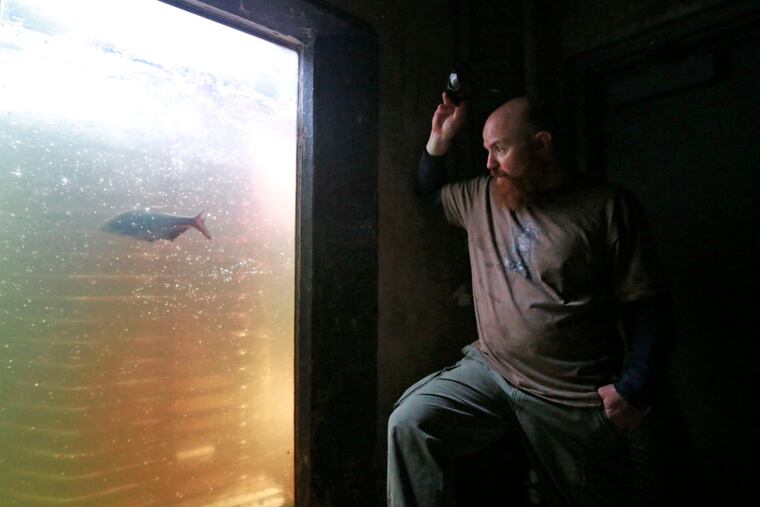
American shad have long been prized in the Delaware River Basin for their meat and roe.
The native Lenape people hosted festivals celebrating the fish. In 1778, legend has it, George Washington’s troops feasted on fresh or dried shad after a long winter at Valley Forge. More recently, the species drove recreational fishing and tourism along the mid-Atlantic coast.
But the once-abundant American shad, along with river herring, have plummeted to levels considered depleted, according to a recent paper by the nonprofit Partnership for the Delaware Estuary.
Research by a scientific advisory committee of the nonprofit provides the most recent information on American shad and river herring in the Delaware River Basin — a 12,700-square-mile drainage area that includes parts of Pennsylvania, New Jersey, New York, and Delaware.
The basin includes a vast network of tributaries, including the Schuylkill.
“Essentially, these fish populations are currently not sustainable,” said Ellie Rothermel, an environmental scientist with the Partnership for the Delaware Estuary and one of the paper’s authors. “If we want to bring back a lot of the ecological important services that these fish provide, it’s going to take cooperation across state boundaries.”
Lance Butler, a scientist with the Philadelphia Water Department, was a lead author of the paper, which contains both good news and bad for the fish.
The report highlights that water quality has improved dramatically over past decades, thanks to federal and state regulations. In addition, efforts to dismantle dams that obstruct the fish’s migration have gained momentum, offering a point of hope.
Threats to shad
While the shad’s decline has been previously documented, the paper shows that the numbers of shad remain at historic lows and that the fish face multiple threats, including:
Fishing reduces the number of spawning fish, lowers maximum size and age, and promotes early maturation.
Dams on major tributaries like the Schuylkill and Lehigh River block access to spawning grounds, and many fish passages are poorly designed and lack maintenance.
Invasive fish — such as flathead catfish, blue catfish, and snakeheads — are expanding their range and are known to prey on American shad and river herring.
» READ MORE: ‘Top predator’: As snakeheads invade area waters, scientists rush to understand the impact
Water intake systems at energy projects, such as power plants, withdraw huge volumes of water and can draw in fish and kill them as they become trapped against intake screens or pass through cooling systems. There are 40 intake systems in the basin.
Rising water temperatures, the result of climate change, pose threats by altering the timing of spawning migrations, potentially leading to reduced growth, survival, and reproductive success. Warming waters also increase predation by invasive species.
» READ MORE: Air above Delaware River Basin has risen 3 degrees in a century, experts say
Historic lows
The paper looked at both shad and two species of river herring — alewife and blueback herring. All three of the fish are known as anadromous species, meaning they spawn in freshwater but spend most of their lives in the ocean, migrating along the Atlantic coast.
They return to their natal rivers to spawn, with adults entering the Delaware Bay from the Atlantic Ocean in late winter.
“Compared to historic conditions, the stock of American shad in the Delaware River Basin is depleted,” the paper states.
» READ MORE: A species of fish once thought gone from Cooper River has returned — in a big way
The authors noted that landings of shad reached 12 million to 14 million pounds, or more than three million fish, in the Delaware River at the turn of the 20th century.
That level declined over decades: to 100,000 to 55,000 fish by the mid-1970s to mid-1980s. By the late 1980s, that number started growing to 830,000 shad.
Populations estimates are no longer officially made. But evidence suggests that the shad population has dropped since the 1980s but are “relatively stable in recent years.”
The Atlantic States Marine Fisheries Commission reported that the American shad population is unknown, and other surveys are conflicting, according to the paper.
A lack of data
Rothermel said there has been a lack of hard data in recent decades. As commercial fisheries focused less on shad, there was less impetus for tracking the population, she said.
However, the Delaware River Basin Fish and Wildlife Management Cooperative, comprised of various government agencies, work to manage American shad and river herring in the Delaware River Basin and has supplied some data.
In 2024, an index of spawning adult female American shad at Smithfield Beach above the Delaware Water Gap fell below a benchmark in four of the past five years, for example.
The report also cited data showing that commercial landings of shad have been declining since the 1980s, with less than 1,000 pounds landed annually in recent years. However, much of that is likely because the population of shad has dropped enough that commercial operations no longer fish for it.
The paper notes that even less is known about the abundance of alewife and blueback herring. Several surveys show “a significant declining trend,” while another found no clear trend.
Bringing back shad
To support restoration of the fish, the report’s authors recommend assessing stressors. This includes conducting a creel survey to determine the impact of recreational fishing, evaluating major water intake structures, continuing dam removals and fish passages, and evaluating changing environmental conditions.
That would take coordination among federal agencies and states.
Rothermel noted a recent success: the removal in August of Dam 6, also known as the DuPont Experimental Station Dam, on the Brandywine River in Delaware.
The dam was removed by the Brandywine River Restoration Trust as part of a multiyear effort to restore fish passage past 11 obsolete dams on the Brandywine.
American shad have quickly begun spawning in newly opened areas, said Jim Shanahan, executive director of the trust.
“Tens of thousands of shad used to swim up the Brandywine every year,” Shanahan said in August when the dam was removed. “We’re on our way to welcoming them back.”