Developers revert to 1.5M-square-foot data center proposal in Chesco after months of fiery opposition
After vehement pushback from residents, the developers plan to move ahead with a version of the project greenlit in 2024.
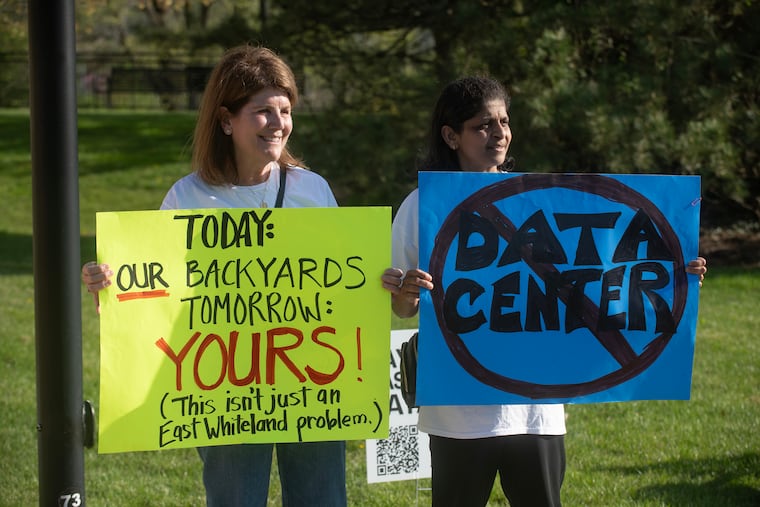
Following months of fiery opposition from residents that saw protests and halted municipal meetings, the developers of an East Whiteland data center called their own bluff, telling the township that they will scrap their revised plans and instead build a previously approved 1.5 million-square-foot version.
The decision takes a smaller plan, proposed last month, off the table — but it also eliminates a much bigger version that residents vehemently opposed.
It comes after the developers — Green Fig LLC and Sentinel Data Centers — defiantly pressed the township last month to move quickly on their revised application, which, in one last-minute iteration, could have scaled back the project’s footprint significantly, by around 74% to 85%.
Limited plans were submitted and were sent to consultants for review, officials said. The developers told the board that it was a concession they’d make only if the township’s three elected officials moved quickly on an approval.
The board of supervisors were expected to vote on the amended project in late May, after pushing the meeting back from the end of April. The township canceled the meeting following a letter from developers on Monday withdrawing the pending application.
In an email, Lou Colagreco, an attorney representing the developers, said that the decision to withdraw the project was partly due to the timeframe from the board, but “the larger factor was that it became obvious that no accommodation which our client offered would be acceptable.”
“We thought that our offer to pivot to a much smaller data center together with enhanced landscaping, sound attenuation, diminished water usage and other modifications would be well received,” he said. “It became apparent to us, however, that the real issue had little to do with these factors. It was simply data center vs. no data center.
Colagreco described the current proposal “a good plan” that developers “are anxious to build.”
Residents considered the downsized project — smaller than one of the amended plans that would have increased square footage by roughly 60% — a win. They’re still pursuing legal action, arguing that the initial approvals have now expired.
The project will sit on about 100 acres at 13 S. Bacton Hill Rd., on a Superfund site near a residential development and the popular Chester Valley Trail.
It has been a winding saga for the project, which saw its first approvals back in 2018 by the zoning hearing board before receiving a final greenlight from the supervisors in 2024.
But outrage over data centers has been growing since, sparking large attendance at local meetings in and surrounding Chester County.
In response to pushback, developers approached the township about shrinking the site’s footprint, but the changes still didn’t appease residents. It resulted in a string of impassioned meetings and prompted the supervisors to consider undoing the zoning language that allowed the project to proceed.
The developer has maintained that the project would be built in some capacity but argued that the newer plans would have a lower impact on the community.
Under the original 2024 plans they said they’ll move forward with, the project — which is 1.5 million square feet across two buildings — would include antenna yards, microwave towers, and cooling towers that rely on evaporating 3 million gallons of water a day.
“We’ve been accused of bluffing. This is not bluffing,” Sentinel Data Centers CEO Josh Rabina told the supervisors and residents in April when presenting plans to shrink the facility. “The approved plan is less desirable for us and for our customers, is less elegant and less efficient of a design, but it’s functional, it’s profitable, it’s vested, and it gives us certainty.”