Racing motorcycles up steep hills is fast, dangerous, and a rural Pa. pastime
“If these bikes had wings on them, they’d probably take off.”
Mankind has stared at mountains for time eternal, and some are compelled to climb up into the clouds, to reach their summits.
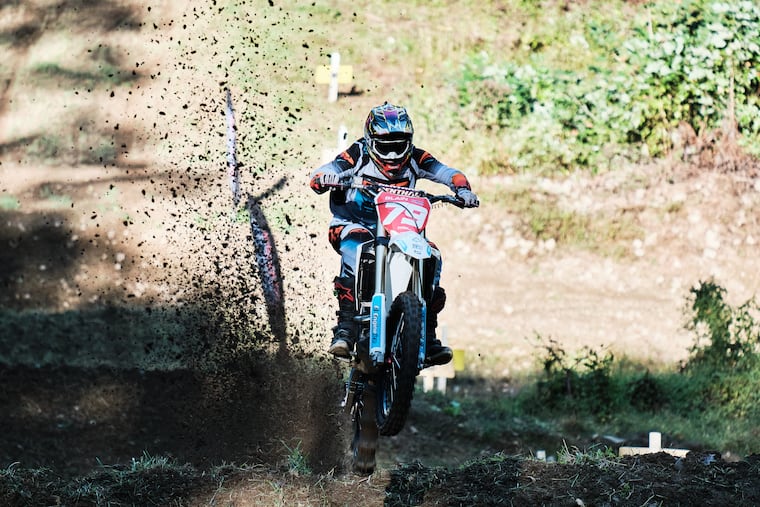
Explorers staked flags on rocky peaks for science or country, or for the hell of it, and no one really asks “why?” these days. That included the thousands of spectators gathered in a sunny field near the Lehigh River in Bethlehem on a recent Sunday afternoon for the Freemansburg Motorcycle Hill Climb and Bike Show. They craned their necks to see motorcyclists crest a ridge atop a 500-foot wall of dirt and rock, to see the checkered flag wave in their binoculars.
Hill climbing is arguably the oldest motorcycle sport in the world, dating back to the early 20th century in rural America. It’s a sport that still begs the question “why,” but still comes up with age-old answers.
“I mean, I don’t know, cause it’s a challenge? Why play volleyball? Why do anything?” said Tom Hockman, a senior member of Bushkill Valley Motorcycle Club, which hosts the climb.
There are more than a few reasons why volleyball and hill climbing are night and day, and, for starters, the most extreme riders are essentially sitting on rockets with wheels.
“Yes, it’s like mountain climbing, but these guys want to get to the top fast. It’s about speed but uphill,” said “Bushkill” Rob Raedisch, a volunteer and pit manager.
These Frankensteins of the motorcycle world — often worth more than $25,000, apiece — can have massive, modified engines, and chain-wrapped tires for traction, affixed to extended swing arms that, in theory, should prevent all that power from tipping them over and down the hill.
“If these bikes had wings on them, they’d probably take off,” the event’s announcer, Tim Vargo, said.
The climbs
The sport, and the heights riders attempt to conquer, is one you need to see, hear, and smell in person to fully understand and appreciate.
“There are some forms of motorsport that seem to simply defy logic, and the laws of gravity at the same time,” an article about the sport on OldBikeBarn.com opined.
The Freemansburg climb has been taking place in the Lehigh Valley since the 1930s, one of the oldest continuous climbs in the nation. It’s part of the American Hillclimb nationwide series that’s sanctioned by the American Motorcycle Association. Most of the hill climbs are major fundraisers for local motorcycle clubs. At the Freemansburg climb, Bushkill Valley Motorcycle Club members did everything from parking cars to hauling bales of hay and shovels up the mountain to “catching” riders and their bikes who failed to reach the peak.
The competition is essentially man (or sometimes a woman) versus mountain, a time trial, but even seasoned veterans will tell you the mind is another foe.
“Anybody who tells you they’re not a little nervous is lying,” said Devin, the “Devistator” Sweitzer, a rider from Red Lion, York County.
And once they’re moving upward, the key to success is keeping the motorcycle as straight as possible. Losing traction or fishtailing the rear tires eats away at a rider’s time.
“Pretty simple. Straight wins,” said Josh Mueller, a rider from Wisconsin.
The falls
The competitors have become so adept, their motorcycles so powerful, that the Bushkill Valley Motorcycle Club installed “jumps” along the course to slow them down.
“We were running out of stopping distance up at the top,” Hockman said.
There’s a slew of social media accounts that show riders blasting up old coal culm piles in Pennsylvania or high, forested trails in deep Appalachia. Sometimes they don’t make it and their ATVs, dirt bikes, and other off-road vehicles, and their rides tumble down a mountain with bits of metal and plastics cascading off. When they finally stop, many machines are destroyed.
There are hill climbs in Idaho, Washington, and Kansas, and other states, with cash purses and points accumulated by winners along the way. On Sept. 20, the White Rose National II, hosted by the White Rose Motorcycle Club, took place on a shorter, 300-foot dirt hill in southwestern York County.
The series culminates in a championship on Columbus Day weekend in Oregonia, Ohio.
‘If there’s a motorcycle going fast, I want to see it’
Early hill climbs were a way for motorcycle manufacturers to exhibit their dominance, and quickly became a battle between Indian Motorcycle, Excelsior, and Harley-Davidson, according to Old Bike Barn. As is often the case, American motor heads took it to a new level, turning stock motorcycles into specific bikes built for the hills.
The same evolution happened in NASCAR and even the seemingly simple world of demolition derby, where Pennsylvania’s best spend tens of thousands turning old cars into veritable war machines.
Many of those early hills, including some in California, are long gone, replaced by housing and highways. Many spectators at Sunday’s event recalled and lamented a famous hill in Utah, dubbed “The Widowmaker.”
Sunday’s crowd was a mix of young and old, with multiple motorcycle riders and clubs representing their respective colors, everything from the Christian Motorcycle Association and the Pagan’s MC.
One fan, Wayne Graver, of Lehighton, Carbon County, was celebrating his 50th year as a fan at Freemansburg and was given a special citation by the AMA after the national anthem for showing up year after year, with his earplugs.
“If there’s a motorcycle going fast, I want to see it,” Graver said at the base of the hill.
While everyone loved to watch, few spectators said they’d like to give it a try. Some people just like to look at mountains and motorcycle hill climbs.
“I’ve done a lot of stuff on motorcycles,” said Hockman, who no longer rides, “but I’ve got more sense than that.”