Shapiro says the threat against free speech is ‘extremely dangerous.’ Local experts agree.
The governor asserts that the Trump administration is "trying to stifle dissent."

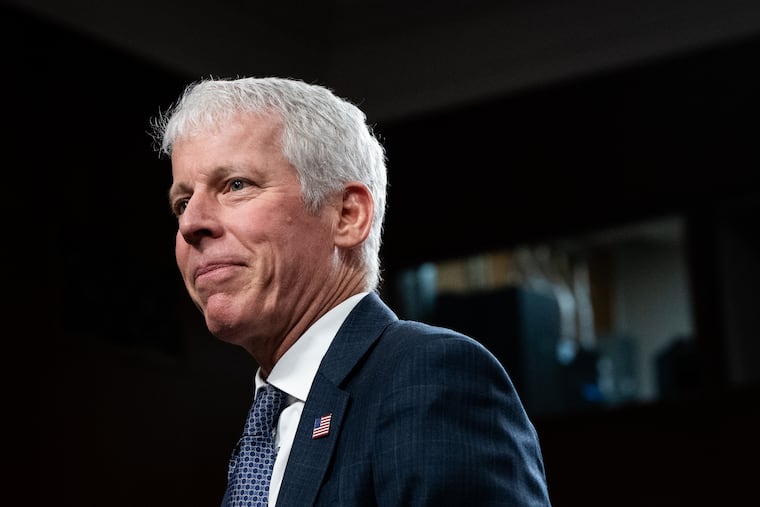
Gov. Josh Shapiro charged that the Trump administration is “trying to stifle dissent” by wielding power to keep critics like late-night comedy host Jimmy Kimmel off the air.
His remarks, made Friday during a taping for NBC News’ Meet the Press, were a response to the Federal Communications Commission’s decision to pressure Disney-owned ABC into suspending Kimmel’s show after he had commented on the assassination of conservative activist Charlie Kirk.
A national debate has ensued about freedom of speech and whether President Donald Trump has the right to muzzle those who criticize him.
On Thursday, Trump said that broadcasters allowing criticism of him should “maybe lose their license,” NPR reported.
Shapiro sees peril ahead.
“Our foundational principle in this country, which has roots in the Commonwealth of Pennsylvania — William Penn settled here in the 1680s — is about freedom of expression, freedom of speech," he told NBC News. “And to see that being undermined by the long arm of the federal government is extremely dangerous.”
Shapiro added that “whether you agree with Jimmy Kimmel or not, whether you found him funny or not, to fire someone because he told a joke about the president repeatedly, and the president didn’t like it … that is dangerous.”
The full interview with Shapiro will be broadcast Sunday, but NBC News published a report on his comments Friday. Experts who work as political strategists or who study free speech, history, and the Constitution weighed in on Saturday to share their reactions.
“I’m glad Shapiro is talking about this,” said Matt Jordan, a professor of communications and a media expert at Pennsylvania State University. ”This kind of thing was one of the first actions the Nazis took in 1939.”
In February of that year, German Propaganda Minister Joseph Goebbels fired five entertainers who had made jokes at Hitler’s expense. “They displayed a lack of any positive attitude toward National Socialism and caused grave annoyance in public and especially to party comrades,” Goebbels said, according to news reports of the day.
“What Trump is doing comes right out of the authoritarian playbook,” Jordan said. Trump had hinted at possible FCC action against ABC if it didn’t drop Kimmel. A group of ABC affiliates said it would not broadcast his show, further forcing the network’s hand, according to news reports.
The FCC is approving more media mergers, making the larger entities more vulnerable to political pressure, said Matt McAllister, an expert on mass media at Penn State. And the Trump administration is squeezing them, he said.
“They’re not hiding,” McAllister said. “They’re being blatant and public, very explicitly saying what they want. That’s pretty rare in U.S. history.”
While it may be difficult to follow every facet of the evolving Kimmel saga, one inescapable fact should stand out, according to J.J. Balaban, an independent Democratic strategist from South Philadelphia: “Having the FCC bully a major broadcaster because it doesn’t like its TV content should be a four-alarm fire for free speech advocates.”
Republican strategists and politicians did not respond to calls for comment.
Some Republicans, such as Sen. Ted Cruz of Texas, disliked what happened to Kimmel. He said that FCC Chairman Brendan Carr’s threat to ABC (“We can do this the easy way or the hard way”) was “right out of Goodfellas.”
David S. Cohen, a constitutional law professor at Drexel University’s Thomas R. Kline School of Law, agreed with Balaban’s premise that these are hard times for advocating the right to speak your mind without backlash.
“It’s very clear that Donald Trump has no respect for the First Amendment, and doesn’t believe in freedom of speech,” he said. “He operates on one principle: ‘Everyone should flatter me.’”
That way lies “a deep problem,” Cohen continued: “If we don’t have the right to make fun of our leaders, we don’t have a functioning, free democracy.”
Fraught times such as these make life hard for professors trying to explain what’s going on, according to sociologist Maria Kefalas, who has taught on social problems for 25 years at St. Joseph’s University.
“My students don’t feel free to express themselves,” she said. She told them that the firing of Kimmel is a big moment in America, and that it was up to them to decide what free speech means.
“I waited with bated breath to hear them on this,” Kefalas said. “And they were silent. Literally.”
She added: “I am struggling to honor my mission in this climate. It’s brutal.”