A bank’s ‘racist and overzealous’ fraud investigator ruined a Pa. car dealership, lawsuit says
M&T Bank ultimately found no fraud in its investigation of Tianna Williams. But the Lehigh Valley dealership owner says her business was still ruined.
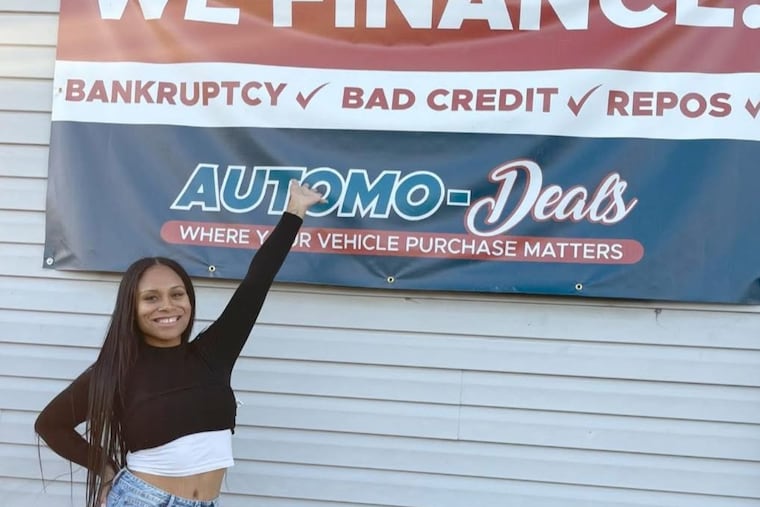
Tianna Williams didn’t finish high school after becoming a mom at 16. As a teen dropout, she began flipping cars to make money, and by her late 20s, her car sales acumen led her to open a dealership in Lehigh Valley that grossed over $1 million in annual sales.
An opportunity to get a line of credit with one of the nation’s largest banks turned Williams’ dream into a nightmare, she said, which led the 30-year-old to file a lawsuit.
M&T Bank opened a fraud investigation into Williams in spring 2023, says the suit filed in Common Pleas Court in Philadelphia in March. The bank inappropriately informed her financial partners that her business could be illegitimate, the complaint says. The bank froze her account, her partners cut ties, and her checks bounced. Williams’ growing businesses crashed.
The investigation found no fraud, M&T lawyers said in a September hearing. But Williams says the damage was done.
The complaint says the Black entrepreneur was a victim of the bank’s “racist and overzealous fraud investigator” who tormented the business owner for weeks. The investigator told Williams “you people” have ways of making fraudulent behavior seem legitimate, the suit says.
Despite eventually finding no fraud, the investigator shared an email with a colleague, signed with a smiley-face emoji, saying “doing my best to not let her win on my watch.”
“She killed my self-esteem,” Williams said of the investigator. “I lost all financial security.”
The phenomenon of Black people being treated with suspicion by financial institutions has been dubbed “banking while Black” and has a history going back at least to the 1930s, when red lines on maps labeled majority-Black neighborhoods as unworthy of mortgages. More subtle variations of the practice have continued into the 21st century, resulting in settlement agreements for millions of dollars.
Black customers have also reported tellers refusing to cash their checks, and banks calling police in disbelief that deposits made by Black people were legitimate. Studies further found that banks are more likely to scrutinize, and less likely to offer assistance to, Black small-business owners compared with their white counterparts.
The Philadelphia area is not immune to the phenomenon. Black Philadelphians are less likely to have a bank account than their white neighbors, according to a report from the Economy League of Greater Philadelphia. And multiple banks entered settlements over offering worse interest rates and ratcheting up closing costs for Black mortgage seekers.
‘Somebody really has it out for you’
Williams’ rags-to-riches story began in 2012, when she became pregnant at the age of 16. Her mother had recently been diagnosed with cervical cancer, and the family barely scraped by. After dropping out of high school before completing 10th grade, Williams learned how to flip cars from auctions with the help of a mentor she met through Facebook.
Her first car: a 2002 Lincoln that as a 17-year-old she sold the next day for a $700 profit.
The young hustler with a knack for sales got her auction license a couple of years later. She kept selling cars on Craigslist and through other social media connections. In 2018, she began working at an auto dealership. She learned the trade and became especially good at working with people who had low credit scores.
Williams’ cut from each sale at the dealership was a fraction of the overall profit, so she decided to go it alone. She bought a lot in Easton in 2020 and set to work. The cars she sold became newer and more expensive.
To sell cars for more than a couple of thousand dollars, Williams needed to offer financing options. She got her banking license and contracted with lenders. Her business was booming and she was planning to open a second location.
That’s when Shazard Mohammed from M&T reached out, the complaint says. He offered Williams a line of credit that would allow her to take her business to the next level, and she transferred her accounts to the bank.
Within days, Williams’ lenders contacted her to say they could no longer offer her financing because she was being investigated by M&T for fraud. Nearly overnight, she was without a business while owing about $200,000 in business and tax debts.
“M&T BANK basically told me that they suspected you of fraud,” one business partner told Williams in a text message, according to the complaint. “If that’s not true, then somebody really has it out for you.”
Records fight
The bank is now fighting in court to keep documents related to the investigation secret, despite an attorney representing M&T saying in a September hearing that “there was no finding of fraud,” according to a transcript.
M&T said in that hearing that Williams was investigated because of “red flags,” such as misspellings on checks that were immediately withdrawn as cash, and that the investigation lasted only seven days.
Common Pleas Court Judge Paula Patrick sanctioned the bank’s lawyers in October for their failure to produce documents and ordered them to pay nearly $8,000 in attorneys’ fees. The judge also found that most records should not be sealed. M&T is appealing the ruling.
Dean Malik, the attorney representing Williams, frames the case as a fight of David vs. Goliath. By issuing sanctions, he said, the judge reminded large entities that in court the playing field is leveled.
“The judge is sending a message that it doesn’t matter if you are a billion-dollar bank and have two law firms representing you with five lawyers, you are still bound by the orders of the court,“ Malik said.
Williams now cleans houses with her mother to support her family financially. She said her self-esteem has been shattered, and she hasn’t set foot inside a bank out of fear since her business closed in 2023.
“There is nothing else I know how to do,” Williams said. “All I know is cars.”