The Narberth Council bars borough police from assisting ICE in immigration enforcement
The resolution came at the heels of a Jan. 30 incident in which two people were taken into custody by ICE during a traffic stop in Penn Wynne.

Narberth’s borough council has voted unanimously to bar the municipality’s police officers from cooperating with U.S. Immigration and Customs Enforcement under the agency’s 287(g) program.
The resolution approved Thursday made clear that “our police department operates to protect our residents and protect the public safety here and does not have a role in immigration enforcement,” said Council President Fred Bush.
ICE’s 287(g) program deputizes local law enforcement officers to carry out immigration actions, including identifying, arresting, and deporting immigrants. ICE has signed around 1,400 such agreements with law enforcement agencies in 40 states, including dozens in Pennsylvania.
In Philadelphia’s collar counties, only the Lansdowne Borough Constable’s Office in Delaware County and the Pennsylvania State Constable Office Honey Brook Precinct 1 in Chester County are 287(g) participants. Bucks County Sheriff Danny Ceisler, a newly elected Democrat, terminated his office’s controversial partnership last month, citing negative impacts on public safety and law enforcement trust.
Neither Lower Merion nor Narberth participates in the program.
Narberth’s resolution establishes that the borough will not enter into any agreement with the federal government, including 287(g), that would commit borough time, funds, efforts, or resources toward ICE noncriminal enforcement activities.
Officials clarified that Narberth’s police department would cooperate with ICE officials if they had a judicial warrant to arrest someone. An internal memo first reported by The Associated Press last month has authorized ICE to forcibly enter people’s homes without a judicial warrant.
Narberth officials acknowledged that the resolution could be seen as “virtue signaling,” given that the borough already does not participate in an ICE partnership. Yet council members said they believe it’s important to publicly signal the municipality’s values regarding immigration enforcement.
The resolution “lets the public clearly know where we stand on the issues, helps reinforce trust, and provides that clarity of what we will do and what we won’t do,” said Dana Edwards, Narberth’s mayor. “From my standpoint, it’s a practical resolution.”
“When our community members trust their law enforcement, they feel comfortable reaching out to them for assistance,” said Councilmember Jean Burock. “We can’t afford to erode that trust.”
Bush cautioned residents against interfering with ICE operations, describing the agency as “poorly trained” and “dangerous,” citing “the actions and the images that came out of Minneapolis” in recent weeks.
Neighboring Haverford Township similarly barred its law enforcement officers from assisting ICE last month.
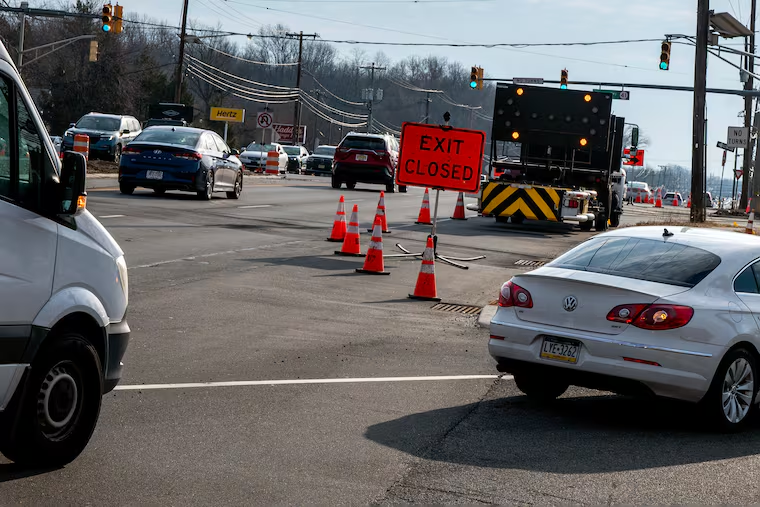
Narberth’s resolution came on the heels of a Jan. 30 incident in which two people were taken into custody by ICE during a traffic stop in Penn Wynne.
Following the arrests, Lower Merion affirmed in a public statement that the township does not participate in 287(g) and encouraged residents to call 911 if they observe law enforcement activity with no Lower Merion police officers present.

Inquirer Lower Merion
This suburban content is produced with support from the Leslie Miller and Richard Worley Foundation and The Lenfest Institute for Journalism. Editorial content is created independently of the project donors. Gifts to support The Inquirer’s high-impact journalism can be made at inquirer.com/donate. A list of Lenfest Institute donors can be found at lenfestinstitute.org/supporters.