Yes, there are bats in her Berks County home — and she’s trying to save them all
"No bats, no tequila. No margaritas."
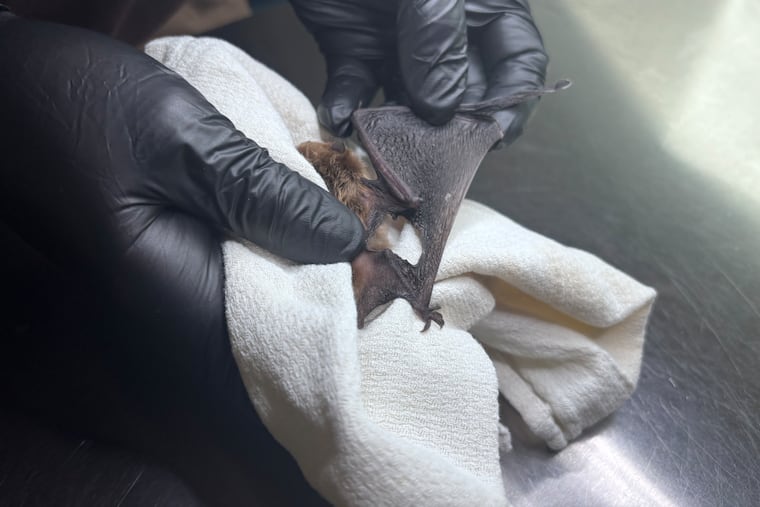
Stephanie Stronsick has bats in her Berks County house. On purpose.
“Aw, look at her little face,” Stronsick said about an injured brown bat her husband was holding on a recent winter afternoon.
Stronsick, 42, is the founder and executive director of Pennsylvania Bat Conservation and Rehabilitation (PA Bat Rescue), a nonprofit that underwent a major overhaul last year.
She’d like the bats to leave, ideally, but only after they’ve healed. Currently, the facility is treating over 100 bats for injuries and illness. Some bonked their heads on tall urban buildings that don’t turn off their lights at night. Others were torn up by outdoor cats or birds of prey.
Some big fruit bats, which look like puppies, were hanging upside down in one room. They used to live at the Akron Zoo.
Like the other bats in Stronsick’s house, they were asleep.
“They’re all retired,” she said.
Some of Stronsick’s bats are being treated for white-nose syndrome, a fungal disease that has killed millions of bats in North America. In Pennsylvania, it’s estimated that 99% of cave-dwelling bats have been affected by the fungus during hibernation.
“We’ve lost so many bats that we’re at a point where if we don’t do something, they’re going to be gone,” Stronsick said. “In my lifetime, we are looking at the [local] extinction of two species that occur in Pennsylvania: the Northern long-eared bat and the tricolored bat.”
Bats get a bad rap, Stronsick said, thanks to horror tropes, rabies fears, and the overhyped interest in vampire bats. Only three of the approximately 1,500 bat species drink blood, and they’re in Central and South America.
“I think all bats are adorable,” she said.
If the general public doesn’t see that, they should at least understand that the flying mammals are biologically fascinating, contribute to healthy ecosystems, and help scientists.
“If it wasn’t for bats, the military wouldn’t have radar, and anticoagulants that vampire bats use have been studied to treat blood clots and stroke,” said Greg Turner, a mammalogist with the Pennsylvania Game Commission.
Bats, Turner said, are also highly resistant to cancer.
In Pennsylvania, bats are insectivores, Turner said, and they eat nothing but flying insects at night. He said studies have shown that bats in Pennsylvania save farmers $74 per acre, by eating moths that would otherwise produce crop-eating caterpillars.
“They also eat mosquitoes,” he said.
Elsewhere in the world, bats help pollinate cacti and agave.
“A lot of people should be happy bats are out there performing every night,” Turner said. “No bats, no tequila. No margaritas.”
Aside from the fungus, Stronsick said bats face serious dangers similar to birds: predation from feral and outdoor cats and building strikes.
“Bats do not recognize cats as a predator. If people have cats outdoors, they absolutely should not be feeding birds in the same area, and they should not have a bat house anywhere near there either,” she said. “If you do that, you’re inviting these animals to die. ”
Stronsick said the light pollution from large cities, combined with a bat’s ability to echolocate, makes window strikes common.
“When they hit something hard, they do a lot of damage,” she said. “Cityscapes are not good environments for bats.”
Turner said wind turbines, which dot the landscape in mountainous regions of Pennsylvania, are bat killers. Bats do not constantly echolocate, he said — that would be like screaming, nonstop — and when they’re not echolocating, they’re susceptible to the turbines.
“It’s estimated that 25 bats are killed per turbine per year, and we have hundreds of turbines in the state,” Turner said.
Stronsick said she grew up outdoors, seeing bats at her grandmother’s home and playing with salamanders. She’s worked with raptors and shore birds in California and stumbled upon bats.
“They were so different from what I imagined,” she said. “I left shore birds and birds of prey and started working with bats.”
Now she has some bat tattoos.
Stronsick’s facility, which is attached to her home, underwent a major investment in May. She accepts both donations and grants, which are hard to come by, she said.
Since 2018, PA Bat Rescue has rehabilitated 2,000 bats. Unlike most animal rehabilitation centers, hers is as quiet as a church.
“Bats prefer silence,” she said. “The fruit bats can get a little noisy when they wake up.”
Correction: This article has been corrected to reflect that there are no bats in the refuge that have been struck by wind turbines. Most bats who do fly into wind turbines die on impact. The article also has been corrected to note that some, but not many, of the bats in Strosnsick’s care are being treated for white-nose syndrome. Finally, a quote has been amended to make clear that two bat species are at risk of extinction in our area, but not total extinction as a species.