Pennsylvania’s $25M solar for schools program is a hit, but budget uncertainty threatens its future
Advocates are pushing for another round of funding, but it comes amid a tricky time for state government.
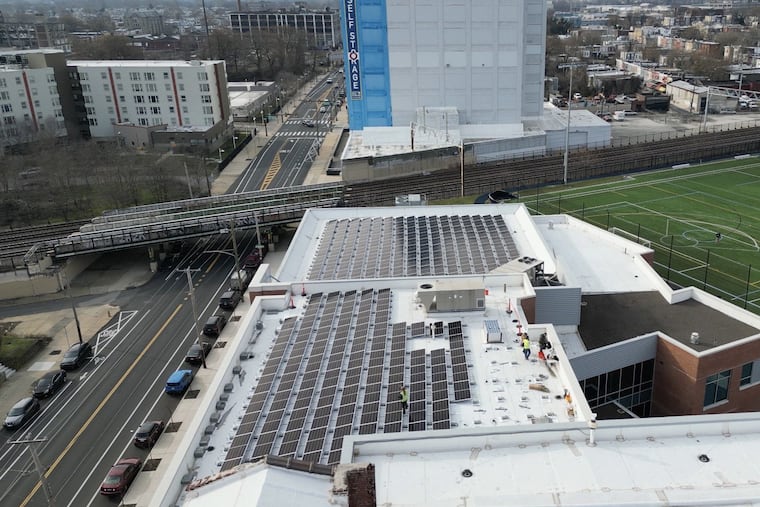
Students in Cristo Rey Philadelphia High School’s sustainability club had been challenged by teachers to come up with recommendations that would benefit not only the school but the community as well.
One of those ideas is now producing half the school’s yearly electricity.
Cristo Rey leadership installed solar panels on the Tioga building’s roof in 2024 after being prompted by the students. In summer and into fall, the system produces more electricity than needed.
Cristo Rey, a private Catholic school, independently funded the $450,000 array, but some of the cost was offset by rebates and tax credits.
“We believe it was a great investment for our school, because this is our long-term home,” said Tom Shoemaker, Cristo Rey’s president and CEO. “We feel really good that this was a process that started with our students and our teachers.”
This year, Pennsylvania launched a $25 million Solar for Schools program. It was wildly popular: the number of school districts that applied for grants far exceeded the pot of money.
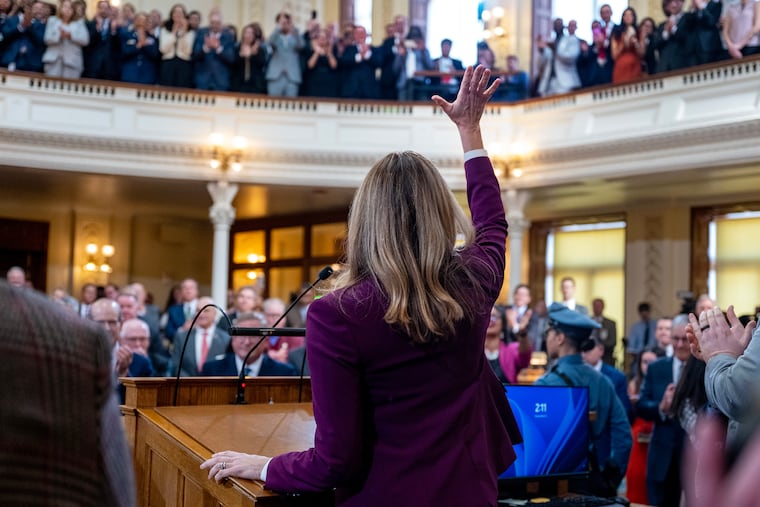
Now, advocates and a legislator who conceived of the idea, state Rep. Elizabeth Fiedler (D-Philadelphia), are pushing for another round of funding. But it comes amid a tricky time for state government as legislators wrestle over SEPTA funding, the clear priority for many.
The program received the initial money from the state legislature for the 2025 fiscal year under a bill introduced by Fiedler. The bill drew Republican cosponsors. About $23 million has been allocated for 73 approved projects.
David Masur, executive director of the nonprofit advocacy group PennEnvironment, describes Solar for Schools as a “triple win.”
“It helps school districts save money, it helps reduce our overall air and climate pollution, and it adds …some reliability to our electricity grid,” Masur said.
Solar’s potential
Flora Cardoni, deputy director of PennEnvironment’s research and policy center, on Wednesday released a report that analyzed the benefits of solar, saying pre-K through 12th-grade educational buildings in Pennsylvania have nearly 2,000 football fields’ worth of rooftop space for solar.
The report said solar arrays placed on those roofs have the potential to produce enough electricity to power 187,000 homes annually. Solar could save schools an estimated $342 million over the systems’ lifetimes, she said.
The clean energy generated would also reduce carbon dioxide pollution equivalent to taking nearly 300,000 cars off the road each year, Cardoni said.
The report found that Philadelphia has big potential because of its number of schools.
PennEnvironment and other advocates are urging legislators and Gov. Josh Shapiro to restore funding for a second year of the program as part of the ongoing budget process. The state budget is more than two months late and legislators remain at a stalemate.
Without state funding, advocates say, schools will be hard-pressed to come up with the money on their own, given the pending expiration of federal tax credits from the Inflation Reduction Act under President Donald Trump’s administration.
Fiedler said she is confident there will be continued bipartisan support for the 2026 budget.
She said there is high demand. Fiedler noted that although not all schools got selected for the grant, the amount of projects proposed totaled $80 million.
Fiedler said she continues to speak to Republican legislators, such as Pa. Rep. Martina White and state Sen. Joe Picozzi, both of Philadelphia. School districts in conservative areas applied for, and received, grants for solar with the backing of their legislators.
The grants are primarily designed for school districts to own their solar systems — rather than leasing — to provide a direct path to long-term savings.
Philly-area schools to go solar
The Philadelphia School District received $1.3 million in grants for solar installations at four schools: W.B. Saul High School, Northeast Community Propel Academy, Andrew Hamilton Elementary School, and Murrel Dobbins CTE High School.
Christina Clark, a spokesperson for the Philadelphia School District, said state-funded solar installations are currently still in design.
Upper Darby School District received nearly $2.4 million for solar installations at all six schools.
Aaronda Beauford, a spokesperson for the Upper Darby district, said she could not comment because it is still in discussions regarding the projects.
An Upper Darby district presentation in August said the grants were “an attractive opportunity” because the state pitches in up to 50% of the solar panel costs, or up to $500,000.
Currently, the federal government, under the Inflation Reduction Act, also pitches in 50%. However, the availability of federal tax credits under the Trump administration remains uncertain, the district said.
It would cost $5.2 million for installations on all six schools but would result in annual energy savings of $303,000, the district estimated.
Micah Gold-Markel, founder of Solar States, a solar contractor, said schools can lock in electricity rates of less than 2 cents per kilowatt-hour for 25 years by switching to solar, compared to 8 to 10 cents by pulling from the grid. His company installed the solar array at Cristo Rey.
“The sun …rains energy down on us,” he said. “If we don’t use it, it’s a waste. Period.”