It’s bee swarm season. Are there more than usual in Philadelphia?
Swarms are a typical springtime ritual for bees as growing hives split in two in search of more space. But this spring, reports of buzzing clouds seem more frequent.
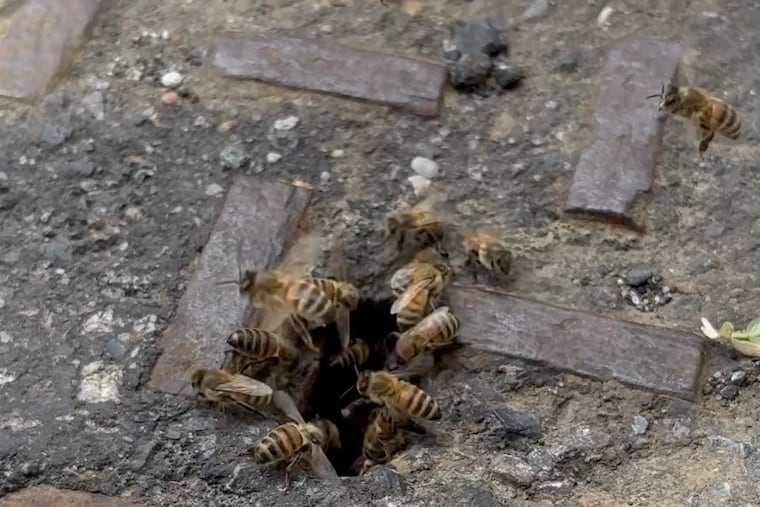
Tens of thousands of honeybees recently clustered in a dank South Philadelphia sewer while another swarm paraded in a buzzy cloud down Market Street.
Though the locations might seem unusual, something else is causing debate within the beekeeping community: Are there more swarms this spring?
“It’s anecdotal, and hard to quantify how many swarms we’ve actually had,” said Mark Berman, a board member of the Philadelphia Beekeepers Guild who runs Anna Bee’s Honey.
Berman said he has experienced a higher level of early-season activity this year. Other apiarists have not.
However, there are 62% more beekeepers registered in Pennsylvania than a decade ago.
Berman recently drew attention for rescuing the swarm nestled inside a South Philadelphia sewer line on the 2300 block of Lambert Street. He set up a trap to lure them out, hoping they would find it more attractive than the dark, damp maintenance hole.
He said it could take until June to coax all the bees away.
Hard data are scarce about swarms, however. Pennsylvania is in peak swarm season. New Jersey is approaching peak.
But it is nearly impossible to tell if there are more swarms or not.
More bees, or just more eyes?
The increase in reports of swarms could be partly due to technology.
A few years ago, developer Mateo Kaiser launched Swarmed, an app and a website that allow the public to report swarms so local beekeepers can respond and collect them.
The app has caused a buzz in the beekeeping community.
Dave Harrod, a past president of the Beekeepers Guild, notes that while the platform has streamlined the rescue process, it also complicates the data.
“The problem, of course, is that an increase in reports could just as easily be an artifact of increased awareness of his service and increased adoption by bee clubs, rather than a reflection of something real happening in the world,” Harrod said.
And others in the beekeeping community note that the presence of more registered beekeepers and apiaries does not necessarily mean there are more bees overall.
Kaiser said 17,000 swarm reports across four years suggests swarms this year began 17 days earlier than in 2025. But he acknowledged the data’s limitations.
He said the numbers reflect a national dataset and show the earlier swarms are mostly happening in the West.
He did not have individual state data for Pennsylvania readily available, although the state has one of the highest volumes of beekeepers actively using the app.
Why bees swarm
Whether or not the total number of swarms is rising, the behavior itself is a spring ritual.
Experts emphasize that a swarm is the sign of a healthy hive. A queen can lay between 1,500 and 2,000 eggs per day. As the hive becomes congested with new bees, pollen, and nectar, the colony makes a collective decision to split.
Before leaving, worker bees raise new queens by feeding larvae an exclusive diet of royal jelly. Once a new queen is sufficiently plumped, the original queen — slimmed down by the workers so she can fly — takes about half the colony to find a new home.
Bees are generally docile during this phase because they have no home or honey stores to defend.
“They bivouac somewhere, usually within 25 to 50 feet of their hive, sending out scout bees,” Berman explained. “They look for a new cavity to call home.”
The food supply factor
Eric Schoefer, manager of public apiaries for the Beekeepers Guild and owner of Cresheim Valley Honey, recently caught three swarms at Ursinus College. With 16 years of experience, Schoefer believes this year’s weather might have shifted the seasonal timeline.
In his West Chester apiary, Schoefer found that hives had more honey earlier in the season than usual, driven by an abundant early spring bloom.
This sudden wealth of resources can trigger a natural impulse to swarm ahead of schedule, he said.
The rise of the backyard beekeeper
Beekeepers maintain apiaries for the honeybees they raise — which are distinct from native bees. An apiary is a designated location where honeybee hives are kept and managed. There can be multiple colonies at an apiary.
Many new beekeepers seek out experts such as the Philadelphia Beekeepers Guild for help in getting started.
A hobbyist beekeeper might run a single apiary in a backyard or on a rooftop.
Some beekeepers can manage 50 or more hives spread across various locations. Commercial beekeepers can manage thousands.
Often, beekeepers sell honey collected from the hives. They might teach beekeeping classes, offer pollinator services to farms, or have side businesses removing swarms.
Schoefer said he has seen growth in hobbyist beekeeping in the Philadelphia region, including South Jersey.
New Jersey has 1,150 registered beekeepers so far this year, and 1,400 apiaries. Officials estimated the actual number is between 3,500 and 4,000.
Schoefer notes that more beekeepers could mean more hobbyists who do not know how, or do not care, to manage their hives, leading to more swarms noticed by neighbors.
Beekeeping laws
Both Pennsylvania and New Jersey have laws regarding beekeeping.
Pennsylvania’s law mandates that each apiary be registered for $10 biannually. The goal is to monitor the movement of bees, prevent disease, and control pests.
Shannon Powers, a spokesperson for the Pennsylvania Department of Agriculture, said the bee law does not dictate how far back a hive must be from a neighboring property or restrict the number of hives per acre.
She said the Apiary Advisory Board issues recommendations for voluntary best management practices. The Pennsylvania State Beekeepers Association issues a sample local ordinance to their members for awareness.
Philadelphia does not regulate beekeeping.
In New Jersey, state law requires not only that each apiary be registered annually, but also that municipalities cannot ban keeping bees nor enact overly restrictive ordinances.
A beekeeper can have up to three colonies, or hives, in New Jersey per one-quarter acre.
With a rise in apiaries, swarms can sometimes result in clashes with neighbors.
If you do find a swarm in Philadelphia, Berman and Schoefer suggest contacting the guild. They note most swarms are temporary stops for bees looking for a permanent residence.
The guild can be reached via email at info@phillybeekeepers.org, or at the “report bees” page at the Phillybeekeepers.org website. The guild can put people in touch with beekeepers who catch swarms.