William Penn Foundation awards nearly $20M in grants to combat illegal dumping, conserve land, and cultivate urban farms
Six million dollars will go to preserve open space and $2.8 million to help tackle illegal dumping in Philly.
The William Penn Foundation announced that it has committed $19.7 million in new grants to nonprofits working to plant trees, expand urban gardens, and confront the growing pressures of climate change.
But the foundation’s largest investments in its two most recent grant rounds will target Philadelphia’s entrenched illegal dumping problem and safeguard remaining open space.
Of the total, $2.8 million will go toward efforts by various organizations to stop illegal dumping and make disposing of waste easier and more affordable, said Nathan Boon, interim director for the William Penn Foundation’s new Environment and Public Space program.
The William Penn Foundation, founded in 1945 by Philadelphia’s philanthropic Haas family, also funds grants for arts and culture, children and families, civic initiatives, and workforce training.
“We’re excited to see close alignment on illegal dumping with multiple stakeholder groups in the city,” Boon said.
City officials, neighborhood groups, and residents are “fed up with the cleanup that’s required,” he said.
Grant money will go to the Philadelphia District Attorney’s Office for enforcement actions against dumpers ($399,255), the Clean Water Fund to reduce “neighbor-on-neighbor dumping in North Philadelphia” ($650,000), and the Frankford Community Development Corp. to reduce household waste dumped on Frankford Avenue ($492,873).
Recipients also include the Hispanic Association of Contractors and Enterprises ($567,000) and the nonprofit We Love Philly ($390,872).
Illegal dumping has been an issue for years in Philadelphia, but city officials have made tackling it a priority over the last year or so.
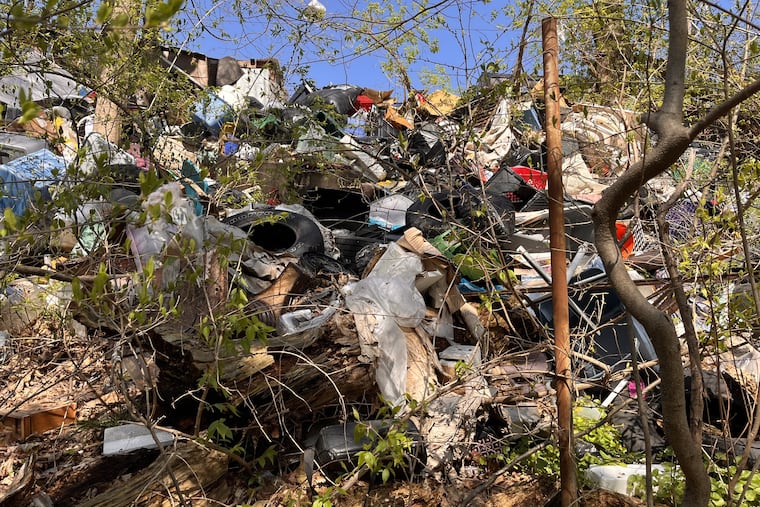
The Inquirer reported in April on the existence of a block-long illegal dump off Pennway Street in Northeast Philadelphia that spans the length and depth of a steep ravine before coming to a halt near a clear stream. City officials say the dump presents a huge logistical task because of its location.
More open space
In addition, a $6 million, three-year grant will go to the Open Space Institute (OSI) to preserve 1,000 acres. OSI is a nonprofit with a conservation mission in the eastern U.S. and Canada.
Under the grant, OSI will work with area land trusts to expand public access to nature and preserve wildlife corridors in the densely populated eight-county Philly region, which includes the city’s western suburbs and parts of South Jersey.
The $6 million from William Penn will be placed in the newly created Greater Philadelphia Land Protection Fund.
OSI brings an expertise to “deliver the biggest impact,” Boon said. “They have the relationships and ability to bring people together to advance shared goals.”
“The Greater Philadelphia Land Protection Fund is conservation at its best — community-centered, focused, and creative,” Nick Richardson, OSI’s senior vice president of capital strategies, said in a statement.
The new fund will award grants to land trusts for conservation projects.
The fund will focus on projects in Bucks, Chester, Delaware, and Montgomery Counties in Pennsylvania and Burlington, Camden, Gloucester, and Mercer Counties in New Jersey.
Grants for outdoor programming, urban tree plantings, and more
The William Penn Foundation also awarded about $13 million in grants to groups planning outdoor programming, urban tree planting and gardens, community greening, climate resilience, and other improvements. The grants range from one year to three years.
For example:
$200,000 to St. Joseph’s Preparatory School for a garden and green space in Francisville.
$340,013 to the Water Center at the University of Pennsylvania to promote “community enjoyment of the Cobbs Creek trails and parkland through a community greening planning process.”
$250,000 to Disability Pride Philadelphia Inc. to build “inclusive, accessible outdoor experiences across Philadelphia.”
$850,000 to Justice Outside for a “community tree collaborative” that would increase the canopy in Philadelphia.
$390,270 to Norris Square Neighborhood Project toward “securing parcels to save Norris Square gardens from development.”
$318,000 to Drexel University for climate resiliency planning in South Philadelphia.
Boon said the William Penn Foundation would release two more rounds of grants in the summer and fall.