Hot streets, cold heists
As Philly broiled under record heat, armed thieves staged a summer of daylight armored car heists, from petty scores to a $700,000 haul. Did their luck finally run out?

Prologue
Something wasn’t right about the Honda. It was an Accord, white with tinted windows and a paper license plate. A Philly cop noticed late Friday morning that it appeared to be casing a Brinks truck at City Line Avenue and Monument Road, next to a Target and a PNC Bank.
And then the Accord sped off, igniting a cat-and-mouse chase that spilled from the city into Lower Merion Township. Police radios hissed with increasingly urgent updates. Three or four people were thought to be inside the Accord.
“Use caution,” a dispatcher warned. “They are armed with a long gun and handguns, per the FBI.”
Local schools locked down. Residents sheltered in place.
“They’ve done multiple armored truck robberies within the city and the suburbs in the last two months,” reported one officer.
The pursuit lured police down unfamiliar winding roads, near wooded trails, until they found the Accord abandoned on a leafy cul-de-sac. The landscape played tricks with their imaginations.
“We got them back here in the tree line,” one cop said, with a hint of uncertainty, “armed with firearms.”
I.
Amid a maze of plush couches and carefully arranged dining room sets, Paul Larrea watched as a young Loomis armored truck guard ambled into Raymour & Flanigan.
Larrea, 55 with short salt-and-pepper hair, had worked for the furniture chain for 18 years, and knew what would happen next: After a quick “Hey-how-are-ya,” the guard would access a safe and retrieve any money that the Crescentville store had collected the previous day.

This story is based on interviews with officials from the FBI’s Philadelphia Field Office and the Philadelphia Police Department, retired FBI agent Vito Roselli, federal court records, police radio transmissions, and past reporting from The Inquirer, Daily News, and other media outlets.
The task wouldn’t take long. Few customers pay for furniture sets in cash. “We’ve never been held up,” Larrea would later tell a reporter.
Outside, in the parking lot of the roughly 300,000-square-foot Northeast Tower Center shopping mall, the guard’s partner idled in a squat white Loomis truck. The time inched past 3 p.m.
It was June 26. On each of the preceding three days, the temperature in Philadelphia had soared to at least 99 degrees — a harbinger of oppressive heat waves to come.
After finishing at Raymour & Flanigan, the Loomis employees drove past a handful of food trucks, then across nearby Whitaker Avenue to an Aldi, and parked next to the tan and gray grocery store’s front entrance.
And then everything went sideways.
Two masked men met one of the Loomis guards as he got out of the truck. One carried a handgun, the other a black AR-style rifle. They wasted little time, yanking away the guard’s gun, and scooping up a satchel from the truck’s rear.
The robbers darted into a waiting brown Nissan Altima, then sped south to Roosevelt Boulevard. On its busiest days, the boulevard’s notorious 12 lanes of traffic hold as many as 100,000 motorists, and can resemble a pinball machine of fender benders and road rage. But it’s also an ideal gateway to other corners of the city, and the heist crew slipped away fast.
Later that day, men in suits marched into Raymour & Flanigan and approached Larrea. They explained that they were agents with the FBI, there to ask a few questions about an armed robbery.
Larrea was stunned.
The furniture store is lined with large windows that offer a clear view of the surrounding area, but he hadn’t caught a glimpse of the Loomis robbery. Hell, he hadn’t even realized that there had been a robbery.
Though the thieves had gotten away, their victory was meager. The satchel they stole from the armored truck reportedly contained just $1,000.
It was the start of a tense and uncomfortable summer in Philadelphia. The weeks and months ahead were shaped by the stench of an eight-day trash strike, the heartache of a mass shooting, unrelenting heat, and the surprising resilience of an injury-riddled Phillies team that rallied to win a second straight division title.
To some, though, the summer of 2025 will also be remembered for a string of daring armored truck heists, executed by crooks who had a taste for danger.
II.
A few days after the Loomis heist, customers trickled in and out of the Holmesburg Shopping Center. Situated at the edge of a small neighborhood, a stone’s throw from the meandering Pennypack Creek, the plaza holds a dozen or so low-slung businesses — pizza and furniture shops, a nail salon, a Dollar General — and the red, white, and blue Liberty Bell Diner.
Soon, every section of Philadelphia — including this otherwise pleasant pocket of the Lower Northeast — would fill with the unmistakable smell of rotting garbage.
At 12:01 a.m. on July 1, more than 9,000 members of District Council 33 of the American Federation of State, County and Municipal Employees went on strike, leaving the city without the sanitation workers who reliably cleared swollen trash bags and jangly recycling bins from sidewalks and driveways every week.
It had been nearly four decades since the city had last experienced the olfactory nightmare of a summertime garbage strike. In July 1986, sanitation workers stayed off the job for nearly three weeks, and newspaper accounts at the time documented how temporary neighborhood dump sites had become overwhelmed by 45,000 tons of “stinking, maggot-laced garbage.”
A day into the latest strike, at about noon on July 2, a Brinks armored truck trundled into the Holmesburg Shopping Center and came to a stop next to the Dollar General. A guard ventured into the store to make a pickup.
Moments later, a silver Honda Accord with tinted windows parked directly behind the gray armored truck.
A passerby photographed the unusual scene that unfolded: Like little kids hovering at the edge of an ice cream truck, three masked figures formed a line behind the Brinks vehicle.
The first wore a light gray hoodie and dark gray pants. The second a black hoodie and gray pants. The third loomed in all black clothing.
The Brinks guard stepped out of the Dollar General, a bag of the store’s money in hand. He was immediately confronted by one of lurking thieves, who brandished a handgun.
The guard reached for his own gun, but the other robbers stepped toward him, clutching AR-style rifles.
There was no question — the guard was outgunned and outfoxed.
The handgun-toting robber took from the guard the bag that he had just carried out of Dollar General, the FBI would later allege, and then struggled to access a vault inside the Brinks truck.
It was broad daylight. Plenty of potential witnesses in the parking lot and nearby shops. A guard who’d already indicated he might be willing to turn this into a gunfight. And every second of delay increased the odds that a police officer might happen upon them. The crew had no choice: They gave up on trying to break into the truck vault, and piled into the Honda Accord.
“They got in the car and drove out. Very calm,” an eyewitness would later tell 6abc. “That’s why I think they were kind of pros. They didn’t speed away.”
The thieves steered away from the shopping center and encountered no trouble.
Later, they abandoned the Accord in West Philly.
The heist had been a success, but the crew again had little to show for their efforts. Philadelphia police estimated that the Brinks bag contained only about $3,000.
Law enforcement was operating under the presumption that this was likely the same crew that had executed the $1,000 Loomis heist.
Time would tell if they could land a bigger score.
III.
For decades, armored car heists have been a staple of Hollywood thrillers — and, oddly enough, crime patterns in Philadelphia.
Director Michael Mann punctuated his 1995 film Heat with white-knuckle sequences of a heist crew, led by Robert De Niro, pulling off elaborate and violent robberies of an armored truck and a bank in Los Angeles. Yet Mann also probed the psyches of De Niro’s Neil McCauley, and his chief pursuer, Los Angeles Police Lt. Vincent Hanna, played by Al Pacino.
“The men in his movie,” film critic Roger Ebert wrote at the time, “are addicted to their lives.”
Vito Roselli observed a similar dynamic in robbery crews that he studied and brought down during a 26-year career as an FBI agent in Philadelphia and Camden.
“There weren’t too many crews who had one good hit and then just stopped,” Roselli recently told The Inquirer. “They keep going. It’s a rush.”
Roselli began working for the FBI in 1997. He soon learned that two cities often recorded more armored car heists and bank robberies than any other: Los Angeles and Philadelphia.
In LA, Roselli said, such criminal activity can often be traced to gangs. The FBI and other agencies have sometimes referred to the city as the “gang capital of the world” for its extensive gang population, including the Bloods and Crips.
But in Philadelphia, Roselli said robbery crews tended to be defined more by neighborhoods and generational bonds.
“The kids who stole the getaway cars for guys who were doing armored truck hits in the 1980s,” he said, “eventually became armed robbers themselves.”
That’s why I think they were kind of pros. They didn’t speed away.”
In January 1991, The Inquirer wrote that many big cities — including Atlanta, Chicago, Detroit, and San Francisco — had experienced a steady decline in the number of armored car robberies, down to the low single digits. Yet Philadelphia had recorded 14 such heists a year earlier.
Six months later, the Daily News wrote that federal authorities had arrested a West Philly man as part of an investigation into 23 armored car heists.
In a pre-smartphone era, Roselli said, investigators who sought to solve armored car heists had fewer digital footprints to follow. Neighborhood informants were a critical piece of trying to identify and locate masked robbers who were on the run.
Often, investigators discovered that armored truck thieves had help on the inside — company employees who provided intelligence on when and where to strike.
Zeroing in on a suspect has grown easier, in recent years, as surveillance technology and the information that can be gleaned from cell tower data has grown steadily more sophisticated.
But some crews still prove elusive.
Between 2011 and 2014, a pair of armed thieves in Ghostface masks — the angular, black-and-white disguise from the Scream film franchise — stole at least $400,000 from Garda trucks on three occasions in Northeast Philly and Olney, and seemingly were never identified by federal authorities.
“If you’re successful, you’re the big dog,” Roselli said. “In those circles, you’re a movie star — until you get caught. That’s the part that everyone leaves out.”
IV.
On July 15, about 11:30 a.m., the crew struck again.
Once more, they targeted a Brinks truck, this time one that had stopped on Castor Avenue in Rhawnhurst, next to a tiny brick building that houses a Planned Parenthood office.
One assailant, brandishing a handgun, approached the driver of the truck, while a second trailed behind with an AR-style rifle, the FBI would later say.
The basic formula of an armored car robbery — guns, adrenaline, and bags that might hold life-changing sums of cash — is inherently combustible, forever at risk of escalating from tense to tragic.
The Brinks driver had a choice: surrender immediately like his colleagues, or resist.
He started shooting.
The first robber ran. The other climbed into a black Nissan Maxima with tinted windows and peeled off.
Philadelphia police radio crackled with an early report of the encounter.
“Attempted robbery of a Brinks truck. Two Black males, all black clothing,” a dispatcher said hurriedly. “Multiple shots were fired from a black Nissan. No tags, southbound on Castor towards the 8300 block. Nothing further.”
“We’ll head down there,” responded one cop.
By the time patrol cars reached the scene, the would-be robbers were long gone. Police found eight fired cartridge casings on the street.
The Brinks guard survived the confrontation unscathed. Other armored truck guards in similar situations haven’t been so fortunate.
In 2007, Mustafa Ali, a 38-year-old man with a history of violent felonies, stalked three Loomis guards as they traveled along their route in Northeast Philly.
At one stop, two of the guards, Joseph Alullo, 54, and William Widmaier, 65, got out of their truck to service a Wachovia Bank drive-through ATM.
If you’re successful, you’re the big dog. In those circles, you’re a movie star — until you get caught. That’s the part that everyone leaves out.”
Ali approached Alullo and Widmaier, both of whom were retired Philadelphia police officers. He fatally shot both of the ex-cops and injured their driver. Ali was later captured, and a jury convicted him of first-degree murder.
“This was a heartless, heartless act,” a Common Pleas Court judge told Ali during his sentencing hearing.
Ali’s punishment: life in prison.
V.
On July 22 — five days after the failed Castor Avenue robbery turned into a shootout — a blue Dodge Durango steered toward a Brinks truck at the More Shopping Center at Old York Road and Cheltenham Avenue, the dividing line between Philadelphia and Cheltenham Township.
The Brinks driver made a heart-stopping observation: The occupants of the Durango were all masked and clutching firearms.
Investigators would later view surveillance footage that showed the Durango had been parked in the lot, waiting, before the Brinks truck arrived.
The driver darted into a nearby store and called police. The Durango slipped away.
This time, the crew would wait three weeks before resurfacing.
On Aug. 12, just before 10:30 a.m., a Brinks truck returned to the Old York Road shopping center and parked next to a handful of orange and white cones, mere steps from the entrance to an H Mart grocery store.
Surveillance cameras captured what happened next in high-definition: A Brinks guard — dressed in a tactical vest, blue short-sleeved shirt, and dark pants — walked toward the H Mart. In her left hand dangled a large black bag.
Within three seconds, two men closed in on her. One wore a gray hoodie. The other wore a black hoodie and brandished a rifle.
Just beyond the camera’s edge, the men appeared to knock the guard to the ground, pick up her bag, and then dart away. They fled in a black Acura TLX.
The FBI would later say the thieves had been waiting in the parking lot, just as they had on July 22.
Police estimate that the H Mart haul was steep — as much as $700,000.
The next day, the U.S. Attorney’s Office for the Eastern District of Philadelphia announced that it had arrested three Philly residents and charged them with robbing a Brinks armored truck driver near a Castor Avenue Home Depot on June 21.
Officials said the suspects — Daishaun Hughes-Murchison, 30; Brian Wallace, 31; Trayvine Jackson, 31 — had stolen more than $2 million from the armored truck. At least one member of the trio was a former Brink’s employee.
Despite the similar tactics, the Home Depot robbers have not been connected to the crew that was responsible for Philly’s other summer heists, authorities say.
On Aug. 27, the FBI offered a $10,000 reward for information that could lead to the arrest and conviction of the thieves who had robbed the Loomis and Brinks trucks between June 26 and Aug. 12.
The bureau said the robbers had each been described as Black men in their 20s, with thin to medium builds. One had freckles and hazel eyes.
Each of the getaway cars — the Nissan Altima, the Honda Accord, the Nissan Maxima, the Dodge Durango, the Acura — were found to have been stolen.
Like the garbage strike, Philly’s hot, humid summer came to a merciful end. And for weeks, the heist crew went quiet.
Epilogue
As Philadelphia police chased after the white Honda Accord on Friday, some of the pursuing officers seemed certain that they were following the men responsible for the summer heists.
One cop noted, over radio, that the crew had previously ditched a getaway car in Fairmount Park before switching to another vehicle.
Others summoned backup: SWAT teams, Pennsylvania State Police, a Philly police helicopter.
They found the Accord on Snowden Road near East Lodges Lane in Bala Cynwyd. A neighbor’s security camera showed that at least one occupant — a man in a black T-shirt, black shorts, and black-and-white sneakers — had run past.
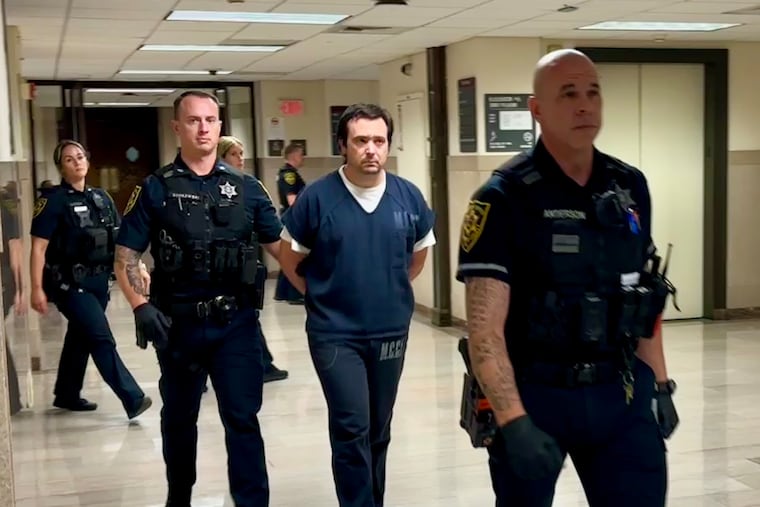
Investigators eventually caught up to him on Colwyn Road. News helicopters hovered overhead as he was handcuffed.
But the chase didn’t end there.
Shortly before noon, a dispatcher reported that other members of the crew might have been picked up by a white Dodge Charger.
Soon, an officer announced he spotted the Charger — back in the city, where it came to a stop at 52nd and Parrish Streets.
“Use caution,” a dispatcher said.
FBI agents, too, were at the scene, and arrested one man in a gray hoodie and gray sweatpants, and another in a blue hoodie and black pants.
“Let’s make some IDs,” one cop advised over radio.
The FBI did not immediately release the names of the men it had in custody, nor did the agency confirm that those three were responsible for the unsolved summer heists.
If these were men behind the heists, they had learned — like other crews before — that the thrill of the action ends once the handcuffs are on.
- Brazen armored truck robberies in Philadelphia marked a sweltering summer
- Does the internet have a Philly accent? Why too much time online can make you ‘culturally Philadelphian.’
- When can I say I'm from Philly? Advice chat
- The best things we ate (and drank) this week
- How to have the perfect Philly day, according to the Phillie Phanatic
- Citywide Quest: Prove how well you know the streets of Philly in our new weekly game
- How to spend a luxurious weekend in St. Michaels, two hours from Philly | Field Trip
- A wine director purchased a 1910 South Philly rowhouse with help from the city | How I Bought My House
- Flies shut down one of Philly’s ‘fancy’ airport lounges | Weekly Report Car
- How I take an image of an image