Bronze Age swords and arrowheads dating back almost 4,000 years are seized by CBP in Philly
Considered cultural artifacts, the items were imported into the United States without proper permitting, and were likely the product of “illicit excavations of burial sites,” federal officials said.
It’s a tale as old as time — or about 3,600 years, anyway.
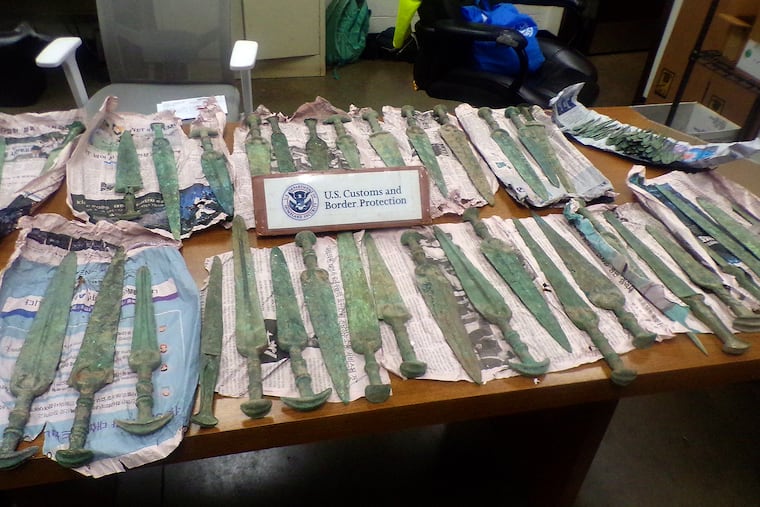
U.S. Customs and Border Protection on Friday announced the seizure of 36 Bronze Age-era short swords and 50 arrowheads following their arrival in Philadelphia in October. Considered cultural artifacts, the items were imported into the United States without proper permitting, and were likely the product of “illicit excavations of burial sites,” federal officials said.
Now, they may soon be returned to Iran, where they are believed to have originated and date from 1600 to 1000 BCE.
CBP tries “to repatriate them to their rightful owners, which in this case would be the country,” said agency spokesperson Stephen Sapp. “So they can retain a piece of their cultural history.”
The Bronze Age is considered to have spanned from 3300 to 1200 BCE, a historical period during which bronze — an alloy of copper and tin — was the prevailing metal used for making weapons and tools. What is today considered Iran was a pivotal area during that time, serving as an important trade route connector and bronze producer.
The items arrived in Philadelphia on Oct. 16 via an express delivery flight from the United Arab Emirates, having been “mis-manifested,” as Sapp put it, as “metal decoration articles.” CBP officers went on to X-ray the shipment, and discovered objects that resembled swords, prompting them to open up the items.
Inside, they saw what appeared to be ancient-looking swords and arrowheads covered in the teal patina of oxidized bronze. Suspecting the items to be of antiquity, the officers detained the shipment for additional investigation.
CBP officers worked with the Antiquities Unit of the department’s National Targeting Center to determine the historical and cultural value of the swords and arrowheads. That unit sought assistance from an archaeologist associated with an unnamed Philadelphia university for more information. The archaeologist later pegged them as hailing from what is today the northeastern area of Iran and dating back as far as 3,600 years.
Being that old, the items were considered to be the historical and cultural property of their origin nation. Many countries, federal officials noted, have laws that require official permission to export such items.
Investigators also reached out to the person who imported the items, and found that they did not have the documentation that would allow them to obtain the objects. As a result, even if the items were legally purchased, they were not able to be lawfully imported into the United States.
“That’s the key thing. If it is considered an artifact, or historical or cultural property of a country, that country has to permit that commodity leaving,” Sapp said. “Generally, you are going to be able find there is a black market — or a market, period — for all things.”
Sapp added that no criminal charges have been filed in the incident. However, he noted that the importer is now known to investigators, and lost the shipment as a result of the investigation.
Elliot N. Ortiz, CBP’s acting area port director in Philadelphia, said in a statement that officers “strive to rescue cultural artifacts from the grips of illicit international traders.” Items are often smuggled into the United States using “deceptive practices” that both violate import laws and “undermine efforts to preserve and protect the integrity of cultural history,” he added.
The investigation lasted about four months — a length of time Sapp said is not unusual in cases like this. Largely, he added, it comes down to investigators doing the due diligence when it comes to seeking the importer’s permitting, as well as allowing archaeologists to properly investigate the items to determine their age and origin.
“We aren’t going to give an archaeologist a day or two to look at this stuff,” Sapp said. “They need to be able to make sure they are accurate to the best of their ability, so when they give their determination, we can trust that to be truthful.”
Now, CBP officers will hold on to the items until the agency issues a disposition order. When that will happen exactly, Sapp said, has not yet been determined.