Some Center City blocks will no longer get sidewalk cleaning
The Center City Residents' Association will not renew its contract with Center City District for cleanings in 2026.
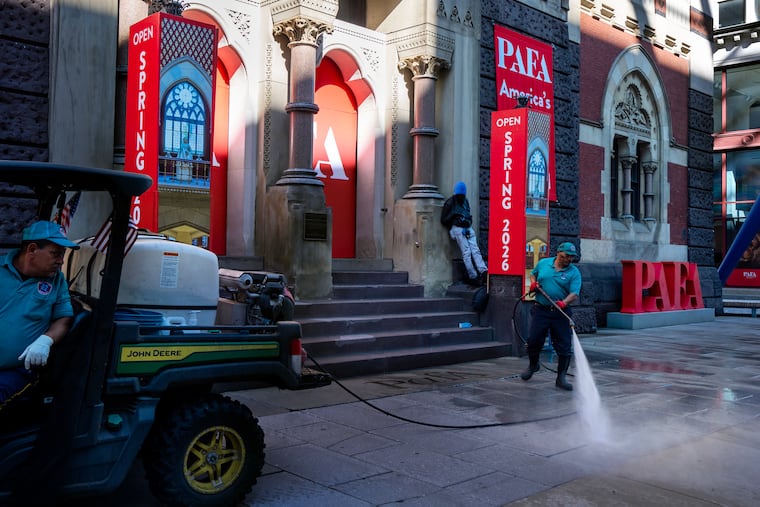
Philly aspires to be the cleanest city in the nation. Does that include the sidewalks?
The Center City Residents Association will not renew its contract with Center City District for sidewalk cleaning that is up at the end of this month, the group said in an email to its members.
The City of Philadelphia does not regularly perform sidewalk cleanings, though recently it has conducted occasional sweeps.
The residents association said its board made the decision because of rising costs charged by the Center City District. The new rate would have doubled the proportion of the association’s budget going toward sidewalk cleaning in 2026, from 20% to 41%. The association paid $39,600 for sidewalk cleaning in the most recent fiscal year, according to tax forms.
“We were losing money. It was like, are we going to clean the sidewalks for another year and a half and be dead as an organization?” said association president Nathaniel Margolies.
The residents association had a long-standing agreement with the Center City District to extend the district’s sidewalk cleaning operations to cover the entire CCRA catchment area — from John F. Kennedy Boulevard to South Street and from the Schuylkill to South Broad Street — at a favorable rate. The cleanings came the day after trash collection.
Things changed coming out of the pandemic. The Center City District could no longer offer a subsidized rate and its prices climbed.
“We presented a proposal to the CCRA that reflects the cost of the program, and they chose not to renew. Much of CCRA’s membership is located outside of our district’s boundaries; within CCD’s boundaries, sidewalks are cleaned three times a day and power washed during warmer months,” CCD spokesperson JoAnn Loviglio said in a statement.
There were other reasons for CCRA to move on. The cleaning wasn’t making a significant difference on some blocks that already had good trash hygiene, Margolies said, and it didn’t make sense to continue asking half of the association to essentially pay twice for sidewalk cleaning, since they’re covered by CCD regardless.
» READ MORE: These South Philly dads bought personal street sweepers for their block: ‘It’s like a little Zamboni’
The residents association has established a Cleanliness Committee to explore other service providers, like Glitter. The popular service positions itself as an affordable option for blocks or neighborhood groups dealing with the same dirty sidewalk problem. Glitter currently cleans 350 blocks that are directly funded by neighbors, typically at $200 per month for weekly cleanings, and another 720 through violence prevention and neighborhood beautification grants, according to its CEO, Brandon Pousley.
Margolies said it was frustrating that so much of the financial responsibility for keeping clean sidewalks falls upon neighborhood groups and individuals, not the city.
In Mayor Cherelle L. Parker’s campaign to make Philadelphia the cleanest big city in the nation, her administration has directed resources toward trash collection and curbing illegal dumping. A signature policy has been the introduction of twice-weekly trash pickup, which began in South Philly and Center City last year, and is about to expand to North Philly.
The extra collection day has been met with a mixed response. Some residents have appreciated holding onto less trash and the city said it’s made a difference on illegal dumping and litter. But other residents have complained that the program has put even more trash on the street.
“If you’re gonna add a second trash day without fixing the functional problems of the system, you’re going to create more litter,” said Nic Esposito, the former director of Mayor Jim Kenney’s Zero Waste and Litter Cabinet.
The city’s Office of Clean and Green Initiatives did not respond to a request for comment.
Esposito said ideally, there would be a balance of responsibility between the city and its residents to making Philly cleaner. He said he believes that when people see the city government demonstrating care, it motivates residents to get more involved.
“That’s what makes Philly so amazing. But it really wears on people when you’re trying to do that and before you can even do it, your street’s filthy … why are we expending our hard-earned money to have to do something as basic as cleaning streets?” he said.
As CCRA weighs what to do about its sidewalks, its cleanliness committee will also advocate with the city, landlords, businesses, and other residents to build better habits and rule enforcement. Margolies said he’s had positive experiences working with the city’s Office of Clean and Green Initiatives, and they have been responsive to residents’ needs.
Residents have expressed disappointment at the sidewalk cleaning service going away, but once he explains the financial situation, they usually understand, he said. But it’s unclear how long their patience will last if litter piles up.
“When you look at the quality-of-life [issues] in the neighborhood, they change as time goes on … the real consistent one over time is trash and cleanliness. It really grates people,” Margolies said.