Philly’s composting program is expanding to up to 30 locations
Philly's community composting program run by Parks and Rec is growing, with 23 active sites and plans for five to 10 more this year.
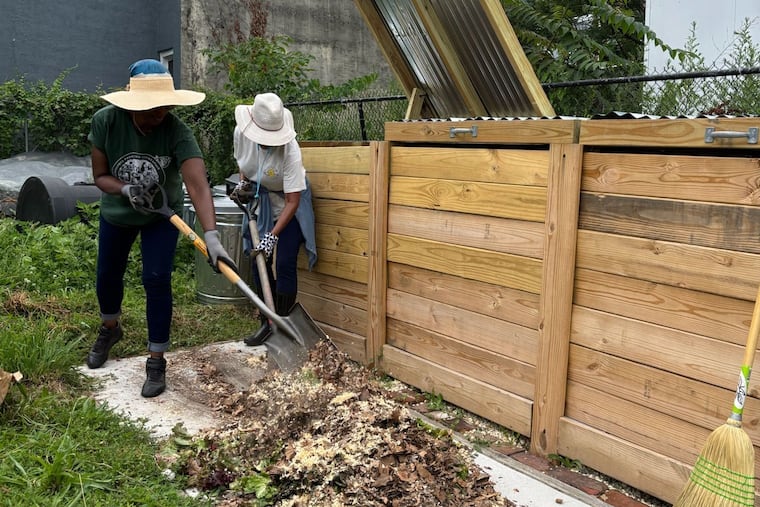
Members of the Mantua Urban Peace Garden squeeze in just about every crop they can cultivate: tomatoes, cucumbers, peppers, lettuces, herbs, strawberries, potatoes, beans, and watermelons.
But only last summer did they begin seriously trying to make their own compost, said Danyel Jones, a garden board member. Volunteers are testing combinations of moisture, temperature, and ingredients.
“It’s sort of like cooking,” Jones explained. “You have your base recipe, you know what’s supposed to happen, and then you watch it and tweak it.”
The Mantua Urban Peace Garden is part of Philly’s expanding community composting network, launched in 2019 on a shoestring budget under Ash Richards, the city’s urban agriculture director. Richards manages Farm Philly, the urban agriculture program within Philadelphia Parks & Recreation.
Richards initially aimed to establish 20 community composting sites. Today, the network operates 23 locations and is accepting applications through March 27 to add another five to 10 this year.
The mission is to divert organic waste from landfills while producing free compost for community use.
Last year, the effort kept 12,000 pounds of food scraps out of landfills, thanks to the all-volunteer composting network.
Why start a citywide compost program?
Richards said the idea for community composting came at a time when the city already had successful composting programs, such as the Fairmount Park Organic Recycling Center in West Fairmount Park, where residents get free compost made from leaves and manure from plant-eating animals. And, the city has a compost facility on Rising Sun Avenue in Northeast Philly that turns food waste generated at the city’s 156 recreation centers into free compost for registered community gardens.
» READ MORE: Philly is turning discarded hamburgers, chicken salad, lettuce into tons of compost
But Richards felt that a decentralized network of composting sites scattered throughout the city would reach more people. That way, residents could bring food and yard waste to a location near their homes, and the resulting soil could be used within their communities.
The sites would be closer to people who might not be able to, or want to, drive to a central location, either hauling food scraps to the pile, or taking compost home.
“They have a desire to not only take waste out of their neighborhoods or take waste out of the waste stream, they also have the desire to generate this life-giving, organic resource that otherwise some of the residents couldn’t afford,” Richards explained.
Richards established partnerships with urban farms, civic organizations, community gardens, recreation centers, and schools to host and maintain sites.
How does it work?
The city supplies a rodent-resistant, three-bin system built by PowerCorpsPHL, which hires city residents from 18 to 30 years old who enter training programs and earn money toward education. The nonprofit Institute for Local Self-Reliance supplies educational materials and expertise, such as rules about what scraps are acceptable.
As part of the city’s agreements with partners, compost sites must be on publicly accessible land. They cannot be on residential or business properties.
Compost facilities on school grounds get their waste from school cafeterias and the soil is used only by the school. Officials cannot open school grounds to the public because of liability issues.
In addition to bins, accepted groups receive wheelbarrows, shovels, and more for free. The groups must allow people to drop food scraps at their sites, and assemble volunteers to help expand the network.
Because the program relies heavily on volunteers, Farm Philly requires a firm commitment from participating sites that they are able to sustain a composting operation.
Recently, the program has evolved into a peer-to-peer “train the trainer” model, where experienced sites help educate incoming leaders. Richards said that helps when compost site leaders can no longer fulfill their duties and successors need to take over.
“It’s a really fantastic grassroots approach to reducing waste, particularly food waste, which takes up a lot of our trash bags going to the landfill,” Richards said.
Richards noted that the network taps into residents’ enthusiasm for both sustainability and agriculture.
To prevent sites from becoming overwhelmed by eager residents, Farm Philly allows each location to dictate its own operations. Composting requires a strict balance of materials, meaning sites cannot accept unlimited fresh waste before letting the compost “cook.”
Consequently, sites set their own boundaries, such as only accepting scraps from a four-block radius, or designating a single weekly drop-off.
How the Peace Garden makes it work
For example, the Mantua Urban Peace Garden on Brown Street is still tweaking its operations, Jones said, with members navigating a learning curve of safety and efficiency since installing the three-bin system eight months ago.
During the garden’s first season, a core group of about six members focused primarily on training and testing. They successfully managed to make 50 to 75 pounds of organic material per week during the summer months.
To keep the compost healthy, they strictly accept only produce scraps — avoiding meat and dairy entirely — and frequently source organic materials from local juicers, healthy eaters, and a nearby coffee shop.
Previously, the community garden, which has been operating since 2013, relied on standard fertilizers or simply allowed organic matter to break down unmanaged in the corners of the lot.
Now, they are intentionally manufacturing nutrient-rich soil to grow crops, which are vital, Jones said, because the area is considered a food desert. Crops are shared with both garden members and surrounding neighbors.
This year, Jones plans to expand the garden’s impact by initiating outreach and opening compost drop-offs to the wider community at least once a week.
“It’s exciting. It’s a learning process,” Jones said. “And I am looking forward to just sort of seeing Philadelphia embrace composting.”