A rare 'corpse flower' blossom graced Temple's Ambler campus
Blooming only every few years, and only for only 24 to 36 hours, nearly 600 visitors have crowded the exotic greenhouse in recent days for a look — and a whiff.
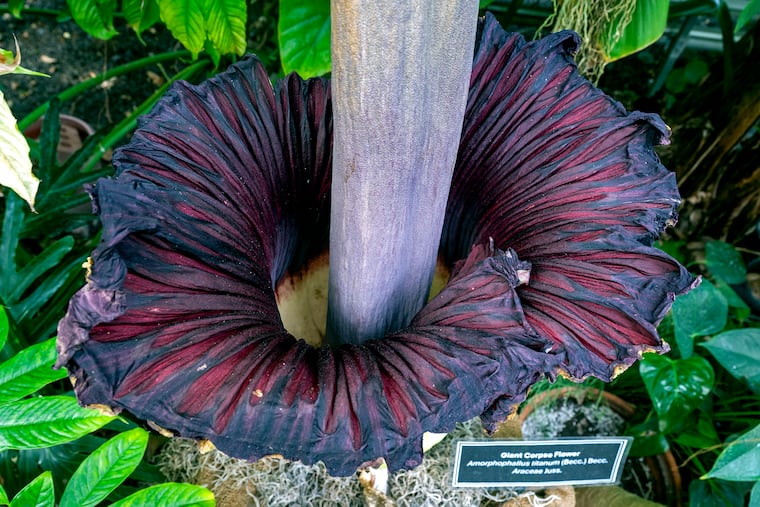
For weeks, Benjamin Snyder scrutinized the prized Amorphophallus titanium — a rare tropical plant better known by its macabre moniker: “corpse flower.”
Snyder, 31, Temple University Ambler Campus’ greenhouse education and research complex manager, monitored the fickle flower famous for its brief blossoms and striking stench similar to the odor of rotting human flesh, for any signs of it blooming.
By last Thursday, when the plant’s burgundy-colored frilly sheath began to separate from its towering spike, Snyder suspected he was witnessing a foul-smelling floral event. By the time he arrived at work the next morning, any doubts were erased.
“You could smell it outside the building,” he said with a smile.
‘Little Stinker’
Blooming only every few years, and only for only 24 to 36 hours — and considered critically endangered with less than 1,000 of the fetid flora remaining in the rainforests of the Indonesian island of Sumatra — nearly 600 visitors have crowded the exotic greenhouse in recent days for a look — and a whiff.
They have not been disappointed.
“In the rainforest you can smell them up to a half a mile away,” said a beaming Snyder, standing in the plant’s fading fetor.
Corpse flowers emit their signature chemical stink — botanists say it contains similar compounds to those from rotting onions and sweaty gym socks — to attract pollinators such as beetles, flies, and the two-inch red and black Australian cockroaches that thrive in the greenhouse.
Capable of growing up to 15 feet in the wild, this one, which Snyder proudly nicknamed “Little Stinker,” stands over 4 feet tall, and is 11 years old. It last bloomed in spring 2021.
Almost a dozen other corpse flowers, sprouting green leaves shaped like tiny umbrellas, surround Little Stinker. The curious plants usually take about seven years to show their first bloom, then flower again every five to seven years, Snyder said.
Acting like a self-heating floral furnace, the plant raises its core temperature upward of 81 degrees before diffusing its redolence through its spongy stalk, like a chimney. Snyder encourages visitors eager for the most nauseating blast to stick their heads inside the plant.
“This one is on the bucket list for a lot of people because of how unusual it is,” he said. “It’s a 4-foot-tall flower that smells like our rotting corpse. So it’s cool to see people that come from all different backgrounds.”
Little Stinker, the fifth corpse flower to bloom at Temple Ambler in recent years, garnered a visit from a local embalmer curious if the plant was worthy of its smelly sobriquet. After breathing in the fumes, the mortician lent her stamp of approval, Snyder said.
“She said it smelled very similar to a dead body,” he said.
‘Pretty stinky’
While often gaining star status, the corpse flowers are just some of 1900 rare and exotic flora varietals for viewing at Temple Ambler’s greenhouse, part of the Tyler School of Art and Architecture. There’s Blue Oil Ferns, a houseplant native to Java and coveted for their leathery, iridescent-blue fronds. Waxy, porcelain-colored hoyas, with their clusters of star-shaped flowers. Bursting African blood lilies. Ghostly Spanish moss. And the strikingly cunning Bundle of Sticks plants, which disguise their trailing tangle of stems as woody twigs to avoid hungry animals. (“Plants are smarter than us in multiple ways,” Snyder said.)
But the corpse flowers are often the door prize that brings people in, he said.
By Sunday morning, Little Stinker’s spike had begun to collapse and the plant had lost most of its stench
But still visitors came.
Like Mark Masko, 9, of Ambler. The fourth grader had asked his mother Emily to bring him to see Little Stinker. He lowered his head deep inside the plant.
“Pretty stinky,” the boy said, laughing, wanting one for his backyard garden. “It’s not a good smell.”