These Manayunk public stairs have been closed for 13 years. A civic group wants them fixed and reopened.
Thirteen years after Philadelphia officials condemned and removed part of the stairway linking Manayunk’s hillside, a civic group is mounting a renewed push to get it rebuilt.
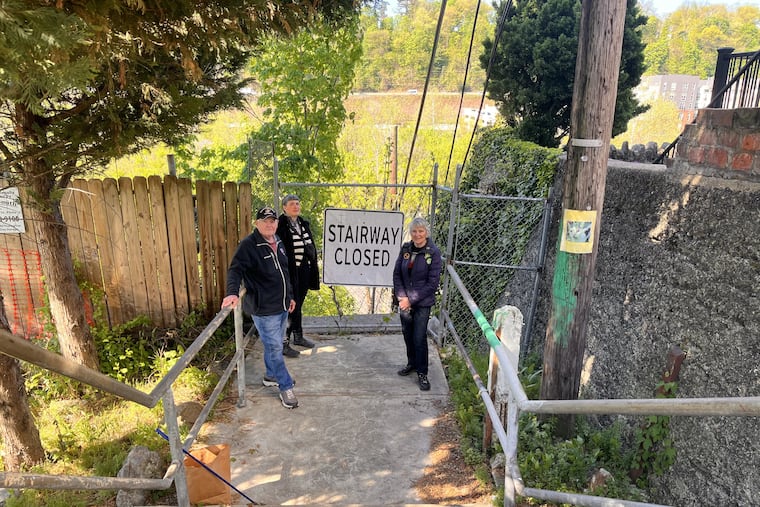
Leonard Gryn has lived all of his 85 years in Manayunk and recalls walking down the steep public stairs that connect Dawson Street to Main Street and the Schuylkill as a youth.
“There used to be a beach down there,” Gryn reminisced. “That’s where we used to swim. We used to swim over to the canal wall. Canal boats would come right up.”
Though he’s still fit, Gryn cannot use the stairs anymore — because the city closed them in 2012, saying they had deteriorated and there was a lack of money to fix them.
He would like to see the stairs reopened, and he is not alone.
Thirteen years after Philadelphia officials condemned and removed part of the stairway linking Manayunk’s hillside, some residents, with the backing of the Wissahickon Neighbors Civic Association (WissNCA), are mounting a renewed push to get it rebuilt.
The WissNCA launched a petition only recently but already has 100 signatures, association president Vicki Beechler said.
She plans to send a letter next week to Councilmember Curtis Jones Jr., urging the city to restore the stairway. Jones has represented the area since 2008.
“Councilmember Jones certainly supports the reopening of these stairs,” said Joshua Cohen, Jones’ chief of staff.
He said that the city has refurbished similar stairs in Manayunk and Roxborough.
“The only thing stopping us is funding,” said Cohen, who noted he has reached out to the Philadelphia Streets Department. “We could also look at our state partners for funding, too.”
Chris Young, a spokesperson for the streets department, said that while the city has plans to repair or maintain other pedestrian paths, Dawson Street is not one of them.
What are the Dawson Street stairs?
The stairs are part of a pedestrian pathway that starts at Dawson Street. The path goes over a SEPTA Regional Rail line to Little Cresson Street. It then drops precipitously to Main Street.
The 91 steps historically served as a direct connection from the residential streets above the rail line to the bustling commercial corridor of Main Street.
When the streets department closed and removed the lowest section of the stairs in November 2012, it cited severe structural deterioration, which included missing treads.
At the time, the department said only about 12 people a day traversed the stairs, according to a Patch article.
These steps are among at least 15 sets of public stairs in Manayunk that allow residents to bypass streets and navigate the neighborhood’s notoriously steep slopes, according to a 2003 publication by the Manayunk-Roxborough Art Center.
The Dawson Street pedestrian bridge over the rail tracks is still open but ends at Little Cresson Street, which is basically an alley that runs behind homes and next to the tracks. It ends at a fenced-off area warning people the broken and missing stairs below are closed.
Why reopen the stairs now?
Beechler argues that the 2012 user data showing that the stairs were barely used no longer reflect the reality of the rapidly evolving neighborhood. In addition, she said, people were likely not using the stairs because of their condition, not because they did not want to.
“Since 2012, our neighborhood has changed so much,” Beechler said, noting an influx of younger families and residents who often live without cars.
“Walkability is really important to folks,” Beechler said.
At the time of the closure, city officials estimated that constructing a modern, code-compliant replacement would cost $650,000 but noted that no funding was available.
Beechler said new residential construction, including the 50-unit Yarn Factory Lofts on the site of the former Wilde Yarns Mill, has brought more people seeking to get to Main Street, especially the CVS store.
This severed connection creates a significant daily hardship for the community, Beechler said.
Instead, residents must navigate an alternate path that adds 15 to 20 minutes to their trip, posing a major barrier, she noted.
In its request to the city, the WissNCA is calling for an updated engineering assessment, the active pursuit of state and federal infrastructure grants, and transparent community engagement in the design process.
Beechler said the campaign is gaining cross-neighborhood traction, drawing interest and coordination from the Manayunk Development Corp., the Manayunk Neighbors Council, and the urbanist transit advocacy group 5th Square.
“It’s a safer, quieter access to Main Street,” said Suzanne Hagner, an organizer with 5th Square who lives in Manayunk.