Soup dumplings and serenades: Meet Dim Sum Garden’s singing waiter
On his path to musical success, Riyan Pondaga, a waiter at Dim Sum Garden, serenades customers most every Friday and Saturday between shifts.
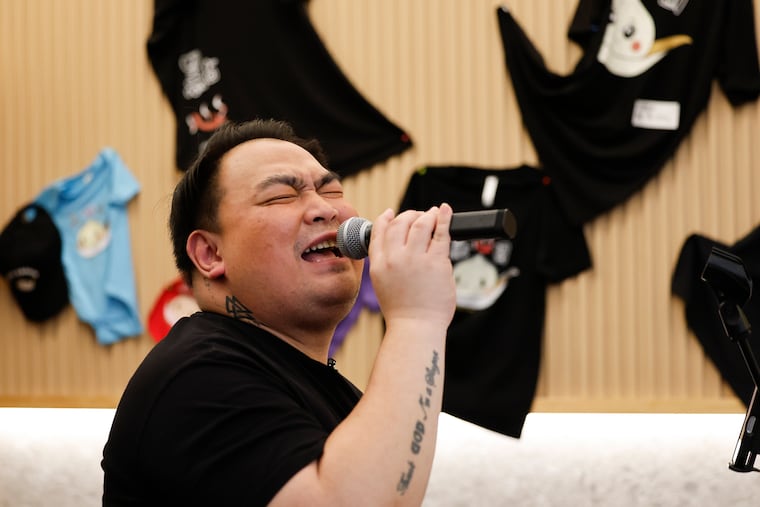
Amid the tapping of chopsticks on dumpling trays and the rustling of smiley-faced to-go bags, a soaring tenor voice cuts above the cacophony of dinner service at Dim Sum Garden on a Friday night.
Riyan Pondaga, 38, sits on a stool in the middle of the dining room, gripping a cordless microphone. He is still wearing his serving uniform — black pants and a black T-shirt with a name tag. Eyes from every corner of the room slowly become trained on him.
As the lilting piano accompaniment of Alicia Keys’ power ballad “If I Ain’t Got You” flows from a speaker, Pondaga effortlessly scales the starting riffs, then seamlessly transitions into the verse.
“Some people need three dozen ro-o-o-o-o-oses and that’s the only way to prove you love them,” he belts into the mic — a tattoo climbing the side of his forearm reading “Thank GOD I’m a singer.”
As the chords build toward the chorus, Pondaga cues the diners to sing along by raising his arms in the air.
“Some peo-ple want it all, but I don’t want nothing at all,” he croons.
Half the customers continue cracking into High Noons and stabbing at bok choy with forks, paying little mind to Pondaga.
The other half are utterly entranced.
They cheer and whoop as Pondaga flips into falsetto on “If I ain’t got you-ou-ou-ou” with impeccable precision.
A trio of Thomas Jefferson University undergrads gleefully sing along over the remnants of their dinner. They allow the anxiety of impending midterm exams to melt away. A man mouths the lyrics as he strolls past tables toward the ATM, bouncing a baby in a crochet beanie on his chest.
Pondaga has been singing to diners at Dim Sum Garden most every Friday and Saturday evening for about a year and a half, he said.
It started when patrons began asking if the restaurant had something special to offer customers on their birthdays, said Sally Song, the owner of the Chinatown mainstay.
At the time, it didn’t.
“I can sing,” Pondaga volunteered.
Coincidentally, Pondaga’s friend Gechang had just purchased a new speaker and microphone and asked him to test it out.
“OK, just come to my restaurant,” Pondaga told him.
The few customers eating lunch there that day started grooving along as he sang. When Song heard his voice, she went slack-jawed.
“I think, ‘Wow,’” Song said. “Unbelievable.”
Soon after, she purchased the same microphone and speaker set for the restaurant.
“Sally is like my hero,” Pondaga said. “She believe in me.”
The gesture was not aimed at racking up business or boosting tips, Song said. She tries to foster a work environment where employees feel creatively stimulated. It’s important, for everyone’s enjoyment, to break up the monotony of kitchen-to-table-to-register once in a while.
One server likes designing the decor in the restaurant during holidays. One delights in experimenting with cake recipes.
“I just try to find it, what they can do, their strengths,” Song said. “I want everyone happy.”
Pondaga started singing as a young child in Jakarta, Indonesia. His father loved listening to his voice and had a propensity for crying when Pondaga serenaded crowds at special occasions.
“Next time, no singing for parents,” his dad playfully chastised him after Pondaga sang at his junior school graduation. “I don’t want to look stupid crying!”
His parents enrolled him in vocal competitions. He always won — citywide, province-wide, statewide. No one could compare to his earnest passion and angelic high notes.
His dad never pushed him to win, just to keep singing.
Pondaga quickly developed an affinity for “the divas” — Mariah Carey, Celine Dion, Whitney Houston.
He tackled their ostentatious vocal runs and legendary whistle tones. He embraced every vocal challenge their music presented.
When Pondaga was 17, he was preparing to compete in Indonesian Idol — an elite televised singing contest.
It would put Pondaga in front of a national audience with the potential to launch his career.
Five months before the competition, his father died of a heart attack.
Proceeding felt impossible. Participating in the competition seemed empty without his dad.
“I almost give up,” Pondaga said.
But his friends encouraged him to compete anyway, so he did.
For the first time, Pondaga did not win. He placed 32nd, he said.
He kept going anyway.
Years later, he released his first EP in Indonesia, but was met with criticism, he said.
“I don’t have the good appearance,” he said. “I’m not the ideal face. I’m fat boy. In my country, that matters.”
Those things did not seem as prohibitive in the American entertainment industry.
So, after travel restrictions from the pandemic lifted, he left for the United States. He did a brief stint in San Antonio, Texas, until friends suggested Philadelphia. It had a sizable Indonesian community and plenty of Indonesian food to choose from.
“That tempted me,” he said.
After about five years in the city, he has settled into some regular gigs at festivals, cafes, and, of course, his home base — Dim Sum Garden.
His dream, he said, is to win a Grammy. But, in another sense, he is already fulfilled with regular gigs, supportive audiences, and a sense of balance in his life that allows him to continue extracting joy from performing.
“Singing is my therapy,” he said.
Beneath red-tasseled wall decorations at the restaurant, Mia Henderson, 30, and her best friend, Philip Siciliano, 31, danced with abandon over garlic chicken and rice balls as Pondaga sang.
His performance injected “a little whimsy into the day,” Henderson said upon returning to her pork soup dumplings.
Watching the tables break away from their disparate conversations and share an unexpected experience together was a huge thrill, Henderson said. It’s moments like that, she said, that take us out of our routines, elevate our lives, and connect us with those around us.
“Especially living in cities, that is what binds you to your neighbors,” Henderson said. “You feel a little less alone.”
A little later in the evening, Pondaga launches into his signature number: Whitney Houston’s “I Wanna Dance with Somebody.”
“Put your hands together,” he tells the diners as he initiates the starting ad-libs.
“Ah, yeah, whoo,” he croons.
By the second chorus, most everyone is swaying along. Three young women pump their arms as their server shows them to their table.
“My lonely heart caaa-lls,” Pondaga belts, his vibrato resonating across porcelain dishes of General Tso’s chicken and bottles of soju.
Pondaga and the diners break out into a call and response.
“Somebody,” Pondaga sings.
“Whooo,” they return.
“Somebody.”
“Whoo!”
“With somebody who loves me,” Pondaga concludes, beaming at the patrons.
“I’m singing every weekend,” he announces over rollicking applause.
Without a beat, he goes back to work. He stashes the mic and speaker and dutifully attends to an empty table of dirty dishes.
