Philly plans to install 800 electric vehicle chargers in the next 10 years
The city has an estimated 200 publicly available chargers, mostly in Center City. Officials want to expand charging to more neighborhoods.
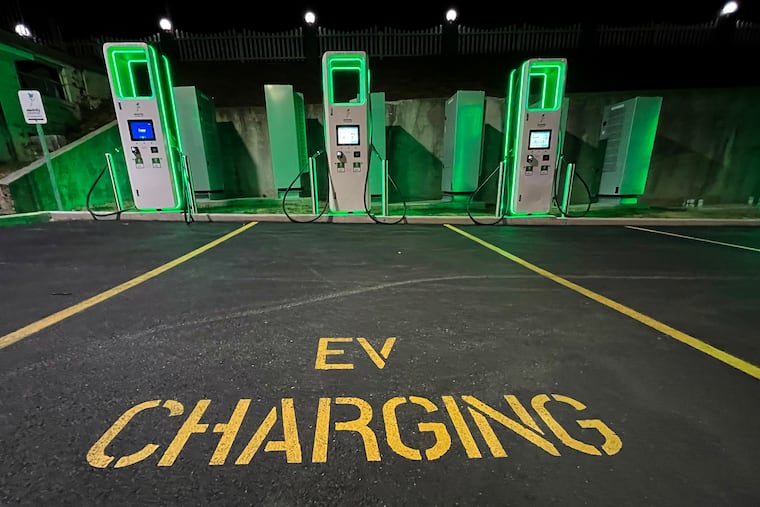
On average, Philadelphia residents live within half a mile from a gas station. But they live 1.4 miles away from the nearest public electric vehicle charging station.
Most of the estimated 200 public chargers are concentrated in Center City, leaving other neighborhoods out of the EV charging loop. In some neighborhoods, EV owners have dangled electrical cords out of garages and windows and snaked them across sidewalks.
City officials plan to improve that access through ChargePHL, a 10-year partnership with two businesses that would install and maintain over 800 publicly available EV charging stations across the city.
Legislation is expected to be considered Thursday from Councilmember Michael Driscoll and Council President Kenyatta Johnson.
The network would be built at no cost to the city. Rather, two companies will tap their own money and federal grants to cover installation costs.
EV charging is classified into three levels. The third level, known as DC fast charging, can charge most EVs to 80% or more in 30 minutes or less and cost up to $800,000 for each charger. A public level 2 charger costs between $15,000 and $25,000, and generally adds about 30 miles per hour of charging. The contract will add a mix of the two types.
Anna Kelly, an adviser for the Philadelphia Office of Transportation and Infrastructure Systems, told Council during a committee hearing Tuesday that two companies have been chosen for the network.
Brooklyn-based It’s Electric Inc. and Miami-based PositivEnergy Inc. would design, install, own, operate, and maintain the network at curbside locations and surface-level parking lots, such as those owned by the Philadelphia Parking Authority.
“Both companies were selected for their experience, operations, and maintenance plans, and siting and expansion approaches,” Kelly told Council.
Kelly noted that motor vehicles are responsible for 60% of the city’s air pollution and that Philadelphia consistently receives a grade of F from the American Lung Association for that pollution.
“The transition to EVs will reduce these pollutants and, as a result, decrease the devastating impacts of asthma and heart disease in our communities,” she testified.
To manage the addition of new curbside chargers, the legislation would also amend the traffic code so that people cannot stand in or park a non-EV in a charging space.
In addition, someone charging a car would have to drive away from the space within 20 minutes of finishing.
Violators would face penalties of $150 to $300.
Officials estimate an overnight charge will cost users approximately $13, providing a competitive alternative to gasoline. Planners anticipate the first chargers will be installed by early 2027.
Councilmember Jeffery Young Jr. said he hoped the program would place chargers on city-owned land that could be accessed easily by residents.
“I would just hope that we take a look at the neighborhoods where we want expansion of electric vehicles and put the infrastructure there to incentivize residents to purchase electric vehicles,” Young said.
He noted that he has friends who rent EVs as Uber drivers and have to drive to Northeast Philly to charge their cars.
Separately from ChargePHL, Council is weighing a bill that would allow PositivEnergy to install four fast chargers at the cell phone lot at Philadelphia International Airport.
The airport chargers would be fully accessible to rideshare operators, passengers, and the wider public.
PositivEnergy would own and maintain the stations, while the Philadelphia Department of Aviation will collect 33% of the revenue during the contract’s first five years and 37% in the following five.