A hidden alley could become a key walking path in Old City for 2026
The city is starting construction on what officials call the Commerce Connector, a pedestrian path designed to guide visitors from the Independence Visitors’ Center to Carpenters Hall.
Tourists arriving in Philadelphia next year may find it easier and far more inviting to stroll through what is now a tucked-away stretch of Old City.
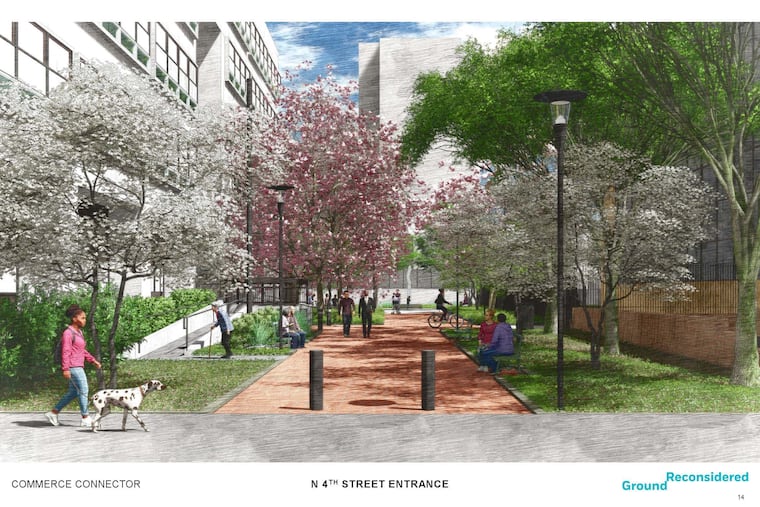
On Wednesday, the city launched construction on what officials call the Commerce Connector, a pedestrian path designed to guide visitors from the Independence Visitor Center to Carpenters Hall along a brick‑lined walkway adorned with seating and ornamental plantings, while bypassing a congested area.
The city has allocated $2.7 million toward the project.
The project is spearheaded by the nonprofit Independence Historical Trust in collaboration with the city; Old City Green, a neighborhood beautification group; and Old City District, a business support organization.
Bill Marrazzo, chair of Independence Historical Trust, called the connector “an important step forward.”
“The Commerce Connector enhances the visitor journey between some of Philadelphia’s most treasured sites while also improving everyday walkability for residents and workers,” he said in a statement.
The bigger picture
The connector is part of a larger effort by the city and nonprofits, led by Independence Historical Trust, to craft a broader vision for the city’s historical area. Some will be complete by the Semiquincentennial, and others might not.
» READ MORE: More bikes and pedestrians, fewer cars: A $100M rethink of Philly’s historical district
That vision, which could take $100 million to implement, calls for more walkable and bike-friendly streets, new plazas, additional green spaces, and easier navigation to cultivate a sense of cohesiveness they say is lacking.
The Historical Philadelphia Vision Framework plan aims to create ways for people to “wayfind” easy-to-follow, less car-centric routes through Independence National Historical Park, Old City, and other historic or local neighborhoods.
The current redo of Market Street in Old City, now under construction, is part of that. It will include a new Tamanend Plaza at Second and Market Streets, and a “road diet” to accommodate bike lanes. Workers were busy Thursday putting down blocks for the new plaza.
Work is also underway by the National Park Service at the Declaration House at Seventh and Market Streets, where Thomas Jefferson stayed while he wrote the famed document, and at the Benjamin Franklin Museum off Chestnut Street, both part of Independence National Historical Park. Also, the 25,000-square-foot, Greek Revival-style First Bank of the United States is undergoing $27 million in work, timed to reopen as a new park attraction for the Semiquincentennial.
What’s the route?
The roughly 2,000-foot-long Commerce Street foot path will lead travelers from the edge of the visitor center’s lawn at Fifth Street, east across Market Street, and onto Commerce Street, now an unmarked alley that runs parallel to Market Street. From there, they will continue east before turning right onto another alley, which leads to Market Street.
After crossing Market, they will cut through Franklin Court, cross Chestnut Street, and arrive at Carpenters Hall.
Once at the hall, visitors can branch out into the wider Independence National Historical Park and other notable areas.
Officials emphasize that the connector will deliver a mostly traffic‑free passage to Carpenters Hall in time for an anticipated surge in tourism tied to the 250th anniversary of the Declaration of Independence. Carpenters Hall was the site of the first Continental Congress in 1774.
Other enhancements
Officials say existing paving, benches, lighting, and plantings are all in poor condition.
The redesigned corridor will get new furnishings, better lighting for security, ornamental trees and bushes, and other enhancements to make it more inviting. It would include a “gathering area” and new entrances.
To slow traffic for pedestrians, a speed bump mid-block on Fifth Street would connect Independence Visitor Center and the alley. Another mid-block bump on Fourth Street would help pedestrians cross Market Street to Franklin Court.
Fourth Street would get a bike lane.
New signs would note area history.
The path would also help connect people to Christ Church Burial Ground, Commodore Uriah Phillips Levy Park, and the Faith and Liberty Discovery Center.
Construction is expected to be complete before July Fourth, ahead of the nation’s Semiquincentennial.
“The Commerce Connector reflects our commitment to making Old City safer and easier to navigate for everyone,” said City Councilmember Mark Squilla, who helped secure funding.
Job Itzkowitz, executive director of Old City District, said the connector “strengthens the backbone of Old City by transforming an underused passageway into a vibrant, welcoming public space” that will make it easier for residents and tourists to move between iconic city sites.
Old City Green launched the early planning efforts for the corridor and will continue to help maintain the path.
“By introducing new plantings, shade, and thoughtfully designed landscape elements, we’re creating a greener and more accessible environment for everyone who walks through this historic neighborhood,” said Joe Schiavo, vice president of Old City Green.