John Coltrane’s endangered Strawberry Mansion home is finally being restored and revitalized
The jazz legend bought the house at 1511 N. 33rd Street and lived there until 1958. Fires, demolition, and legal troubles have long threatened its survival.
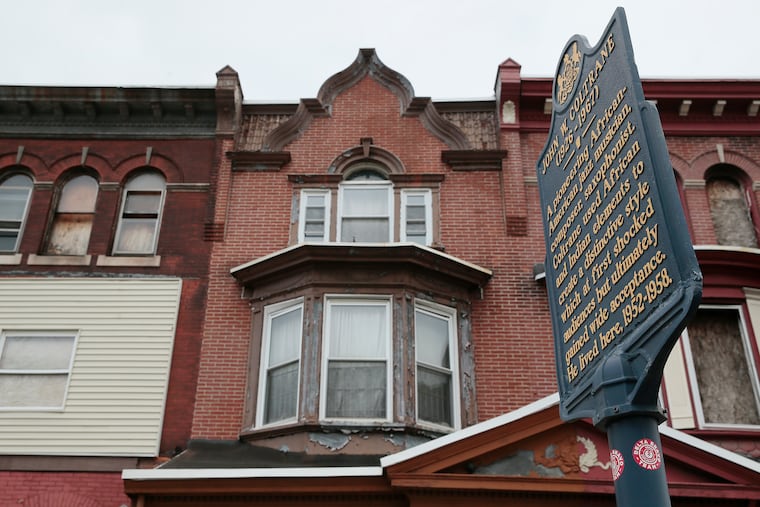
Just in time for the 2026 celebration of John Coltrane’s centennial, progress is finally underway on the restoration of the saxophonist’s long beleaguered house in Strawberry Mansion.
Coltrane bought the house at 1511 N. 33rd St. in 1952, living there until 1958 with his mother, his cousin Mary Alexander (immortalized as “Cousin Mary” on the 1960 classic Giant Steps, written while Coltrane lived in Strawberry Mansion), and a childhood friend from North Carolina. After their marriage in 1955, Coltrane’s first wife, Juanita “Naima” Austin, also moved in.
The saxophonist lived at 1511 N. 33rd St. until 1958, encompassing his formative years with Thelonious Monk and Miles Davis and his earliest solo efforts, and overcame his heroin addiction there.
After he left Philadelphia for New York, his mother continued to reside there until her death in 1977; Cousin Mary stayed there until a few years before she died in 2019.
On Friday afternoon, a group of musicians, jazz fans, neighbors, and preservationists gathered in The Yard, a public space that opened last November in a formerly vacant lot behind 1515-1517 N. 33rd St., a few doors away from the Coltrane House. They announced a partnership between a number of local and national organizations to restore and revitalize the three-story rowhouse, which has been named a National Historic Landmark but has been deteriorating for decades.
As a group of young musicians from the Lovett Hines Global Creative Arts Initiative performed Coltrane compositions, the jazz legend’s son, saxophonist Ravi Coltrane, spoke about his relief at seeing the site rescued from potential destruction.
“I think this house can exist as a symbol of John’s legacy,” he said. “We want to open it up as a cultural landmark for creative and artists of all types, for seekers of musical and spiritual knowledge, and for those just looking to be inspired. We all recognize that it can exist as a symbol for creative and artistic excellence, for spiritual growth and for everything that John Coltrane stood for.”
Ravi Coltrane has no memories of his father, who died when he was just 2 years old in 1967. He was raised in the house that his mother, pianist and harpist Alice Coltrane, shared with John in Dix Hills, N.Y.
But he does remember the house in Strawberry Mansion, where he spent summers visiting his grandmother and Cousin Mary. He fondly recalled trips to the Philadelphia Zoo and the Franklin Institute. “I assumed the house would always be here,” he said. “But without the proper care and support, these homes can vanish … This is definitely a long time coming.”
The fate of the house has been in question since Mary Alexander sold the property to Norman Gadson, a real estate developer and avid jazz aficionado, in 2004. Gadson died in 2007, leaving his family to maintain the property, while questions arose over Alexander’s right to make the sale.
Meanwhile, structural damage and a crumbling façade threatened to cost the city one of its most important cultural landmarks, exacerbated by fires and planned demolition in neighboring properties.
The Coltrane Estate has since worked to conserve the house, rescuing it from the National Trust for Historic Preservation’s list of America’s Most Endangered Places. The house was named to the Preservation Alliance for Greater Philadelphia’s own Endangered Properties List in 2011.
After years of legal wrangling, the estate has regained ownership of the house. It has formed a nonprofit that will take ownership, and a working group with Ars Nova Workshop’s Mark Christman and Anthony Tidd.
They have undertaken their efforts in partnership with the Strawberry Mansion Community Development Corporation and the African American Cultural Heritage Action Fund of the National Trust for Historic Preservation, with financial support from the Mellon Foundation and the Commonwealth of Pennsylvania Blight Remediation Program
In recent weeks, work has begun on urgent maintenance and a façade restoration that is expected to be completed in late November. The house’s windows are boarded up in anticipation of replacements, the debris-littered backyard has been cleared, and a new banner hangs above the front porch depicting Coltrane standing on the front steps.
Those are just the initial steps in a long-term project that will require a substantial capital campaign. The timeline for the project and the ultimate future of the house remain to be determined.
Ravi Coltrane envisions the doors being opened to the public, the house having a positive impact on the community, and the site to include performance, educational, and spiritual components in keeping with his father’s work and legacy.
“This is day one in some ways,” said Christman, director of Ars Nova Workshop. “This entire city is going to come together around Coltrane for next year’s centennial, and that will provide opportunities for us to connect Coltrane, his ideas and his contributions to Philadelphia and the house.”
Much of the effort in Philly has been led by bassist/composer Tidd, Ars Nova’s chief creative catalyst and one of several community activists who have long spoken out for the house to be saved from the wrecking ball. “Not too long ago, many of us who were very concerned and invested in the Coltrane property were very fearful for its survival,” he said. “This is such a beautiful thing, that we’re now in a different position because of the work of all of these organizations. We’re looking forward to a brighter future.”
Asked why he felt it was so important to preserve and open these historic spaces to the public, Ravi Coltrane said:
“Jazz history is American history. Jazz history is Black American history. It’s something that should be acknowledged and respected and affirmed by all cultures. It’s something that we take pride in, and these homes exist as a physical embodiment of that pride.”