A Yew-logy: A former state champion tree was felled at Laurel Hill West Cemetery
A towering English yew that was the largest tree of its species in the state was cut down Friday after battling an illness. Laurel Hill West Cemetery honored the centenarian with a funeral.
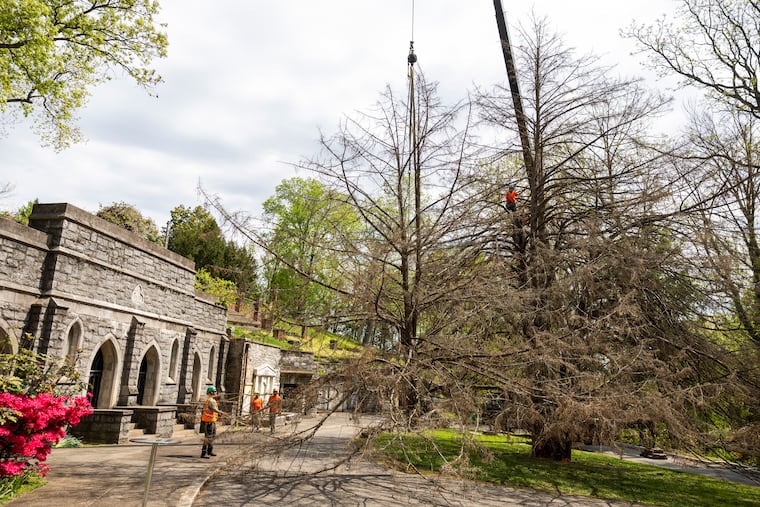
A towering English yew, once the largest tree of its species in Pennsylvania and a provider of shady respite to more than a century of mourners at Laurel Hill West Cemetery, has died.
It was 157 years old. At least.
The tree — known to some as “yew,” known to fewer as “Taxus baccata” — was humanely chopped down Friday, aptly Arbor Day, in Bala Cynwyd after a lengthy battle with an unidentified illness and following drastic resuscitation efforts by arborists, who were on hand for its final moments. Stoic to the end, the yew whispered no last words as its first limb was lobbed off to Queen’s “We Are the Champions.”
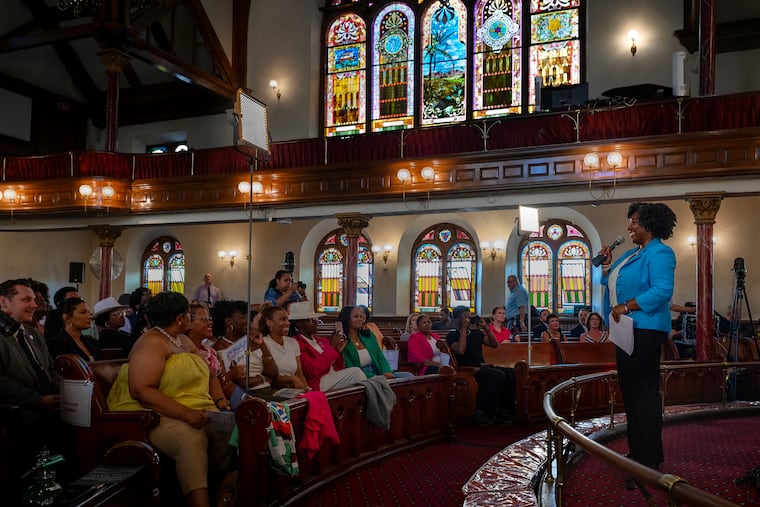
“We do everything we can to prolong the life of trees,” Laurel Hill arboretum director Aaron Greenberg said to a 100-person crowd gathered for a somber, albeit humorous, funeral. “I’ve gotten used to having to make these tough decisions, and I usually don’t get emotional about them.
“This one hurts.”
Commonly planted in cemeteries, the English yew’s evergreen foliage and ability to grow new trunks has come to symbolize eternal life and unavoidable death, according to Laurel Hill president and CEO Nancy Goldenberg. The yew, in some cultures, is seen as a guardian of the underworld, whose roots can reach the dead, ward off evil, and carry wayward souls to the afterlife.
The origin of this yew is unknown. It was likely as old as, if not older than, the cemetery founded in 1869. The tree has stood near the ground’s receiving vaults since, through trials of grief and remembrance, as a memento to the slow, aching, and hallowed passage of time.
The centenarian has seen the country’s Centennial and Bicentennial, its life cut short just before the Semiquincentennial this July. It lived through the rise and fall of industry, the MOVE bombing, Live Aid, two papal visits, and Jason Kelce’s speech at the 2018 Super Bowl parade. It survived massive deforestation, the 1918 flu pandemic, a Legionnaires’ outbreak, and COVID-19. It predates the Philadelphia Zoo — and its oldest residents, Mommy and Abrazzo — and Philadelphia City Hall.
“This tree has seen the world change in ways we can hardly comprehend,” said State Rep. Mary Jo Daley (D., Montgomery).
Lower Merion Township Commissioner Louis Rossman said: “Its life has ended, but its presence remains in the landscape and in our memories. … May its passing remind us to treasure and cherish what is living while it’s still among us.”
» READ MORE: John Bartram founded America’s first botanical garden
Friends eulogized the yew as a protector, who cleared the air of pollutants, stored carbon, and supported an entire ecosystem. But its size was its defining characteristic: “Magnificent, majestic, big,” Goldenberg said. Greenberg called it enormous and incredible.
In 2019, the yew was dubbed a state champion — the biggest English yew in the Commonwealth, measuring 64 feet tall with a 22-foot trunk circumference, according to Greenberg and a cemetery news release. It was roughly five times as big as the average yew, Greenberg said. A new champion has since been crowned in Reading.
The sickness started in its needles; usually a lustrous green, they browned and yellowed. Crews tried changing the soil, adding compost and mulch, and treating for possible pests. While the yew’s condition stabilized for a couple of seasons, it ultimately succumbed to its ailment last year.
The tree is survived by a fledgling dawn redwood, a scion of Longwood Gardens’ state champion, planted Friday in the yew’s honor. It will also live on through a bench carved from its stump and Laurel Hill walking sticks, birdhouses, picture frames, and tables crafted from its wood, Goldenberg said.
It was preceded in death by other iconic Philadelphia-area flora: the photogenic Fairmount Park sugar maple (d. 2021); the historic East Falls “witness tree” (d. 2016); and the notorious “gum tree” on South Street (d. 2008).
“Thank you — yew — for being part of Laurel Hill since the beginning,” Greenberg said.