The world will be coming to Philly this year to celebrate America’s 250th birthday. We’re ready.
Philly is where it happened.
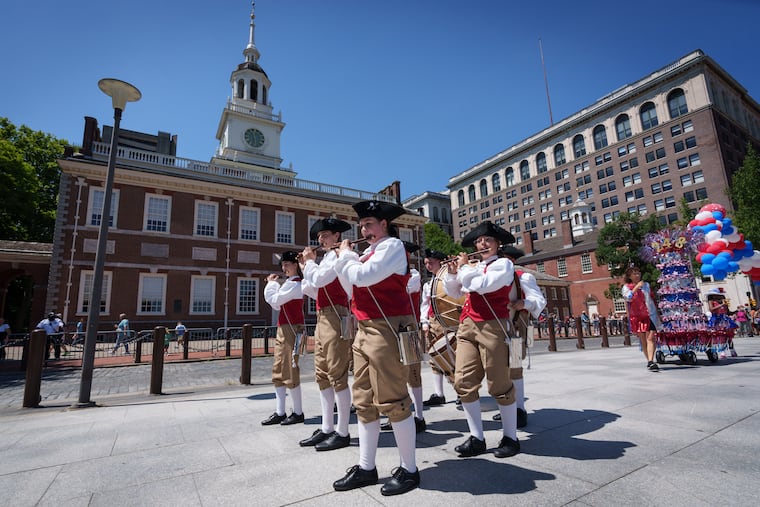
Nowhere will celebrate America’s 250th anniversary like Philadelphia. Because nowhere else can celebrate the national milestone like Philadelphia.
Philly is where it happened.
Only in Philadelphia, on July 4, 1776, did 56 sweat-soaked delegates of the Second Continental Congress stride into sweltering Independence Hall to stake their necks on an idea. In the course of human events, it had become time to declare self-evident truths. All men are created equal and endowed by certain unalienable rights.
Some men, that is.
This unforgivable erasure would have reverberations to this day. Nowhere are the centuries-old wounds of that betrayal more visible than in the unrelenting poverty, violence, and inequality preventing so many Philadelphians from their pursuit of happiness.
But the manifesto was still the most revolutionary freedom document humankind ever produced. A single piece of parchment composed of elegant, unwavering prose that defied and dared an empire, forever reordered the rights of man, and drew the eyes of humanity — and judgments of history — upon our humble burg.
Their work for the day done — and in keeping with the rest of the Founders’ stay in the City of Brotherly Love — the framers presumably dusted off their wigs, loosened up their waistcoats, and repaired to the cooling comfort of the City Tavern for a rager for the ages.
Only in Philadelphia.
‘Philly is beyond ready’
Two-and-half centuries later, the eyes of the world again fall upon our Philly — for yet another rager for the ages.
In Philly fashion, the city’s preparations for the 250th anniversary of the signing of the Declaration of Independence, also known as the Semiquincentennial, stumbled to a rocky start. Poor funding, a lack of leadership, and miscommunication plagued early stages of Philly’s 250th party planning.
But in truer Philly fashion, dozens of passionate Philadelphian civil servants, cultural leaders, artists, volunteers, and philanthropies rallied to ensure the city where it happened met the moment.
Only a year ago, during a 2026 preparedness meetings, worried planners requested $100 million from city and state coffers to fund festivities and programming worthy of democracy’s birthplace. They have received it.
“A year ago, we were having a conversation about, ‘Are we ready?’, ‘Is the money there?’, ‘Can we pull this off?’” said Max Weisman, an aide to Councilmember Isaiah Thomas, a key planner. “Yes, yes, yes.”
Philadelphia is ready, the planners say. Have no doubt.
These Philly-loving patriots say they have organized a once-in-a-lifetime party equal to the city’s unparalleled role in history — and its irrepressibly proud personality.
“Philly is beyond ready,” said Kathryn Ott Lovell, president and CEO of the Philadelphia Visitor Center Corporation and Philadelphia250, the city’s key planning partner for 2026. “Everyone is pulling out the red carpet. Every museum. Every cultural institution. Every neighborhood organization. Everyone is doing something special for the company that’s coming.”
A ‘reintroduction to the world’
Look around. Everywhere signs abound of the already-underway party. In the scores of new museum exhibits grandly exploring every power and contradiction enshrined in the declaration bellowed out of Philadelphia 250 years ago. In the abundance of plans for neighborhood programming and beautifications that bring the party to the people in 2026. In new ventures honoring Philly diversity and pride. In the polish and paint in the works for the Historic District.
Hey, Philly cleans up when it needs to.
It was visible when a parade of ships sailed along the Delaware in October to kick off the 250th anniversary of the Navy, founded in Philly. And it was heard in the crisp salutes and solemn hymns of the Marines who crowded Old City in November to mark their branch’s founding, also in Philly in 1775. It builds in the excitement of clock-ticking preparations for the string of big-ticket events that will grace Philadelphia in 2026.
Six FIFA World Cup matches, with a summer fan festival and volunteer-training campus. The MLB All-Star Game. A pumped-up Fourth of July with to-be-announced special guests. TED Democracy talks featuring citizen speakers from Philly and beyond, exploring democracy’s painful past and uncertain present.
It rings out in the genuine excitement of Philadelphians who work in ceaseless dedication to the principle that Philadelphians know how to throw a party.
Philadelphia is not screwing up a party, is Weisman’s mantra (except he doesn’t say, “screwing.”)
Not just a party. A year-long, city-wide commemoration that delivers Philadelphia into a more prosperous future. Before city planners found their 250th footing, Philly tourism and cultural leaders banded together to seize the opportunity. With more than 500,000 visitors expected for the World Cup alone, they aim to reintroduce Philadelphia to the world.
“Or introduce ourselves for the very first time to people who do not know Philadelphia or have a very narrow view of Philadelphia,” said Angela Val, president and CEO of Visit Philadelphia, the nonprofit that serves as the city’s official leisure-tourism marketing agency. “We don’t take these big events lightly. They are investments. This is really an opportunity to set ourselves up for success in 2026 and beyond.”
Parties of the past
We’ve been here before.
Every 50 years since 1876, the nation’s Centennial year, and America’s first major birthday bash, Philly has dusted off its wig to get down. Each of these events came with larger national wounds.
“Before every one of these fairs, there’s a scar,” said David Brigham, librarian and CEO of the Historical Society of Pennsylvania, referring to Philly’s previous national birthday parties. “There’s always been a conflict and a pain.”
And in these moments, Philly has strove to be a salve, he said. Most of the time, anyway.
In 1876, when America reeled from unhealed wounds of the Civil War, Philadelphia built a small city in Fairmount Park — and hosted 10 million people from 37 countries. The showcase of growing American innovation and economic prowess aimed to heal a ruptured nation. Memorial Hall, its massive art gallery, remains today as the Please Touch Museum.
In 1926, as America emerged from the carnage of World War I, our Sesquicentennial marked the building of the Ben Franklin Bridge, the transformation of what is now FDR Park, and the construction of a temporary, gleaming, utopian metropolis in South Philly.
The Bicentennial in 1976 led to the creation of the Mann Center and the African American Museum in Philadelphia, even if the party itself was marred by Mayor Frank Rizzo’s heavy-handed security — he summoned 15,000 National Guard members.
We’ve been here before. And we aren’t perfect.
As ready as Philadelphia stands, next year’s commemoration will not include the big legacy projects of past celebrations, the bridges, stadium, and new museums.
But maybe that’s not what this moment is about, anyway.
An unfinished journey
Just as past planners grappled with the questions of their American moment, Philadelphia organizers wrestle with ours.
“It’s a commemoration of why our republic was created,” Lovell said. “But also about a recommitment to the ideals that were established. We were founded on these basic principles and values that the Founding Fathers fought over. And we’re still fighting over it.”
It’s that same theme — the grand fragility of our American experiment — that pulses though the Museum of the American Revolution’s landmark exhibit, “The Declaration’s Journey.”
A breath-taking assemblage of rare artifacts, including Thomas Jefferson’s writing chair and Martin Luther King’s prison bench, the museum’s most ambitious show ever explores the 250-year global impact of the declaration. How words proclaimed out from Philadelphia inspired revolutions and freedom movements throughout the centuries
“The American Revolution is not synonymous with the Revolutionary War,” said R. Scott Stephenson, president of the museum. “It is a centuries-long, ongoing experiment in liberty, equality, and self-government.”
And that journey’s not yet over.
The birth of democracy in Philadelphia, and the worldwide struggle to sustain it, represents the most significant event since the birth of Christ, said filmmaker Ken Burns. (And here we though it was Super Bowl LII.)
The American war may be over, but the revolution is not, said Burns, whose 12-hour docuseries, “The American Revolution,” is streaming on PBS.
All we were promised was the pursuit, he said. And the chance to forever make the imperfect a little less so.
The republic the Founders forged in the Philly heat stands the most divided and tested it has been in decades, with core disagreements about its very foundations.
It is only right, then, that Philadelphians march onto the global stage. Who else but us?
In every way, being America’s birthplace shapes Philadelphia. Where else is its hallowed iconography such a daily staple? Where else does its symbolism so powerfully frame every civic successes — and failure? Every sports triumph and cultural happening. Every step forward; every stumble backward.
Where else does the promise and contradictions of a proclamation that turned the world upside down so intrinsically coarse through the lifeblood of a place?
Where is it all so still alive?
Where else but where it all happened.
Only in Philadelphia.

- The world will be coming to Philly this year to celebrate America’s 250th birthday. We’re ready.
- How to have a Perfect Philly Day, according to 92.5 XTU’s Nicole Michalik
- Here are the 21 best things we ate in 2025
- Citywide Quest: Do you know where in Philly these New Year-themed photos were taken?
- Charm City eats, museums, and waterfront stays in Baltimore | Field Trip
- After walking away during an inspection, she rebounded with a two-bedroom in Newbold| How I Bought This
- My New Year’s resolution is to not let Philly team losses ruin my day. Any advice?
- A Mummers wedding on Market Street | Weekly report card
- Capturing the ghosts of 2025 and the future memories of 2026