A Marine from West Philadelphia was declared missing in action in Vietnam. Nearly 60 years later, his family still seeks answers.
Nearly 1,600 Americans are unaccounted for in Vietnam, according to the Defense POW/MIA Accounting Agency, which works to identify and recover remains of those missing from America’s wars.
She was a little girl, recalled Ca-Tisha Ashlock-Adams, when men from the government would call at her grandmother’s house in West Philadelphia, bringing news on the search for her son, Marines Cpl. Carlos Ashlock, who was declared missing in action after a 1967 firefight in Vietnam.
The visits went on for years. And Ashlock-Adams saw how after each one, her grandmother’s mood would shift, the sadness enveloping her.
“My grandmother was just heartbroken,” said Ashlock-Adams, 48, who is Cpl. Ashlock’s niece.
Ashlock was still missing when the war ended in 1975, and missing a year later when the government declared he and many other MIAs to be presumed dead.
Government reports offer no definitive answer, but suggest that Ashlock, 21, was killed in the firefight. His body may have been carried away by North Vietnamese soldiers, often accused of keeping American remains for use as leverage.
One thing that’s certain, nearly 60 years later: Ashlock has not been forgotten. His family has continued to search for answers, and the U.S. government maintains his case as active.
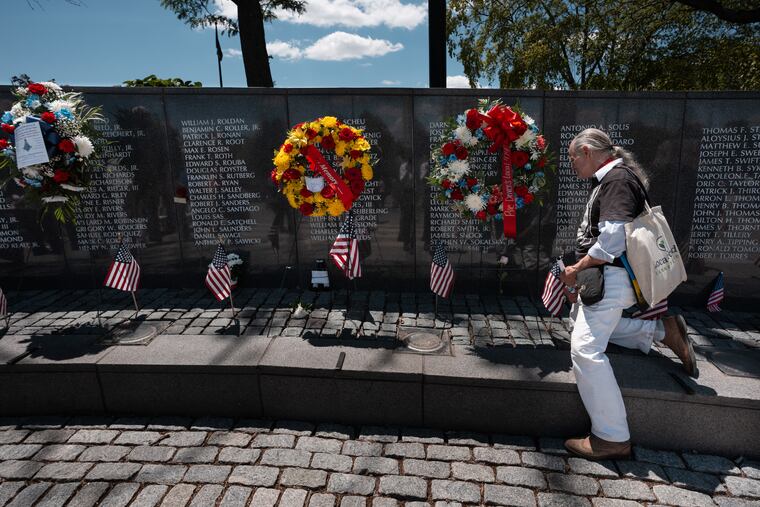
On Monday, Ashlock’s service and sacrifice were honored during Memorial Day ceremonies at the Philadelphia Vietnam Veterans Memorial at Penn’s Landing. More than 200 people gathered under a striking blue sky, where the Republic of Vietnam Air Force Association helped present the colors and Philadelphia Police Officer Matthew Lint played a mournful “Taps.”
The veterans are old now, their hair gray and thinning, and some leaned on canes for support as they walked the grounds of the memorial. Some came wearing old Vietnam-era uniforms, others in new T-shirts and hats that proclaimed their service.
The war claimed 58,200 American service members, including 648 from Philadelphia whose names are inscribed on the black granite walls of the memorial, Carlos Ashlock among them.
“We do not forget,” said Ashlock’s brother, Major Ashlock, who turns 72 this month. “I’m still hoping and praying … I’m hoping he’s maybe still over there somewhere. They haven’t found any kind of remains.”
Nearly 1,600 Americans are unaccounted for in Vietnam, according to the Defense POW/MIA Accounting Agency, which works to identify and recover remains of those missing from America‘s wars. Hundreds of those missing in Vietnam are believed to be “non-recoverable,” that is, after investigation the DPAA determined that the person died but does not believe it is possible to recover the remains.
Investigators rotate into Vietnam on a regular basis to pursue leads.
Ashlock’s case has been classified under “active pursuit,” a category that means there is sufficient information to justify research, investigation, or recovery operations in the field. Those cases are the priority for planning and allocation of resources.
The DPAA says Ashlock was one of two Marines who suffered deadly wounds in the May 12, 1967, firefight near Que Son village. Intense Viet Cong fire forced fellow soldiers to leave their bodies in the rice fields where they had fallen. A search of the battlefield found nothing the next morning.
Major Ashlock remembers falling asleep as a boy to the sounds of Carlos’ rhythm-and-blues records. Carlos took him to see his first movie at the Boyd Theater on Market Street, How the West Was Won.
Carlos, his brother said, was modest and soft-spoken.
At Edward W. Bok Technical High School in South Philadelphia, Carlos Ashlock concentrated on graphic and commercial arts, becoming an outstanding sketch artist. His work won an award that was displayed at the John Wanamaker department store, his brother said.
He also competed in track and field and sped across practice hurdles he set up near 20th and Cambridge Streets.
A Bok teacher described Ashlock as “a quiet gentleman.”
He graduated in spring 1964 and joined the Marines in October, surprising his family, which had no military tradition.
He was sent to Vietnam in June 1966 and wounded that December, suffering fragmentation injuries in his neck and his left arm, hand, and hip during combat in the vicinity of Quang Tin Province, records show.
He wrote to his family. “He said he was healing from the wounds and going back out,” Major Ashlock recalled.
On the day of May 12, 1967, Ashlock was the squad leader of a rocket unit engaged in close combat with Viet Cong guerillas. Growing casualties, intense automatic-weapons fire, mortar shelling, and approaching darkness caused the Americans to withdraw.
When the troops reached a secure area, Ashlock wasn’t with them. He was reported as missing, according to a 1976 casualty report that concluded that he had been killed in the fighting. The Marine Corps subsequently promoted Ashlock to the rank of staff sergeant.
“He was a good person, he really was, really down to earth,” Ashlock’s brother said.
Also true, said Ashlock-Adams, the Marine’s niece, is that a sense of loss ricocheted through the family, for decades and today, the loss and absence of one person deeply impacting the lives of others.
Her grandmother, Ethel Mae Turner, died without knowing the ultimate fate of her son, Ashlock-Adams said. Her grandmother lies in Mount Lawn Cemetery in Sharon Hill, resting beside the empty plot where her son’s remains would have been interred.
“My grandmother passed never having any closure, just knowing where her son was,” Ashlock-Adams said. “Such a great loss.”