Philly’s public toilets are important in lots of ways. We need more of them.
Philadelphia is a better place for everyone when facilities are available to all.
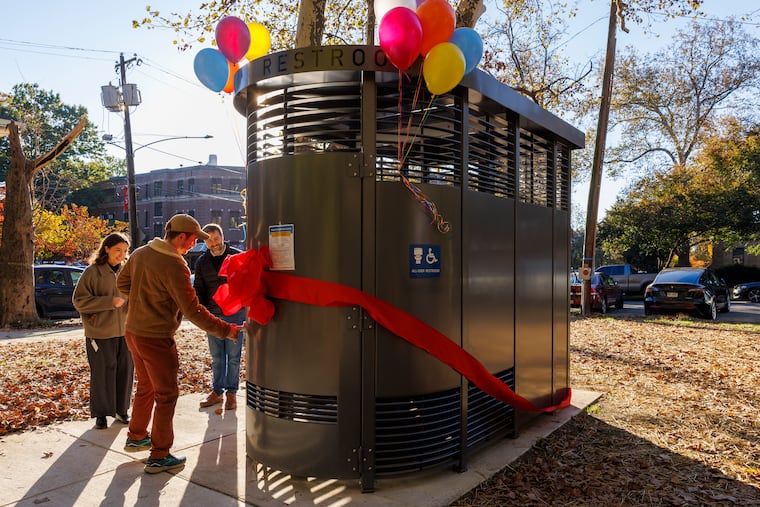
I am a toilet scholar, and I live in West Philly. No surprise, then, that my interest was piqued when I read about, Philly Phlush, the city’s cheekily named new public bathroom program. Starting in 2023, the city promised to build six stand-alone, single-user “Portland Loos.” I was even more interested the next year when I heard that one of these new public toilets would be opened near my house in Clark Park.
By that time, I had been looking into the history of public bathrooms in the United States for more than five years, digging through archives and pouring over digital records, including countless Philadelphia Inquirer articles from over the past century.
» READ MORE: Temple professor on America's troubled history with toilets
My research revealed that public bathrooms in Philly (and everywhere else) mattered because they were a prerequisite for making the city accessible. That meant where city leaders placed these facilities was critical and reflected which residents and communities they cared about the most.
» READ MORE: Is Philly's public toilet program a royal flush?
But also, I knew that the state of public bathrooms is a kind of real-time test of how far governments are willing to go, or not go, in the service of the most basic needs of their citizens. Really, public bathrooms uncover who is included and excluded at a given moment. These same dynamics made clear why that Portland Loo in my neighborhood said something about what Philly is currently doing right, and what other cities can learn from it.
The story of public bathrooms, toilets built and maintained by local governments and generally open to all, started 150 years ago as the United States was set to celebrate another milestone, its 100th birthday. Like other cities, Philadelphia was getting bigger and denser as the 19th century ended. Bricklayers heading to a ball game or a job, the faithful in search of a charismatic preacher, and nickelodeon patrons went further from home each day for work, worship and fun. As they did, they needed bathrooms. But many quickly realized that the existing network of privately-operated toilets in restaurants, department stores, hotels and saloons were not extensive enough, or clean enough, to support the growth of the city. Temperance groups, ethnic clubs, women’s organizations and business associations in Philadelphia, as in other cities, pressed for municipal leaders to filled in the gaps with new, publicly-financed “comfort stations,” as the first public bathrooms were called.
Cities responded, and not begrudgingly. Local officials held ribbon-cutting ceremonies and bragged to reporters about the marble countertops and hand-crafted mahogany doors in the new facilities.
Few of these comfort stations reached into working-class, immigrant or Black neighborhoods. The sparkling new facilities were meant for salesmen, bankers and bakers, train travelers and female shoppers. These people comprised “the public” that turn-of-the-century city officials had in mind when they allocated funds for well-appointed, away-from-home toilets.
But they weren’t the only people who showed up at the stall doors and urinals of newly-built public bathrooms. As early as 1905, police officers and civil servants complained that the costly new comfort stations attracted an unanticipated crowd of drinkers, smokers, slackers, vagrants and sex-seekers. They pushed for more surveillance and more arrests, and they learned, without openly admitting it, what officials would learn again at the end of the 20th century: it is difficult to arrest your way out of a problem. In the face of failure, municipal leaders shifted gears; they pulled back funding and cut back on maintenance for public bathrooms, making these places unacceptable to the middle-classes.
Eventually, they took a final, drastic step to keep the unwanted away. City officials across the country closed public bathrooms to stop men and LGBTQ people from having sex in the relative privacy of stalls and out-of-the-way facilities. They closed them to prevent angry teens and drunken adults from also taking advantage of the privacy of these places and smashing sinks and pulling down towel dispensers. By the 1980s, as Reagan-era budget cuts ripped holes into the social safety net and drained the coffers for public housing, cities closed even more public bathrooms to try to “disappear” the unhoused, and bathroom-less, from downtown streets and up-and-coming financial districts.
But in the drive to edit the public, municipal leaders made the city inaccessible for workers, students, families and shoppers, as well as those deemed undesirable.
With no public bathrooms near Independence Mall or Rittenhouse Square, the private sector that had failed decades before once again took over. But only to the advantage of some. Those who could paid for bathrooms, first with coins slipped into lock boxes drilled onto toilet stall doors, and later with credit cards for lattes and iced coffees for a “free” trip to the bathroom. Those who couldn’t afford the “latte tax” or lived in an area without a Starbucks or a Bass Pro Shop had only the street, bushes and the spaces between cars “to go.”
Toward the end of the 20th century, American cities experienced something that they hadn’t dealt with since before the American Revolution: open defecation and public urination, all day long and not just when the bars emptied in the early morning hours. This forced the hand of policymakers. They once again had to fund public bathrooms or face capital and population flight. But they didn’t put funds into public toilets to make the city more open or accessible; they did it, largely, to contain the unhoused and their bodies and to clean up central business districts and keep commerce flowing.
That’s what Los Angeles did. That’s what Albuquerque, N.M., and Cambridge, Mass., did. They built new public bathrooms—not the ornate facilities of the past, but functional ones, like Portland Loos with steel toilets, or hard plastic porta potties. These new toilets, unlike their early 20th century predecessors, weren’t meant for middle-class tourists visiting the Constitution Center, suburban lawyers in town for a trial, or even for Walnut Street shoppers. They weren’t there to solve the housing crisis or to deal with the problems of addiction or cuts in spending on mental health—some of the key factors leading to jumps in homelessness. They were there to contain the failures of the system and the bodies of the poor and unhoused, and to make the city look and smell better for everyone else.
Philly joined in this trend but with a twist.
The first Philly Phlush toilet opened in Fotterall Square, a revitalized park with basketball courts, walking trails and movie nights on 11th Street in North Philadelphia. The second was located at 15th and Arch Streets in Center City across from Love Park, not far from bustling Suburban Station. The third was the one in my neighborhood, just north of the corner of 43rd Street and Woodland Avenue.
By placing public toilets in North and West Philly, Philadelphia did something markedly different from most other cities. It sited its bathrooms not just so they could control people considered problematic, but to meet the needs of city residents in their neighborhoods. These toilets outside of Center City promised to make parks and squares available to parents and kids; they made it easier to stroll through a farmer’s market, watch a film on a summer’s night and play basketball all day long without the risk of discomfort, embarrassment or even arrest.
Philly, and every other city, should fund and maintain public bathrooms. The more the better. They should put them where people are and where they live. They should maintain them, because infrastructure needs ongoing care, and everyone needs clean spaces to attend to their bodies away from home.
Public bathrooms can’t solve every problem created by decades of government neglect, and they shouldn’t be expected to. But they can address the health and safety of city residents right now. Even more, away-from-home toilets, situated both in business districts and neighborhoods, are fundamental building blocks to a city open and equal to all, to a Philadelphia that shows through investment and maintenance that it cares about the people who visit and live here.
Bryant Simon is the academic chair of the Honors Program and a history professor at Temple University. He is the author of the forthcoming book, For Customers Only: Public Bathrooms and the Making of American Inequality.
Made by History takes readers beyond the headlines with articles written and edited by professional historians. Opinions expressed do not necessarily reflect the views of The Inquirer.