Philly is not dumping snow in the Schuylkill, but it has in the past
Newspaper archives show references to dumping snow in the Delaware and Schuylkill dating back at least to the late 19th century. But the practice is not used now amid environmental concerns.
Many Philadelphians are continuing to deal with snow-clogged, slushy, ice-laden streets nearly two weeks after a winter storm produced the city’s biggest snowfall in a decade.
To deal with the snow, the city has deployed roughly 1,000 workers and 800 pieces of snow-removal equipment, and instituted programs to break up ice at crosswalks and streets in residential neighborhoods, among other efforts. But to some Inquirer readers, the solution has been right in front of us all along.
“I know we used to toss snow into the river,” one reader wrote via Curious Philly, The Inquirer’s forum for questions on all things local. “What happens to it now?”
» ASK US: Have something you’re wondering about the Philly region? Submit your Curious Philly question here.
In the past, the city has dumped snow into the Delaware River and the Schuylkill on various occasions. But in recent decades, that practice has been used rarely — if at all — primarily over environmental concerns. Here is what we know:
An old practice
Newspaper archives show references to dumping snow in the Delaware and Schuylkill dating back at least to the late 19th century — during a storm colloquially known as the “Great Arctic Outbreak of 1899.” That storm dumped 19 inches of snow on Philadelphia around Valentine’s Day.
In the aftermath, the city sought permission from its Board of Port Wardens to dump snow in the rivers surrounding Philadelphia, but there were concerns over the “considerable amount of dirt” that would be thrown into the water.
The practice was utilized in the winter of 1909, when 21 inches of snow fell. Initially, snow was dumped into the rivers at three points, but officials later expanded approved dumping sites to be “at any point and from any wharf” along either river.
“It was contended that this was perfectly proper, since snow is not refuse, but will readily melt after it is thrown into the water,” The Inquirer reported at the time.
https://www.newspapers.com/article/philadelphia-daily-news/190719291/
Article from Jan 10, 1996 Philadelphia Daily News (Philadelphia, Pennsylvania)
The blizzard of ’96
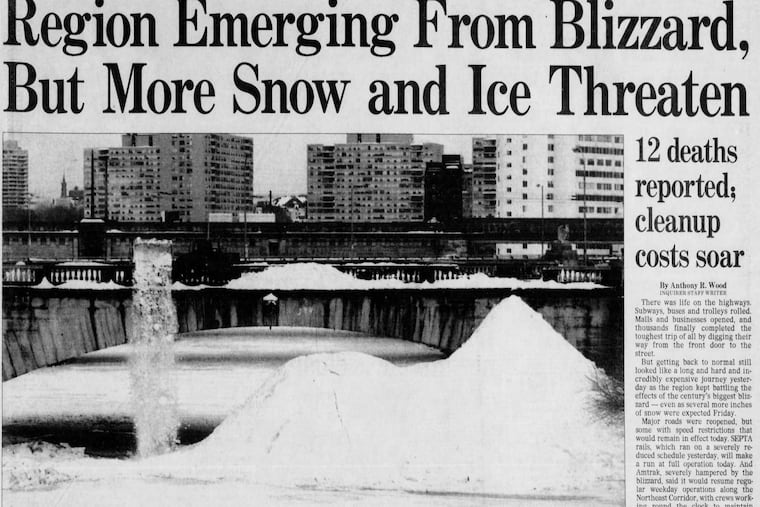
Perhaps the most well-known modern use of Philadelphia’s rivers as a snow dump came in 1996, when a debilitating 30.7 inches of snow fell in early January. The city was left with few options, and got a permit from state environmental officials to dump snow in the rivers, Inquirer reports from the time indicate.
Within days, roughly 500 tons of snow were dumped into the rivers, and that total would grow into the thousands. Famously, city trucks were spotted dumping snow into the Schuylkill from the Market Street Bridge — until being asked to stop by the U.S. Coast Guard.
“We did advise the city to stop dumping snow into the Schuylkill. Our concern was the accumulation of ice in the river,” a Coast Guard spokesperson said at the time. The piles of snow in the river ran the risk of forming dams that could cause flooding.
The piles became so severe they had to be beaten back down. By mid-January, one Inquirer report noted, wrecking balls were sent in to break up at least one mountain of snow that threatened to clog the Schuylkill.
https://www.newspapers.com/article/the-philadelphia-inquirer/190719516/
Article from Feb 22, 2003 The Philadelphia Inquirer (Philadelphia, Pennsylvania)
An ‘option of last resort’
The city again in 2003 dumped snow into Philadelphia’s rivers, this time in an attempt to mitigate the impacts from a February storm that left about 19 inches of the white stuff. This time, though, city officials seemed to at least feel bad about it, calling it an “option of last resort.”
For this storm, roughly 400,000 pounds of snow was dumped into the Schuylkill. But along with it went road salt, antifreeze, trash, and other pollutants, prompting concerns from regional environmental groups. That pollution, they said, could harm marine life and devastate the riverbanks.
“All the stuff that’s on the road surface goes into the water,” Delaware Riverkeeper Network head Maya van Rossum told The Inquirer that year. “This is not the appropriate way to deal with the snow. There are plenty of places on the land to put it.”
The dumping, Streets Commissioner Clarena Tolson said, was limited. And the Pennsylvania Department of Environmental Protection said it asked the city to only dump “virgin snow” into the rivers.
https://www.newspapers.com/article/the-philadelphia-inquirer/190719722/
Article from Feb 12, 2010 The Philadelphia Inquirer (Philadelphia, Pennsylvania)
No more dumping, officially
By 2010, the city appeared to have officially abandoned the practice of dumping snow into city riverways. That February, one storm caused more than 28 inches of snow to fall, but Mayor Michael A. Nutter’s administration declined to pour it into the rivers.
“We’re going to take some of that down to the Navy Yard. We will not dump in the river,” Tolson said. “There are environmental concerns with placing snow in the river. The snow accumulates pollutants and salt, and dumping it in the river would be a very extreme measure.”
The Center for Environmental Policy at the Academy of Natural Sciences applauded the Nutter administration’s decision, writing in a letter to The Inquirer that the move would “prevent serious environmental damages to the river.”
“Urban precipitation, including snow, acquires a witch’s brew of contaminants such as oil, grease, litter, road salt, and lawn fertilizer,” director Roland Wall wrote. “We salute the city for making a commonsense decision that will protect one of Philadelphia’s natural treasures.”
So what do we do now?
On Wednesday, Carlton Williams, the city’s director of clean and green initiatives, said the city does not dump snow in Philadelphia’s rivers, as that practice is “not an EPA standard.” Instead, the city has gravitated toward removing the snow from city streets and placing it at 37 snow dump sites around Philadelphia.
The city did not respond to a request for comment regarding those dump sites’ locations. Some of them contain mounds of snow up to 12 feet high that stretch for blocks, Williams said Wednesday. Officials also brought in a snow-melting machine from Chicago.
Pennsylvania Department of Environmental Protection guidelines, meanwhile, recommend municipalities push snow at least 100 feet away from surface waters, where it will be able to melt with less environmental impact.
“Dumping of snow directly into a stream carries with it the shock of loading de-icing chemicals and anti-skid agents,” the agency said in a recent recommendations document. “Allowing a natural melt provides a slow release of the water, dilutes the chemicals, and provides filtration of the solids through the soil.”