Street festival organizers say the rising costs of Philadelphia police patrols are crushing them
Street festival organizers are considering shrinking or canceling events, as security consumes a higher portion of the event budget.
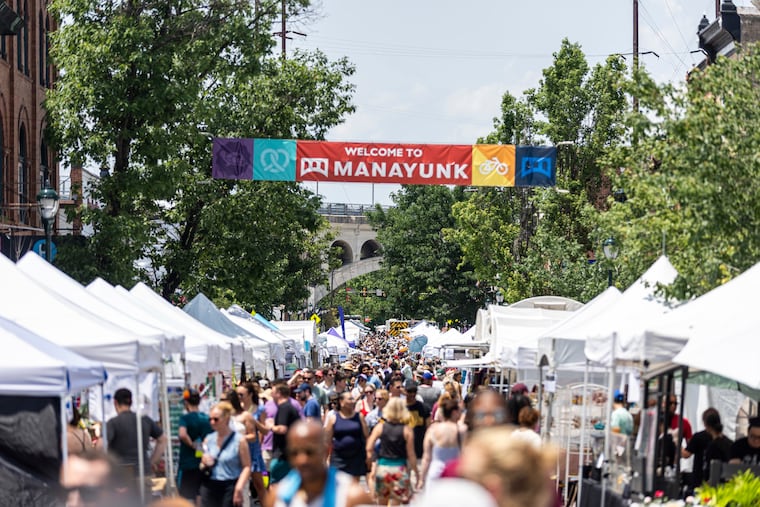
In 2019, the Manayunk Development Corp. paid just over $18,800 for the police patrols, sanitation services, and health and safety inspections required to throw the neighborhood’s beloved Manayunk Arts Festival.
In 2023, the same amount barely covered the cost of the Philadelphia Police Department alone.
The two-day event is one of the largest outdoor arts festivals in the area, drawing an average of 40,000 people to a four-block stretch of Main Street every June since 1990 to peruse offerings from upward of 250 artists. At first, said executive director Gwen McCauley, the festival was so profitable it could help bankroll other community events. Now, she said, it’s barely breaking even amid increasing bills.
“We’re limping along,” McCauley said.
The cost of police patrols for special events has skyrocketed since the COVID-19 pandemic, throwing the future of several long-running street festivals into flux as organizers say they can’t keep up. And while police say the increases are a natural consequence of perpetual staffing shortages, community groups say ideas for cutting costs — like hiring private security — haven’t gotten off the ground.
The result has unveiled a divide between Philadelphia’s embrace of pedestrianized streets and the reality of what it takes to temporarily close them in the name of a little fun.
This summer, the Northern Liberties Arts and Commerce Alliance canceled its July night market after receiving a $24,600 bill from the City of Philadelphia for the costs associated with closing three city blocks for a lineup of food trucks and craft vendors.
Organizing a street fair is more elaborate than hosting a block party with your neighbors. A permit for the latter costs $25 to $150, while a street fair involves coordinating with different city departments through the Philadelphia Office of Special Events to cover security, emergency services, sanitation, and health inspections, a process that can cost thousands of dollars on top of staffing and marketing.
Police patrols can account for up to 44% of a street festival’s budget, Temple University researchers found in a May report commissioned by the Philadelphia BID Alliance and obtained by The Inquirer. There’s also little uniformity among how police resources are used at special events, the report said.
“There is not a single formula that determines what it’s going to cost,” said Jeffrey Doshna, the Temple urban planning professor who supervised the team behind the report. “Certain neighborhoods are going to end up paying more for the same amount of police coverage … it’s something that has to get fixed.”
Philadelphia Police Department spokesperson Eric Gripp said district captains deploy police to street festivals based on the event’s size and historical precedent. Sometimes, however, the managing director’s office will decide if an event requires police presence or can use private security, Gripp said.
The managing director’s office denied involvement with the process.
“The Philadelphia Police Department … holds the final authority in determining event security requirements,” said Natalie Faragalli, a spokesperson for the Philadelphia Office of Special Events. “The office of special events does not decide the deployment of police.”
Skyrocketing costs
For a Sunday in April, 12,000 to 16,000 attendees flood five blocks of East Passyunk Avenue for Flavors on the Avenue, an annual food festival the East Passyunk Avenue Business Improvement District throws to show off neighborhood restaurants.
The festival’s scope has remained the same, said East Passyunk Avenue BID executive director Katie Hanford, but police patrols have taken a larger and larger chunk of the event’s $40,000 budget each year.
Invoices reviewed by The Inquirer show the cost of policing more than doubled from just under $4,200 in 2022 to over $9,200 in 2025.
» READ MORE: Ready to throw a block party in Philadelphia? Apply for a permit first.
Changes like that can feel drastic, Hanford explained, since the East Passyunk Avenue BID has the second-smallest annual budget out of Philadelphia’s 16 business improvement districts. They also have her worried about the future.
“If costs go up in a large way — not even just security costs — we’d have to either scale back or maybe even not even have the festival anymore," Hanford said.
Philadelphia is known for its block parties, at one point hosting more than New York, Washington, Los Angeles, or Chicago before the city started clamping down on the festivities over public safety concerns. Those same concerns are bogging down street festivals, which draw locals to businesses that would otherwise struggle during the summer Shore slump.
These events “are really incredible for bringing the community together. They introduce you to your neighbors, to your small businesses,” Hanford said.
Street festivals have helped transform Manayunk, said McCauley, from a row of abandoned textile mills to a vibrant postgrad community.
The business improvement district’s mission, she said, is to promote the area. “That’s our job. And without these events, we survive, but it looks different. It gets harder.”
The cost of all the city services — including policing — required to host the Manayunk Arts Festival have nearly doubled since 2019, jumping from about $18,800 to nearly $40,000, according to invoices reviewed by The Inquirer.
McCauley said she has exhausted several pathways to reprieve: badgering City Council, using private security, haggling for a better rate. None of them, she said, have worked.
Paying for labor, gas, and lunch
“There is nothing online that specifically states there is a requirement” for event organizers to use the Philadelphia Police Department as their sole security provider, said Gripp, nor is there a hard-and-fast rule for the number of officers deployed.
The city and police do “not determine whether or not an event organizer may engage private security,” said Faragalli, the special events office spokesperson, since private security perform tasks that police officers are not assigned to do, such as security screenings.
Using private security alongside police can be a way to cut costs, said McCauley, but it’s something she has never been able to take advantage of for the Manayunk Arts Festival. McCauley has asked the special events office if the development corporation could use private security in exchange for fewer officers and a smaller bill. The response, she said, was that the arts festival should shrink.
“They asked me I want to change my footprint of the event,” McCauley said. “Or if I could reduce the hours, or make it a one-day art show.”
Once the police department decides an event will require officers, the applicable district captain decides how many to send. The decision is made based on size and if there is a history of crime surrounding the festival, which can create variability, according to Gripp.
After patrolling a festival, police will bill for the labor costs — the officers are working voluntary overtime — as well “equipment and fuel costs‚" said the police spokesperson. In two invoices provided to The Inquirer, police also billed for the cost of an officer’s lunch.
The process is also complicated by the reality of mass terror attacks changing the nature of patrolling a street festival, said the police spokesperson, as well as consistent understaffing. The vacancy rate for the police force “is hovering around 20%” Gripp said, with about 1,300 vacancies.
» READ MORE: The Philadelphia Police Department is still short 1,200 cops. Leaders say it will take ‘years of momentum’ to fix.
Private security is also not the silver bullet event organizers think it is, police say. “By allowing a security force to take over an event, we are essentially allowing that entity to conduct actions that could affect the public,” Gripp said. They also “have no powers of arrest and will rely on a police response if the event … becomes unmanageable.”
Organizers said their complaints are not about shirking responsibility for public safety, but rather the cost of police eventually cannibalizing community events.
“I’m not saying they should just throw safety to the wind and let us do whatever what we want,” McCauley said. “But at the same time, police and the city should be helping us find a solution.”