An IBM Selectric, a mother’s legacy, and a prop plane: Philly Typewriter takes on its latest adventure
Philly Typewriter’s latest adventure seems unfurled from the platen of Ian Fleming’s Royal: A protagonist embarks on an airborne journey to deliver a family artifact to a few skilled craftsmen.
Staff were stunned when Bill Rhoda strolled into the Northeast Philadelphia Airport one bitterly cold Saturday in December looking for an unusual jet-setter.
“‘Did he say a typewriter?’” Rhoda, co-owner of Philly Typewriter in South Philadelphia, recalled airport personnel musing. “‘Why are you here for a typewriter?’”
Escorted by security, Rhoda drove out onto the tarmac for the handoff. From a prop plane emerged the pilot, Barry Partlo, and one of his passengers: an IBM Selectric III in need of repair.
Philly Typewriter’s latest adventure seems unfurled from the platen of Ian Fleming’s Royal: A driven protagonist embarks on a nearly 600-mile airborne journey to deliver a family artifact to the few craftsmen skilled to restore it.
“It is absurd already — typewriters — and now we’re in an airport,” Rhoda recently told The Inquirer.
A driven protagonist
Partlo, 66, of Clayton, N.C., kept the IBM Selectric in his office. He inherited it from his late mother, who was a secretary trained in the bygone ways of touch typing and shorthand.
Nowadays, Partlo’s once-popular mid-1980s model is used sparingly. But months ago, he pulled it out only to discover it wasn’t working. Partio, a family historian with a passion for antiquities and a bent for nostalgia, took to the internet, hunting for a restorationist. He netted two results: Philly Typewriter and a business in Arizona.
“Believe it or not, there’s no one that fixes them anymore,” he said. “There’s not many people that use them anymore.”
Rhoda was the first to respond to Partlo’s inquiries.
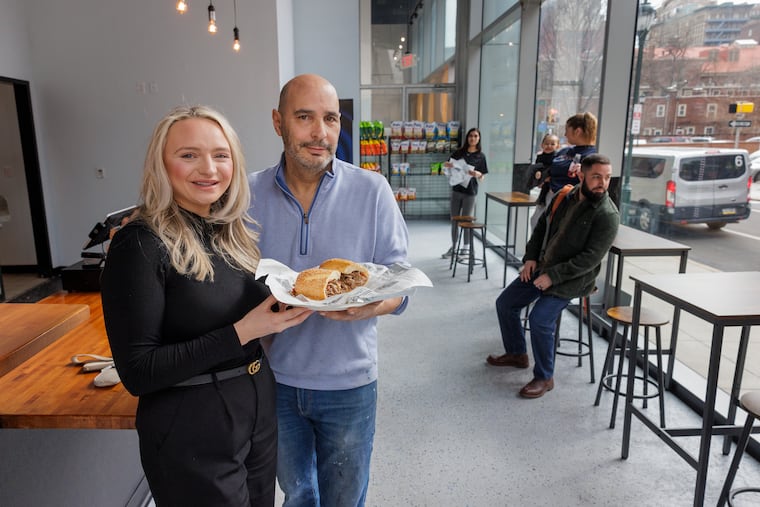
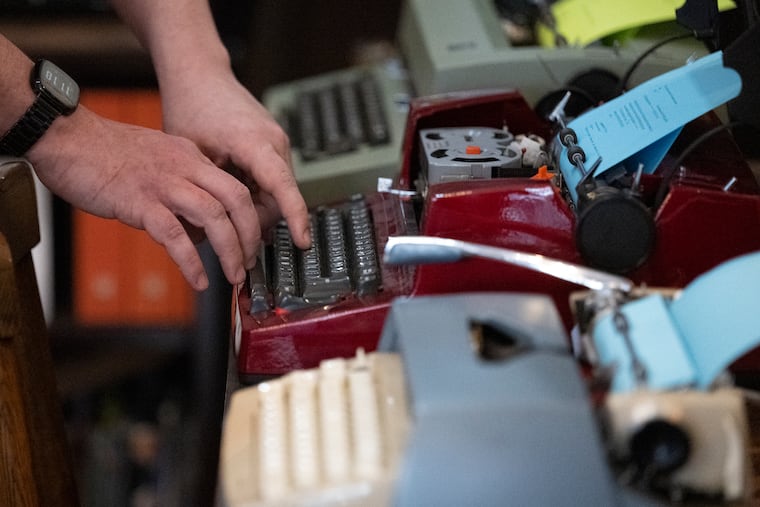
Philly Typewriter is a premier dealer and servicer of its namesake, housing more than 1,000 machines — from portable models used to send messages from battlefields to 20th-century office workhorses — and at any given time, as many as 60 typewriters — some caked in rust, others soiled by spilled soda — are undergoing repairs.
» READ MORE: Tom Hanks gifted this Philadelphia shop a typewriter from his personal collection
A formidable antagonist
Partlo — who lives a seven-hour drive away from the company’s East Passyunk Avenue storefront — initially suggested he would mail the Selectric to Rhoda. But Philly Typewriter does not accept or send typewriter shipments, fearing damage in transit.
“We might be the largest typewriter company, but we are still a small business,” Rhoda said.
Rhoda has accommodated long-distance clients before, from Fairbanks, Alaska, to Honolulu, Hawaii. He immediately started buzzing: “How can I help this guy?” he remembers thinking. “Is there anybody down there I know?”
Then Partlo suggested, “Well, what’s your closest regional airport?”
Partlo has been piloting planes for three decades, and flying half a day — less than two hours each way — to have his mother’s typewriter and a Corona foldable machine dating to the 1910s rehabbed seemed like a “valuable use” of time. He charted his course, filed a flight path, fueled up his A36 Bonanza plane, and waited for a weekend when the Philadelphia winter was tolerable for his Southern disposition.
“It was like an operation,” Rhoda quipped.
Resolution
What followed involved about 25 hours of labor and a complete rebuild of Partlo’s machine.
At one time, the Selectric was the most successful typewriter in history, a ubiquitous desktop feature, with more than 13 million units sold, according to IBM. What set it apart was its “golf ball” mechanism of characters — which prevented jams, enabled faster typing, and supported nonalphabetic languages, like Hebrew or Braille — and its “correcting” key, which literally lifted mistakes off the page.
But these features also make it “one of the most extensive, complicated typewriters that was ever built,” with roughly 2,800 parts and 400 adjustments, according to Rhoda.
“We can’t do a little of anything — we actually have to gut the machine,” he said.
Philly Typewriter’s clientele is a mix of sentimentalists, like Partlo, and practicalists, like writers wanting to break up with their screens. Beloved actor and known typewriter enthusiast Tom Hanks has gushed over the shop and even donated a machine from his collection. Rhoda said that especially around the holidays, there was an uptick in sales to kids and young people.
“We wake up in the morning, we look at the small screen,” Rhoda said, “go to work, we look at a bigger screen. We go home, and we try to look at a big screen, while looking at a little screen at the same time. Then we go to bed looking at a little screen.
“People just don’t want it anymore — we’re looking for something.”
Digital appetites are shifting with the rise of artificial intelligence, general screen fatigue, and a resurgence of nostalgic, analog, “grandma” hobbies. Last year, physical book sales were up slightly and vinyl record sales rose for the 19th consecutive year.
“It may not mean anything to anyone in the future, but one day a grandchild might go, ‘Oh, well, that’s cool,’” Partlo said.
As of early March, Partlo’s typewriters were all fixed up.
Rhoda is just waiting on his return flight.