Lawsuit accuses FanDuel, DraftKings, and the NFL of profiting from ‘unreasonably dangerous’ microbetting
The Public Health Advocacy Institute alleges that sports betting companies use push notifications, VIP perks, and targeted promotions to ensure that gamblers continue to place microbets.
When he was a younger man, fresh out of college, Terry Thompson placed occasional bets on NFL and college football games with a neighborhood bookie.
Those pregame wagers on point spreads remained a manageable hobby for nearly two decades. Then, in October 2020, Thompson created an account with FanDuel Sportsbook, and used its app to bet on his favorite team, the Philadelphia Eagles.
Thompson, of Montgomery County, soon grew addicted to a more modern form of gambling: placing countless microbets during live NFL games through FanDuel and one of its peers, DraftKings. In the five years that followed, Thompson wagered more than $22 million between the two companies, and they rewarded him with VIP perks, including Champagne and tickets to Eagles games, court records show.
He also lost more than $1.8 million, and his life crumbled. Thompson sold his finance company, took out additional mortgages on his home, and finally, in February, gambled away his last dollar. Rather than reveal the scope of his losses to his family, Thompson planned to kill himself, according to a lawsuit that the Public Health Advocacy Institute filed March 24 on his behalf in Common Pleas Court of Philadelphia against FanDuel and DraftKings.
How to find help
- The National Suicide Prevention Talk Line offers help in over 150 languages. Call 1-800-273-8255 or text HELLO to 741741. En Español, marca al 1-888-628-9454. If you're deaf or hard of hearing, call 1-800-799-4889.
- The Philadelphia Suicide and Crisis Center offers guidance and assessment about depression, self harm, hopelessness, anger, addiction, and relationship problems, at 215-686-4420.
- Veterans Crisis Chat is available at 1-800-273-8255 or by text at 838255.
- The Trevor Project offers crisis support to LGBTQ+ youth 25 and under. Call 1-866-488-7386, text START to 678678, or start a chat.
The advocacy institute, a Massachusetts-based nonprofit, alleges that the sports betting companies — as well as the NFL and the data company Genius Sports, which are each named as defendants — are profiting from the compulsive nature of microbets, which have turned FanDuel’s and DraftKings’ apps into “unreasonably dangerous products that are intentionally designed to maximize addiction.”
Sports betting companies mine their customers’ data and generate gambling offers based on their wagering history, the lawsuit alleges, and utilize cell phone push notifications to encourage bettors to return to the companies’ apps.
“We’re dealing with a product that we know is as addictive as tobacco, heroin, alcohol, and cocaine,” Harry Levant, the advocacy institute’s director of gambling policy, told The Inquirer.
Neither FanDuel nor DraftKings responded to a request for comment.
The lawsuit explores not just the financial and personal ruin of Thompson and another plaintiff — a Delaware County man named Christopher Sage — but how the betting industry has evolved since the U.S. Supreme Court ruled in 2018 that states could establish their own sports gambling laws.
Forty states, including Pennsylvania, now allow some form of legalized sports betting.
London-based Genius Sports licenses official statistics and data from the NFL, the NCAA, and other leagues, and supplies that information to betting markets. The company also earns commissions on gamblers’ microbets, the lawsuit alleges, a revenue stream that reached more than $125 million in 2025.
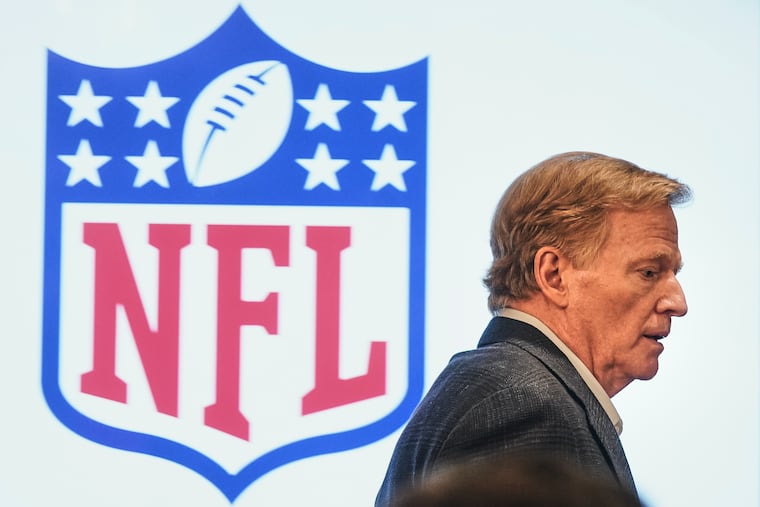
The NFL occupies a unique position in this ecosystem. In addition to licensing its data to Genius Sports, it has also owned as much as 8.7% of the publicly traded company’s stock, making it Genius Sports’ largest shareholder. The advocacy institute argues that the NFL is benefiting from gamblers’ losses.
Neither the NFL nor Genius Sports responded to a request for comment.
“All of these entities, including the NFL, need to be held accountable for what they’ve launched on the American public,” Levant said.
Also named as defendants in the lawsuit are two VIP hosts who work for FanDuel, and three who work for DraftKings. They’re accused of feigning friendships with Thompson and Sage, and using gifts, promotions, and betting credits to urge the men to continue betting, even after they exhibited signs of addiction.
The lawsuit seeks unspecified compensatory and punitive damages, attorneys fees, and related costs.
Similar spirals
Sage placed his first sports wager in 2003, when he was a high school senior, at a neighborhood betting parlor.
He returned to the parlor periodically for the next 15 years, placing pregame bets on point spreads and over/under wagers, according to the lawsuit, but did not have an addiction.
In 2019, Sage created an account with DraftKings.
Two years later, the company began to integrate microbetting — such as wagering on whether an individual pitch in a baseball game will be called a ball or a strike — into its platforms.
Sage became hooked. He placed microbets in the shower, on his way to work, in his bed until he fell asleep, on everything from NFL games to international table tennis matches.
DraftKings and FanDuel sent Sage push notifications about tennis matches that involved players upon whom he had previously placed bets, while VIP hosts offered him free tickets to Philadelphia Phillies games and helped him plan a bachelor party in Atlantic City, including free hotel and casino accommodations, according to the lawsuit.
“They’re trying to get you to gamble more, to lose more,” said Levant, a onetime Philadelphia attorney who surrendered his law license more than a decade ago, when he was battling a gambling addiction. “They’re using every tool they have, including this illusion of friendship.”
Sage resorted to desperate measures to fund his gambling addiction, borrowing $25,000 from loan sharks and $40,000 from family members, and stopped making payments on his mortgage, as well as his truck, which was repossessed, according to the lawsuit.
By March 2025, Sage had made more than $1.6 million worth of bets through FanDuel, losing more than $133,000, and $360,000 worth of wagers through DraftKings, losing about $42,000.
He was diagnosed with a gambling addiction disorder, and added himself to Pennsylvania’s gambling self-exclusion list.
The voluntary designation prohibits bettors from being able to collect any winnings or gifts from casinos or sportsbook companies, according to the state gaming control board.
Yet a DraftKings VIP host continued to contact Sage, according to the lawsuit, and tried to lure him back to the betting app.
‘An emergency’
Thompson’s initial bet on the Eagles through FanDuel in the fall of 2020 later blossomed into his using FanDuel’s and DraftKings’ apps to place microbets on what the score of a game might be after each team had a possession, and at the end of each quarter and half.
He wagered on every manner of NFL product: games held on Sundays, Mondays, and Thursdays. On Thanksgiving, he chose to sit alone and place bets, rather than spend time with his family, according to the lawsuit.
As they did with Sage, the betting companies conferred VIP status on Thompson. A FanDuel VIP host commiserated with him about the Eagles, sent him a $500 bottle of Champagne, and provided him with free tickets to Eagles, Flyers, and Sixers games.
After Thompson sustained some losses in 2021, the host provided him with betting credits, along with a message that read: “Hit a crazy one! Get us on a good role! [sic]”
That same year, the NFL began licensing its play-by-play statistics to Genius Sports.
In December 2022, after Thompson suffered some significant losses with FanDuel, a VIP host suggested that he take a break from betting and spend time with his family during the Christmas holiday.
A month later, in January 2023, the host asked Thompson to call her due to an “emergency” — FanDuel wanted to offer him two tickets to Super Bowl LVII in Arizona, where the Eagles were going to battle the Kansas City Chiefs, along with free hotel accommodations, and tickets to various parties, according to court documents.
Three years later, Thompson was broke, and contemplating suicide.
He checked himself into a psychiatric facility, where he was diagnosed with a gambling addiction.
“The enormity of harm that is taking place, that is baked into this business model,” Levant said, “is frightening.”

The Inquirer’s journalism is supported, in part, by the Lenfest Institute for Journalism and readers like you. News and editorial content are created independently of The Inquirer’s donors. Gifts to support The Inquirer’s high-impact journalism can be made at inquirer.com/donate. A list of Lenfest Institute donors can be found at lenfestinstitute.org/supporters.