Philadelphians are messing with Uber Eats delivery robots. It’s hitchBOT all over again.
A second Uber Eats delivery robot has been hazed in Center City in the last two weeks. Philadelphians yearn for hitchBOT 2.0.
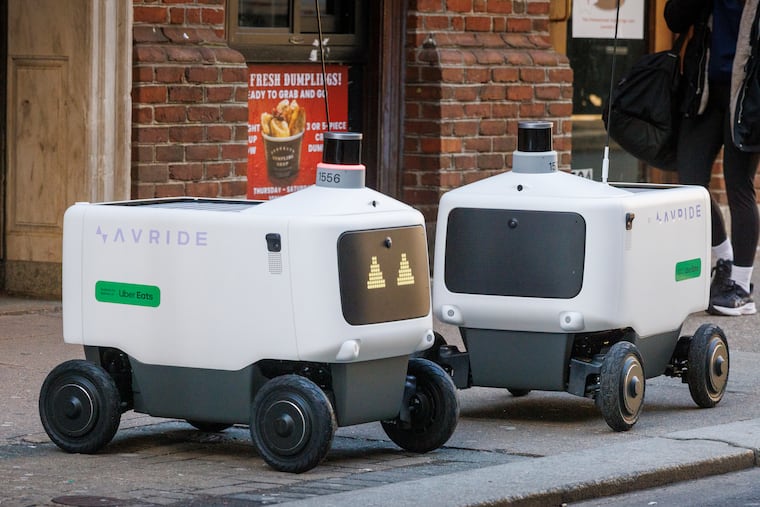
A group of late-night revelers belting the Killers’ “Mr. Brightside” from the inside of a roving karaoke trolley was the last thing a delivery robot experienced before being toppled over by a forceful kick from a Philadelphian over the weekend.
The bot had been in Philadelphia for all of 18 days.
The autonomous Uber Eats delivery robot was kicked and toppled over in Center City on Saturday at Juniper and Locust Streets around midnight, said Funcab Karaoke Taxi owner Dominik Glazewski, whose trolley security cameras captured the incident on video.
Though the delivery bots are not supposed to be out past 10 p.m., this one was reportedly still wheeling around at midnight, said Glazewski. Uber did not respond to a request for comment on the timing.
This marks the second time in two weeks that residents have gone viral for interfering with the AI-powered robot fleet. Earlier in March, a pedestrian sat on top of an Uber Eats robot while it was making a delivery.
As residents get more acquainted with the multi-wheeled entities with anthropomorphic eyes that blink and wink, it raises the question of why a company would roll out robots in a city known for murdering them. Avride, which makes Uber Eats’ delivery bots, could not be reached for comment.
In 2015, an autonomous hitchhiking robot, dubbed hitchBOT, embarked on a journey to walk cross-country, testing the limits of humanity’s generosity toward a robotic counterpart. The bot had garnered a fan base as it trekked across Canada, Germany, and the Netherlands. But when it reached Philadelphia, the robot came to be decapitated.
A decade later, and Philadelphians are still bringing that energy. During the robot-sitting incident two weeks ago, a separate person scrawled “DESTROY ME PLZ” on the Uber Eats bot.
The Philadelphia Police Department is not investigating the latest two incidents of delivery bot hazing but confirmed that people could be charged with criminal mischief for vandalism or be issued a code violation depending on “the severity of the damage and the circumstances of the encounter.”
Philadelphians are navigating the swift arrival of autonomous delivery robots and vehicles with the rollout of not just Uber Eats bots but Waymo autonomous taxis — similar to Uber but without a human driver. Waymo declined to comment on ushering robots into enemy territory.
Apart from sitting on, kicking, and decapitating robots, some Philadelphians have a gut instinct to distrust them, with one passerby calling them “police surveillance bots.” While no proof exists of Philly’s robots collaborating with local police, other companies have supplied law enforcement with footage recorded from these types of delivery bots.
The Uber Eats delivery robots by Avride were introduced to Philadelphia in March as the 12th city to operate autonomous Uber Eats deliveries, joining others such as Los Angeles, Miami, Jersey City, Chicago, Austin, and Dallas.
Around two dozen restaurants are getting their food delivered by the bots, which are scheduled to operate daily from 10 a.m. to 10 p.m. Uber declined to share which restaurants are participating, but The Inquirer observed the robots servicing Carter’s Cheesesteaks in Chinatown as one of those two dozen.
Using a mix of cameras, ultrasonic sensors, and Lidar — which uses pulsed laser lights to measure distances — the robots, which cost about $10,000 each, navigate sidewalks and crosswalks at speeds of up to 5 mph, can carry up to 55 pounds, and can run for 12 hours between charges. There are no extra fees for robot deliveries, and robots can’t accept tips, according to Uber.
Tech companies, like Avride and Waymo, have received pushback on everything from robots replacing human labor to overtaking, or even destroying, human thoroughfares. In Chicago, an Uber Eats delivery robot, made by the company Serve, shattered a glass bus stop shelter.
But these robots can legally operate under a 2020 Pennsylvania statute that considers these types of services as “personal delivery devices,” which are treated the same as human pedestrians. Philadelphia doesn’t have regulations on delivery bots.
For now, the ongoing beef between man and machine continues to play out in Philadelphia.