Uber Eats robots are now rolling around Philly, delivering food
Wheeled robots from Uber Eats may bring out your next food-delivery order. For this dinner by droid, there is no need to tip, either.
From googly-eyed Marty roaming Giant’s aisles to driverless Waymo cars cruising city streets, robots have been edging into everyday life around the Philadelphia area.
Now they’re coming to you with food.
Starting this week, Uber Eats customers in Center City may see a new delivery option: an autonomous robot. Bot appétit, you might say.
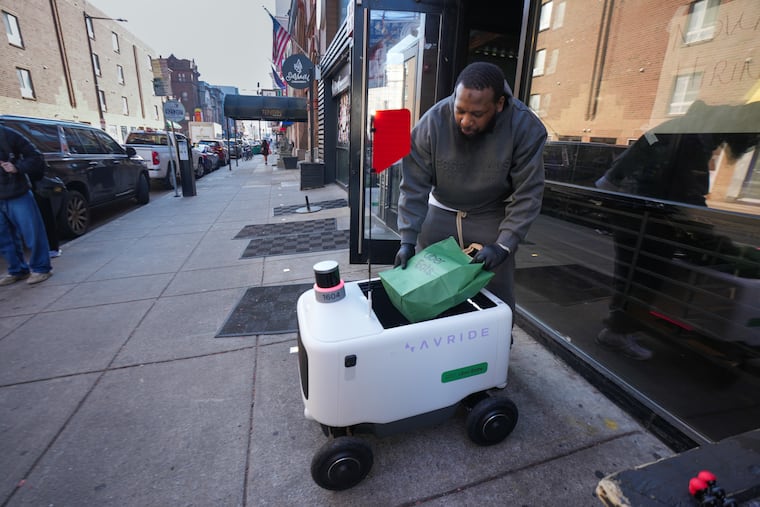
The wheeled vehicles, by Avride, are designed to carry food orders over short distances on city sidewalks. Philadelphia is Uber Eats’ 12th city, including Los Angeles, Miami, Jersey City, Chicago, Austin, and Dallas, to get the robots.
Uber said about two dozen restaurants have signed up so far to share a small fleet of robots now on the ground; more are expected as the zone expands beyond Center City. Uber said the service will operate daily from 10 a.m. to 10 p.m.
Uber declined to specify which restaurants are participating in the program, as well as its delivery area in Center City.
The battery-powered robots — which cost about $10,000 each — are about the size of a tailgate cooler, weigh roughly 150 pounds empty, and are built to travel up to about 2 miles. Uber says they can travel as fast as 5 miles per hour, carry up to 55 pounds, and run for as long as 12 hours between charges.
The bots rely on a mix of LiDAR, ultrasonic sensors, radar, and cameras to detect obstacles and move safely. Try picking one up and putting it in the back of a pickup, for example, and Uber’s monitors will track it down and have video evidence, the company said.
For customers who opt for robo-delivery (offered if available), the process is pretty straightforward: After an order is placed, a robot arrives at the restaurant, a worker loads the food into a locked compartment, and the customer tracks the trip in real time through the Uber Eats app. The customer gets a notification when the robot arrives and unlocks the compartment through the app. The droids cannot climb stairs or ride elevators. They will wait outside for up to 10 minutes, Uber said.
There is no extra fee for robot delivery, and the bots do not take tips.
Uber put a robot through its paces Tuesday at Carter’s Cheesesteaks by Garci in Chinatown, where owner Levell “Garci” Peterkin placed a bag of sandwiches inside a robot and locked it. An Uber employee directed the robot down the sidewalk for cameras as passersby grinned.
Megan Jensen, head of autonomous delivery operations at Uber, said the robots can navigate in all kinds of weather. “We first rolled out the robots in Jersey City in the dead of winter,” she said. If weather or sidewalk conditions make a trip impossible, she said, the robot simply stays put and the delivery is routed to a traditional courier instead.
Uber says the robots are not meant to replace human delivery drivers. “The goal is not to eliminate traditional couriers,” Jensen said. “Autonomous robots can’t complete every delivery; they serve one segment of the market.”
Philadelphia’s sidewalks may prove navigable enough. Whether Philadelphians readily embrace the newcomers is another question. This is, after all, the city where hitchBOT — the cheerful, cross-country robot traveler — met its American end on a Philadelphia sidewalk in 2015.
Jensen said public curiosity has followed the robots everywhere. “People stop, they’re curious, and they have questions,” she said. Over time, she said, “as people get used to seeing robots in their neighborhoods, it becomes part of everyday delivery.”
Their arrival is helped by Pennsylvania law. Under the 2020 statute governing “personal delivery devices,” robots are treated as pedestrians. Operators apply through PennDOT for authorization, and cities have limited authority to regulate how, where, or whether they operate. Philadelphia can restrict them in specific places if they pose a safety hazard, but it cannot create a local licensing system or sweeping operating rules. The city did not immediately comment on the robots’ arrival.
That light regulatory touch has been part of the debate nationally. A recent NPR report found that while some people see delivery robots as cute or convenient, critics say they can clog sidewalks, create accessibility concerns, and roll into public space faster than cities can write rules for them.
Asked about pedestrian protections in dense areas such as Center City, PennDOT spokesperson Zachary Appleby said state law requires the devices to yield to pedestrians. Violations can bring fines ranging from $25 to $1,000.
Peterkin had been using human couriers for Uber Eats deliveries. Asked what he thought of having robots pick up his food, he replied: “If it means I sell more and people are happy, I’m all for it.”