Schuylkill River Trail, city transit shelters to get upgrades from state transportation grants
Funding will address a gap in the popular thoroughfare for runners, walkers, and cyclists, as well as issues with transit shelters in Center City.
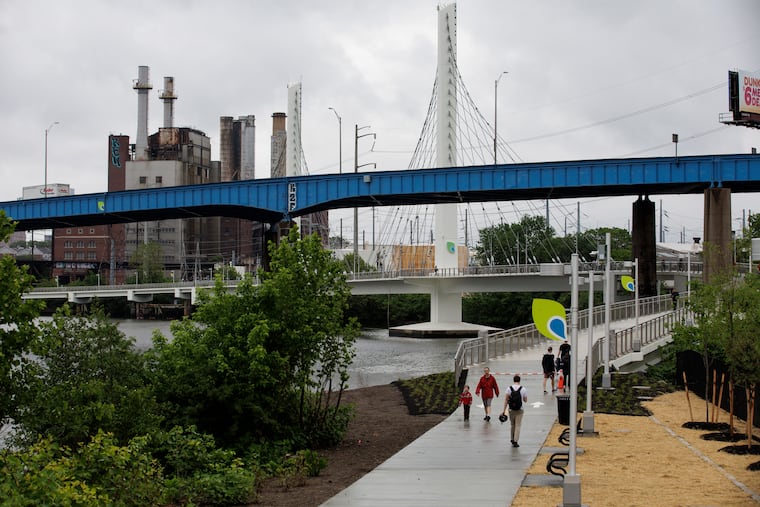
The Schuylkill River Trail and some of the city’s transit shelters are slated for upgrades as a result of a funding infusion from state coffers.
The two projects will receive nearly $1.3 million, part of $47 million for 54 transportation projects across the commonwealth.
The state will provide $947,668 to the Philadelphia Department of Streets to obtain a right-of-way so that it can complete a gap in the Schuylkill River Trail, Gov. Josh Shapiro’s office said in a news release. The funding is for the city to acquire rights of way to construct a trail segment between Kelly Drive and Main Street, near the Pencoyd Bridge, according to a Streets Department spokesperson.
The city portion of the trail is an immensely popular thoroughfare for people walking, biking, and cycling, and offers views of the Art Museum, Boathouse Row, and Fairmount Park. The multiuse trail stretches out of the city into neighboring counties, with a plan to eventually connect 120 miles of trail from Philly to Frackville, Schuylkill County, according to the nonprofit Schuylkill River Greenways.
» READ MORE: Schuylkill Trail sinkhole repaired, area reopened for Christmas Eve ‘as a holiday present’
The state earmarked $328,295 for the Center City District to fix up transit shelters “in preparation for Philadelphia250,” according to the governor’s office.
America’s 250th birthday celebration, aka the Semiquincentennial, is expected to draw hundreds of thousands of tourists, with a long list of events scheduled. Philadelphia will also host the FIFA World Cup, NCAA March Madness games, the Major League Baseball All-Star game, and the PGA Championship next year.
The money for the projects comes out of the state’s multimodal transportation fund, created in 2013 to provide investments for ports, rail freight, aviation, and “bicycle and pedestrian improvements,” according to a state website.
“Infrastructure is essential to Pennsylvania’s growth and to connecting people with opportunity,” Shapiro said in a Dec. 23 news release.
» READ MORE: America’s 250th birthday is the moment Philly museums have been waiting for
In Bucks County, Upper Makefield will get $250,000 for sidewalks, ramps, and features that comply with the Americans With Disabilities Act, and other improvements including “decorative crosswalks” and pedestrian signals along Route 532.
Chester County is set to see $113,920 for trails and ADA-compliant improvements on Broad Run Road in West Bradford and $126,827 for storm sewer and pedestrian improvements in West Goshen.
Communities in Delaware County will get more than $1.4 million for three projects:
nearly $400,000 for an “emergency preemption system” in Aston to notify the fire department of incidents;
about $700,000 to realign roadways, providing safe areas for pedestrians in Springfield; and
$314,249 for safety and streetscape improvements on Myers Avenue in Swarthmore.
Recipients in Montgomery County are set to receive about $3.3 million for four projects:
$1,324,000 for safety improvements in Conshohocken;
$1,415,183 to Hopwood Homes, a business registered by real estate investor Arnold Galman, for road widening, drainage, and trail additions on Hopwood Road;
$3 million for intersection improvements in Towamencin ; and
$3 million to replace a bridge and build a roundabout in Upper Providence.
Projects were decided by PennDot based on “safety benefits, regional economic conditions, technical and financial feasibility, job creation, energy efficiency, and operational sustainability,” the news release said.
The next application period for grants opens Jan. 5.