Immigration activists stage protests at Philly Target stores, demand the company reject ICE
The group No ICE Philly has led demonstrations against ICE and against the arrests of immigrants outside the city's Criminal Justice Center as well.
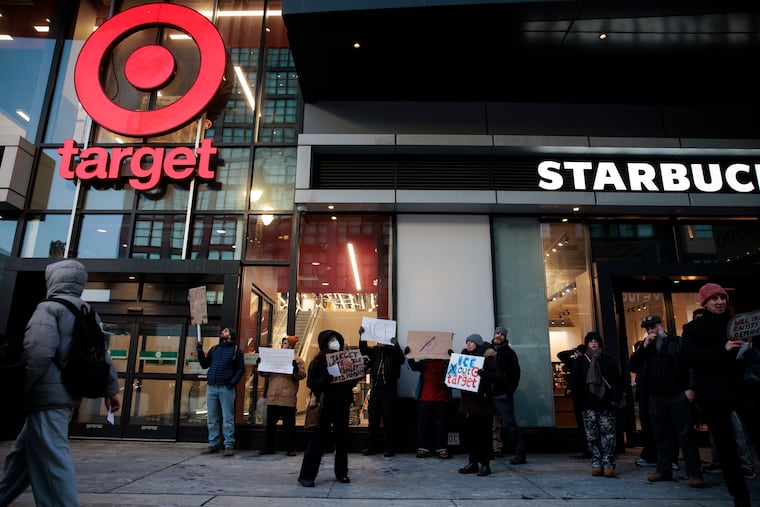
Activists with No ICE Philly demonstrated at Target stores in the city on Tuesday evening, attempting to slow business operations at a company that they say wrongly cooperates with federal immigration enforcement.
Stores in South Philadelphia, Rittenhouse, Fairmount, Port Richmond and on Washington Avenue and City Avenue were among those targeted, the group said.
Advocates say the retailer has failed to speak out against U.S. Immigration and Customs Enforcement, to safeguard employees and customers, and has allowed the agency to set up operations in its parking lots.
More than 40 people rallied on a frozen, 19-degree night outside the Target at Broad Street and Washington Avenue, holding signs that showed solidarity with Minneapolis residents who have resisted ICE in their community.
“From MPLS to PHL, keep ICE out,” read one sign.
Inside, some masked customers bought ice trays and single bottles of table salt. As soon as they paid for the items at the checkout counters, they headed to the “Returns” area to seek refunds.
Items were quickly restocked on store shelves by staff, only to be purchased and returned again.
Demonstrators visited at least seven stores, according to the Rev. Jay Bergen, a leader of No ICE Philly and pastor at the Germantown Mennonite Church.
“Our actions are in solidarity with people across the country responding to the call from Minneapolis communities to pressure Target,” Bergen said Wednesday.
Company spokespeople did not immediately reply to a request for comment on the protests in Philadelphia. Target, founded in 1962, operates 1,989 stores across the United States and has a net revenue of more than $100 billion a year.
At Broad and Washington on Tuesday, members of No ICE Philly handed out pocket-sized fliers that described their goals as they urged shoppers to go elsewhere. Some people turned away after talking to demonstrators. Others who went inside were met with boos.
“Find another store!” the protesters shouted, as a police officer looked on.
Elijah Wald, 66, said the Washington Avenue location was his neighborhood Target.
“Our main hope is that businesses will understand that they need to protect their employees, that they need to not collaborate with a government that right now is targeting everybody,” he said.
Wald, whose mother was a Jewish refugee who fled Nazi Austria, said he has always felt positive about immigration, that the United States was built of “people who are used to moving to find work, moving to find cheaper housing.”
But the discourse over ICE operations in major cities has gone beyond undocumented people, said Wald.
“They’re shooting U.S. citizens now,” he said.
At the Target at Snyder Plaza, about 20 demonstrators encouraged people to do their shopping elsewhere.
“Protest with your wallet; Acme is right there,” a protester said through a sound system.
Celine Bossart, 34, said boycotts are an effective way to denounce ICE actions.
“As citizens, our power is limited, but a big part of the power that we do have is where we choose to spend our money,” she said, “and at the end of the day, corporations aren’t necessarily going to listen until it hits their bottom line.”
A man in a Flyers jersey stopped to heckle the demonstrators, who responded with words of their own. Bossart said the protest did not aim to make anyone’s day difficult.
“Our neighbors are people who work at Target, people who work at Acme; these are the neighbors who we’re trying to protect,” she said. “So we’re just trying to send a message to upper, upper management.”
Last week, demonstrators held a sit-in at a store in Minneapolis, where the company is headquartered, chanting, “Something ’bout this isn’t right ― why does Target work for ICE?”
At other Minnesota stores, demonstrators formed long lines to buy bags of winter ice melt, then immediately got back in line to return them, slowing the checkout process.
No ICE Philly, which has led demonstrations against the agency, and against the arrests of immigrants outside the city Criminal Justice Center, said Target must:
Publicly call for Immigration and Customs Enforcement to leave Minnesota.
Post signs in its stores that deny entrance to immigration agents, absent a signed judicial warrant.
Train store staff on how to respond if agents arrive.
Publicly call for Congress to end ICE funding.
Chief executives of Target and more than 60 large Minnesota companies issued a public letter on Sunday calling for an “immediate de-escalation of tensions.” It marked the first time, The New York Times reported, that the most recognizable businesses in the state weighed in on the turmoil in Minneapolis.
Critics said the letter offered too little, too late, coming after two local U.S. citizens were shot to death by federal agents.