Many students had to abandon their artwork when UArts closed. Thunderbird Salvage is trying to reunite them.
Starting Aug. 16, people can buy the equipment the thrift operation salvages from Anderson Hall. Artists can keep their artworks for free.
Thunderbird Salvage’s Instagram account will tell us that they’re into all things “new/used/vintage/eclectic/salvage.” And last week, the historic preservation and thrift operation with a pair of Frankford Avenue locations posted an Instagram reel promoting its new haul.
“We are cleaning out University Arts Anderson Hall,” it read. “Yall want anything?”
Dwight City Group, who bought the former University of the Arts classroom and workshop space, plans to turn Anderson Hall into a set of mid-market luxury apartments overlooking the Avenue of the Arts. And Dwight construction manager Joe Michalski had offered Thunderbird Salvage owner George Mathes the chance to save art and other valuables from the hall’s interior.
“We’re trying to find a home,” Michalski said, “and reuse and repurpose whatever can be used or given back to the community.”
Roomfuls of equipment have been sitting inside the building since UArts abruptly closed last year.
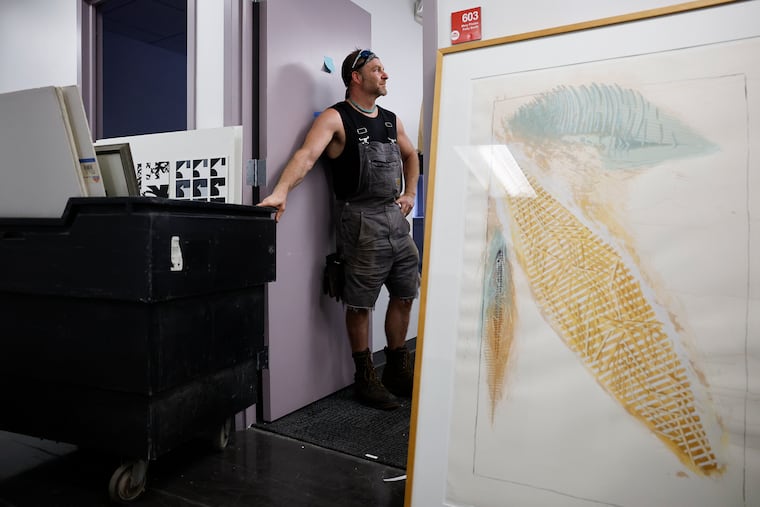
Last week, Thunderbird owner George Mathes walked through Anderson Hall’s upper levels, eyes wide as he surveyed drawings, sculptures, sketches, and prints gathering dust.
“We’re a different kind of business,” Mathes said. Unlike traditional thrift stores that deal mostly in donations, Thunderbird routinely visits sites on the verge of demolition or renovation, sweeping the premises for valuables that would otherwise be discarded.
Thunderbird’s Instagram post racked up several hundred comments within days, while Mathes warned users that the brutalist, nine-story classroom and workshop building had too much stuff inside to catalog.
Footlong ink cartridges lay atop sixth-floor file cabinets. Plaster mock skulls gazed at Mathes as translucent blue Apple computers stood sentry outside classrooms and offices as doorstops. And the workshops held more presses and plates than the average forward-looking American daily.
Mathes says he’ll save what he can and haul it up to Thunderbird’s locations — a church on the 2400 block of Frankford and a hall on the 2800 block of Frankford — for a sale planned for mid-August. If an artist drops by with a credible claim to a specific piece, it’s theirs at no cost, he said.
Thunderbird staff Lucca Voltoio, Mathes said, will help locate items if a former UArts student gets in touch over social media and walk artists through the building to pick up what they might have left behind.
UArts closed so quickly last June that students and faculty had to leave behind much of their art and belongings in its downtown academic buildings when they were locked down.
Back then, security guards walked students, faculty, and staff through some buildings to retrieve some items. Some of the equipment inside, valued at tens of thousands of dollars, was sold off in auctions. And the availability of prime Center City real estate tipped off a bidding brawl won by a mix of area colleges, real estate developers, and Scout, the artists’ collective responsible for remaking the Bok building.
Temple University bought Terra Hall, the largest of UArts’ former buildings, as an $18 million jumpstarter to its plans for the North Philly school’s Center City satellite. Scout nabbed Hamilton Hall and the Furness dormitory, which are in fact a single building, with plans to create affordable housing and maker spaces for artists. Curtis Institute of Music landed the Art Alliance as a rehearsal space.
Everything else went to developers — including Dwight City Group, now in command of Anderson Hall.
When UArts faculty went looking for some of their possessions last summer, they received instructions on where to go and how to collect. But it’s unclear what direction, if any, students got on reclaiming lost projects.
“It was nowhere near as easy, and they were nowhere near as responsive for students whose art may have been there,” said a former UArts professor, who didn’t wish to be named because of his current job.
What Mathes and Thunderbird don’t manage to save, workers from Richard S. Burns Waste Recycling Company are hauling to the company’s scrapyard. But Mathes soldiers on: The thought of junking items still precious to the artists, if not potential buyers, bugs him.
“I started this business based off the fact that I wanted to save history and make it available to the world — stuff that was going to be lost forever,” he said. “So, here I am.”
Note: The article has been updated to correct the name of the company that bought Anderson Hall. It is Dwight City Group.