Those ‘two moons’ reports aside, we still have only one
No, NASA did not confirm that we now have two moons.
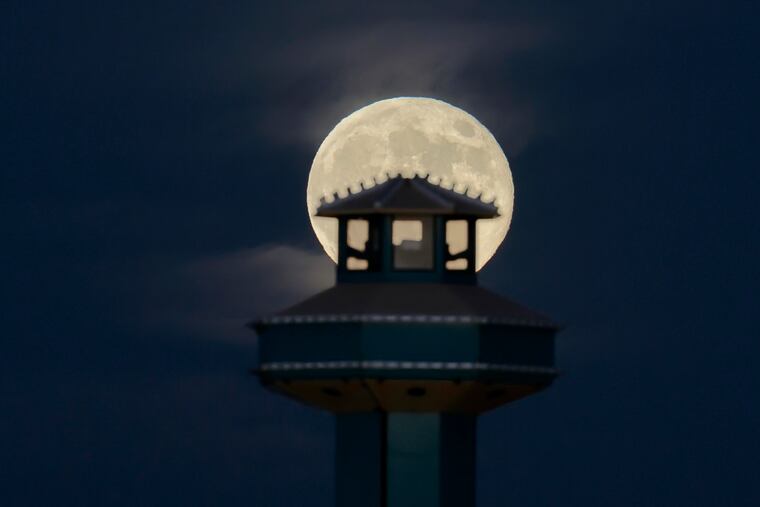
Those social media and other reports that the Earth now has two moons appear to be off the mark by about a moon.
Astronomers assure that we still have only one, true lunar satellite and that the object garnering all the buzz is a so-called quasi moon, technically a “quasi satellite,” known as 2025 PN7.
The American Astronomical Society reported last month that it was discovered in August at the Pan-STARSS Observatory in Hawaii, sighted by a 6-foot-diameter telescope on a Maui mountaintop. (Light pollution isn’t an issue out that way.)
It is not orbiting Earth, nor experiencing its gravitational force, but is moving more or less parallel to our planet as it orbits the sun. It is one of several such quasi satellites, the astronomical society says.
While it was discovered only recently, the astronomy site EarthSky reports it has been riding around with Earth since Lyndon B. Johnson, for whom the Houston space center was named, was president. It is expected to hang on an additional 60 years.
Is this quasi moon visible?
Definitely, if you happen to be at the Pan-STARSS observatory, but NASA reports that its magnitude is an ultra-dim 26.36.
Said Teddy Kareta, astrophysics and astronomy professor at Villanova University, “even with the big telescopes I have access to, it’d be a challenge.”
What is the quasi moon made of?
As standard procedure, when an object such as this is detected scientists first check for “space junk” — detritus shed by spacecraft, such as solar panels, said Kareta, whose specialities include the composition of “near-Earth objects.”
This one assuredly is “natural,” he said. Its orbit doesn’t appear to be drifting, which implies “a rocky density.”
Is it any danger to Earth?
NASA calculates it’s about 20 million miles away, which is relatively close in the cosmic sense, but still about 70 times farther away than the real moon.
But it’s also a relative pip-squeak: Kareta estimates that it’s from 40 to 100 feet in diameter.
“And I’d wager it’s more likely to be on the smaller side of that size range,” he said. Even if it did happen to wander this way, it “wouldn’t hit us going particularly fast.”
Will it have any effect on the tides?
No, nor, evidently on anything else, besides social media.