An Uber delivery bot bumped into her. Reporting the incident felt harder than it should have.
As Li Gordon-Washington called around, it seemed no one knew which government agency, if any, was responsible for logging complaints about the new technology.
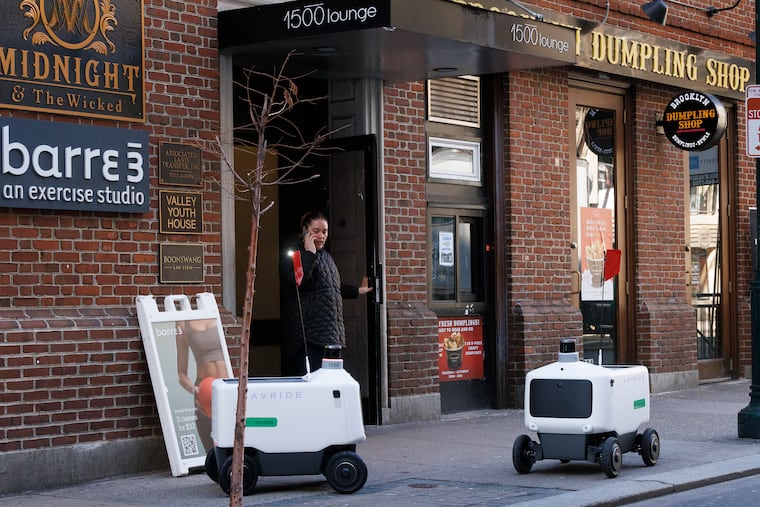
Li Gordon-Washington, 25, was at 15th and Locust Streets when an Uber autonomous delivery bot bumped into her from behind.
“I didn’t see it coming,” said Gordon-Washington, who kicked it in a knee-jerk reaction last month. “It kept coming at me, like once or twice more.”
Gordon-Washington was able to walk away as soon as the light changed — the bot didn’t follow her — and she was ultimately fine, only suffering a scratch.
Still, the whole episode felt like a malfunction in need of reporting. While Gordon-Washington was wearing dark clothes, it was about 7:50 p.m. when the bot bumped into her and not pitch black. What’s more, the bot was much sturdier than she’d imagined. Avride, the bot’s manufacturer, says the autonomous delivery robot weighs about 150 pounds.
“There’s a lot of kids here, there’s a lot of people that are mobility impaired, the elderly, dogs,” she said, worried they might be less lucky. “It really bothered me that this happened.”
But as she called around, she was unclear which government agency is keeping track of autonomous bot complaints and she worried about what Avride and Uber did with her complaint, if anything.
Gordon-Washington’s experience can best be described as the growing pains of dealing with a new technology, according to one personal injury attorney and various city and state agencies.
With no federal agency keeping track of autonomous delivery vehicle complaints, bot-related issues should be reported to state and local regulatory agencies. In Pennsylvania, that would be PennDot, though Gordon-Washington’s experience suggests this is not widely known yet. Avride only rolled out its bots in Philadelphia in March.
In her first call to Uber support, Gordon-Washington said the representative didn’t seem to know that the autonomous bots were in Philadelphia. An Avride representative told her it would file a report with its insurance carrier, despite her insisting she wasn’t seeking to file a claim.
A representative with Pennsylvania’s Bureau of Consumer Protection told her the incident was “a first” for them, directing Gordon-Washington to the Philadelphia Parking Authority, which regulates Lyft and Uber in the city, but not the bots. Gordon-Washington let the mayor’s office and her Councilmember Mark Squilla’s office know, in case they did anything with the information. She also tried 311 and a dispatcher suggested filing a police report to get the video of the incident, but that felt like a waste of police resources.
Part of the problem is Gordon-Washington’s bump with one of these bots is the first to be officially reported in Pennsylvania, according to PennDot, which governs the operations of these so-called “personal delivery devices” under a 2020 statute.
A spokesperson for the department said there is a system to report incidents. Companies operating these devices in the state must report incidents to PennDot within 24 hours of the event. Avride did report Gordon-Washington’s experience with PennDot, the spokesperson said. Separately, people can report issues with the bots by emailing pdd@pa.gov.
If PennDot finds companies violate reporting requirements or other terms that allow them to operate, it can suspend authorization. If a company’s devices can’t operate safely, PennDot can revoke the authorization.
An Avride spokesperson said their autonomous vehicle was “completing a turning maneuver that had already been initiated” when it had “minor contact” with Gordon-Washington.
“Our team has already implemented measures to minimize the likelihood of similar occurrences in the future,” said the spokesperson in an email, adding the robots are designed to work in nighttime conditions using an assortment of sensors that do not rely on lighting.
The delivery bots have a QR code and phone number that people can use to connect directly with Avride. But a company spokesperson said it does not have publicly available data on how many incidents or complaints have been reported in the cities it’s operating in.
Gordon-Washington worries bot complaints are underreported in Philadelphia because of how difficult it was to figure out who to go to.
“It took me maybe 10 different phone calls and about half a day’s worth of time to call the people that I did and complain to them and follow up,” she said. “It took a lot of effort on my part and I think a lot of people wouldn’t do that.”
The few known issues with the bots, such as blocked entryways or near collisions, are only known because of lawsuits and residents who are taking it upon themselves to collect and report this information.
Fed up, one Chicago resident launched a “No Sidewalk Bots” petition last year, collecting more than 4,300 signatures. Coco and Serve Robotics are the companies operating the bots in Chicago. The “incidents” field in the petition has yielded more than 1,000 entries, according to the petition’s landing page.
The federal government could be a great resource in governing the new technology, noted Aidan Carickhoff, partner at personal injury firm Saltz Mongeluzzi Bendesky.
Even if Pennsylvania is dutifully tracking incidents and complaints, these autonomous delivery bots are operating in Los Angeles, Austin, Dallas, Chicago, and Jersey City.
Uber and Avride are also far from the only companies looking to expand their fleets of autonomous delivery bots. Between Philadelphia and Pittsburgh, four companies are allowed to operate these bots.
“The federal government has the ability to coordinate with states and gather information from states, if they want to, and if they choose to take that step, as they probably should, and as they often do, to be able to understand how the problem is affecting people across the country,” said Carickhoff.
It’s unclear, however, if any federal agency is collecting this information.
The U.S. Consumer Product Safety Commission suggested trying the National Highway Traffic Safety Administration, which has jurisdiction over motor vehicles “primarily for use on public streets, roads, and highways.”
A slow-moving delivery robot doing most of its travel on sidewalks, however, is not considered a motor vehicle under the statute that governs them, according to a National Highway Traffic Safety Administration spokesperson, redirecting concerns to state or local authorities.