Valley Forge Military Academy’s closure quietly made way for a new charter school campaign. Critics call it deception.
The Valley Forge Public Service Academy Charter School is proposing to open next fall on the historic Main Line campus.
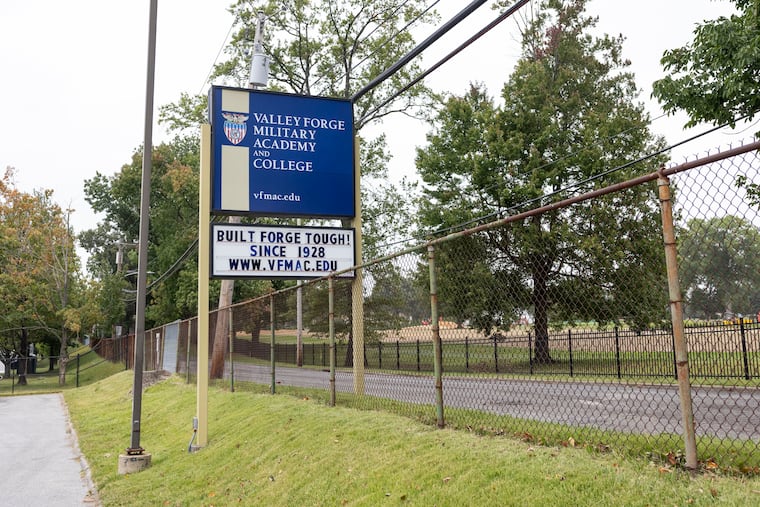
In March, Col. Stuart B. Helgeson hailed signs of a turnaround at the struggling Valley Forge Military Academy. For the first time in Helgeson’s eight years as president, the freshman class finished a semester without losing any students to attrition.
“Hats off to everyone who recruited them, trained them, and to the academy that’s going to continue educating them,” Helgeson told stakeholders in a video update then.
In September, though, Helgeson, who is president of both the academy and college there, stunned parents, alumni, and faculty when he announced that the once-elite boarding school would permanently close next year, citing years of declining enrollment and money troubles.
The two-year college program will continue to operate.
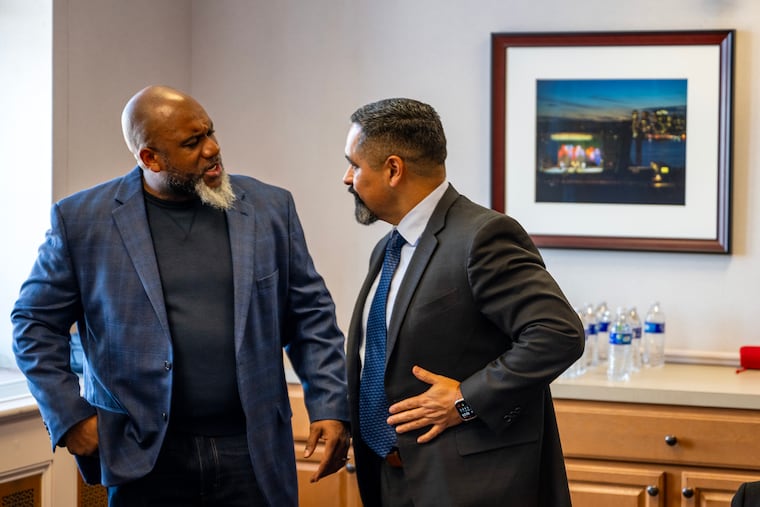
But his account about the VFMA’s demise masked another plan that officials declined to disclose at the time. Behind closed doors, the president and board had spent months discussing plans to install a charter school that would replace the academy on the historic Main Line campus — a plan that was predicated on the academy’s closure, according to two organizers of the proposal.
By the time the public announcement of the closing was made, a group of charter school backers was already forming a pitch for the Valley Forge Public Service Academy Charter School, alongside ambitious plans for 30 units of affordable housing in the academy barracks as well as a new community center for Radnor residents.
The viability of the charter school plan remains an open question considering that two prior attempts to create one there that failed. But if approved, it would enroll up to 150 students next year to prepare them for careers as first responders, such as police officers and firefighters, and as public servants.
Chris Massaro, who runs a firm that advises educational institutions, confirmed that plans for the school were in the works as early as March. The plan materialized by July with an agreement that the financially troubled academy would cease operations next year.
“We were not going to move forward unless the academy was closing,” Massaro told The Inquirer.
News of the charter school proposal was never publicized by VFMA leaders, angering some parents, faculty, and alumni who say school leaders kept them in the dark about the academy’s future as they questioned efforts to stabilize the school.
The plans ultimately became known after a promotional website — whose domain name quietly went live in July — began circulating among alumni on social media in recent weeks.
In July, the same month the charter website was registered online, Helgeson posted another video heralding a reorganization of leadership at the academy, new building improvements, and a successful fundraising haul.
Will Perdigon, a parent who unenrolled his son from the academy over the summer over concerns about mismanagement, accused the school of being “deceptive” in its effort to line up a new state-funded tenant — all while using the academy’s prestige to continue to raise money.
“Their ultimate goal is to collect rent,” he said. “And I honestly don’t think the school should be rewarded for mismanaging Valley Forge so that they can offload the campus to someone else to collect rent.”
Jeff Jubelirer, a spokesperson hired by VFMA Foundation, did not refute the timeline of events that Massaro and a second consultant, Alan Wohlstetter, detailed. Asked why the plan was kept secret, Jubelirer said the school was exploring all options and has been “looking at renting out space to day schools” for years.
He acknowledged that, in July, the board became “increasingly concerned about enrollment numbers” at the academy. In August, the board enacted austerity measures that leadership realized “may make the school unsustainable beyond the 2025-2026 academic year,” Jubelirer said.
The board did not make a formal decision to close the academy until Sept. 7, he said, about a week before the announcement. He declined to answer questions about the charter proposal, casting it as a distinct legal entity from the foundation.
“They would simply be tenants on the campus,” he said in a statement.
Third time’s a charm for charter bid?
Massaro, a Radnor native, began working with Helgeson and leaders of the school’s nonprofit foundation in January to help to save what he saw as a sinking ship.
As detailed in an Inquirer report last month, VFMA’s finances had long been in a death spiral.
Lawsuits and related legal costs related to cadet abuse mounted against the academy. Enrollment dwindled from a historical peak of over a thousand cadets to fewer than one hundred this year. Desperation grew to the point that board members floated personal loans to cover operating costs.
The strain led to an array of unconventional turnaround initiatives before the announced closing, including selling off campus property to luxury housing developers, franchising an academy in Qatar, and the two prior charter school applications.
Meanwhile, alumni and parents questioned why, amid a financial crisis, the board approved the construction of a $1.7 million official residence for Helgeson and his family and hired his wife to lead fundraising efforts.
To Massaro, the problem was the outdated military boarding school model.
“Saving a private K-12 boarding school is very difficult,” he said. “Parents don’t want to send their kids away anymore. Then add the military component. … It’s a tough sell.”
He proposed a charter school as a way to preserve the VFMA legacy. But the academy’s closure was an early sticking point. Twice before, plans to add a military-themed charter school to the campus had failed to gain support of the Radnor Township School District.
The local school board criticized those proposals as an attempt to subsidize an ailing military academy that had failed to address long-running and highly-publicized concerns over cadet abuse.
Massaro brought on another consultant, Wohlstetter, who proposed another charter with a new twist: one geared toward students eying first-responder jobs, such as firefighters and police officers, not just the armed forces.
The proposed Valley Forge Public Service Academy Charter School would function as a day school that could readily fill the classrooms left behind by the academy, said Wohlstetter, president of School Improvement Partnership, a charter school consultancy based in Philadelphia.
It could also become a feeder school for VFMA’s two-year college program that will continue on campus after the academy’s closure. And it would help fill jobs in struggling municipal workforces throughout the region.
“It’s a bit of a pivot from the 98-year history from the military academy,” Wohlstetter said. “It’s a pivot from military service to public service.”
A pivot from military to ‘public service’
With the VFMA’s support, Wohlstetter said that the academy plans to submit its application to Radnor Township School District by a Nov. 15 deadline and that grades six to eight of the charter school could be ready to accept students as soon as next fall.
A school district spokesperson said Friday that Radnor school district officials were unaware of the proposal.
Charter school applicants typically face resistance from local public school districts because of negative impacts to student enrollment and state funding. Wohlstetter said the charter’s initial 150 students would come from 10 regional school districts, about 25% of them from Radnor Township School District.
Susan DeJarnatt, a Temple University professor emerita who studies education reform, said charter school laws were written to support community members and teachers interested in developing new, more effective educational models. She questioned whether the VFMA’s plan met those objectives in a district that consistently ranks as one of the best in the state.
“It looks like yet another attempt to use the charter school option to solve the financial problems of a different entity,” she said. “Maybe they will show a groundswell of support in Radnor for this public option. But it sounds like a solution in search of a problem.”
She expressed concern over the apparently close relationship between the VFMA board and the nascent charter organization. She said similar structures had created significant conflicts of interest at other schools, resulting in self-dealing or other improprieties.
“It runs the risk of creating those kinds of conflicts,” she said.
» READ MORE: For a second time, a charter school is being proposed at Valley Forge Military Academy
Massaro, whose family all attended Radnor public schools, said the proposed charter school model is desperately needed.
The affluent suburb is behind the times when it comes to offering young students options outside of going to universities, he said, describing the mentality as “college or bust.” And the private boarding-school model — with annual tuition approaching $50,000 — was no longer viable at Valley Forge, he argued.
Though billed as separate entities, the charter school is simultaneously pitching several other projects with VFMA properties.
An official website for the charter floats the idea of converting the academy’s old barracks into a 30-unit affordable apartment development aimed at teachers and first responders. The campus has also drawn significant interest from real estate developers. Massaro said has already sought financial backing for the project.
“Radnor teachers can’t afford to live in the area,” he said, noting the high cost of living on the Main Line.
Another proposal on the website states that the foundation “is open to exploring the idea” of transforming the academy’s mess hall into the “Radnor Community Recreation Center,” billed as “a new hub for families and neighbors to gather, play, and stay active!”
The foundation board said it is focused on repurposing campus buildings for the college and had yet to discuss either plan, according to Jubilerer.
“The Foundation Board has not discussed or decided on either of those concepts,” he said.
The prospect of a charter school replacing the academy doesn’t sit well with alumnus Julius Kaufmann, a 21 year-old VFMA graduate now enrolled at Pennsylvania State University.
Before graduating in 2023, he saw the school franchise and fundraise off the academy’s once-elite brand, all while leaders sapped resources for the cadets.
“The more fundraising they did, the less we got out of it,” he said. “We all thought [the charter] would be an expansion of the academy, but it’s just a replacement.”

The Inquirer’s journalism is supported, in part, by the Lenfest Institute for Journalism and readers like you. News and editorial content are created independently of The Inquirer’s donors. Gifts to support The Inquirer’s high-impact journalism can be made at inquirer.com/donate. A list of Lenfest Institute donors can be found at lenfestinstitute.org/supporters.