How Valley Forge Military Academy fell apart nearly a century after its founding
The storied Main Line boarding school saw declining enrollment, rising costs, and, some parents say, misplaced priorities.
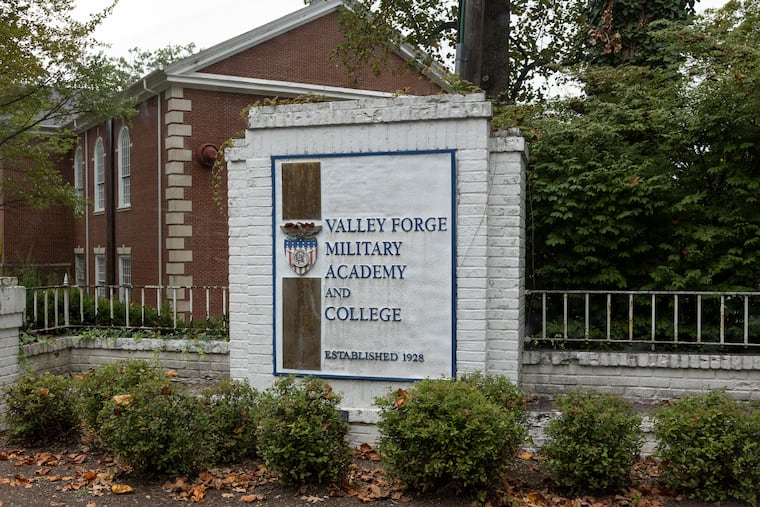
In November 2023, Valley Forge Military Academy was on the brink.
Paint was flaking off the nearly century-old academic buildings. Roofs needed to be replaced. Enrollment at the once-elite boarding school on Philadelphia’s Main Line had reached a historic low.
To make matters worse, the storied academy — known as “The Forge” to many alumni — was facing new legal costs as former cadets filed lawsuits alleging that as teenagers they were abused.
And yet, amid this existential crisis, the board of trustees hosted a ribbon-cutting for a new project on the edge of the 70-acre campus: an official residence for academy president Col. Stuart B. Helgeson and his wife to use, free of charge.
The four-bedroom farmhouse-style home — dubbed “Crossed Sabres” — is replete with a three-car garage and wraparound porch. According to county tax records, it is valued today at $1.7 million.
John English, the board of trustees president, cast the project as part of a $7.5 million facilities upgrade that would modernize the crumbling campus.
But to some parents of cadets, the home symbolized years of baffling priorities that preceded news last week of the academy’s demise.
“It’s a bad look,” said Fred Drabick, who pulled his son from the academy last year due to what he called mismanagement. “With everything that’s going down, there [the president] is, in a $2 million house.”
On Monday, VFMA leaders announced the academy would close for good in 2026, citing declining enrollment and rising insurance premiums, in part tied to the school’s extensive legal battles. VFMA’s two-year college program will continue after the closure of the better-known academy that serves grades seven to 12.
School leaders declined interview requests from The Inquirer last week. Campus security barred a reporter from attempting to visit Helgeson at his office.
Jeff Jubelirer, a crisis communications consultant hired by the school, said on Friday that the academy tried “an array of methods to increase enrollment” but that those “efforts did not prove successful.”
The closure was predicted by some parents and alumni who had long sought answers about the school’s path to financial stability. As scrutiny mounted, Helgeson told reporters in 2020 that outspoken alumni were “weakening the brand,” sometimes blaming them for hurting enrollment by speaking ill of the Forge.
“This place isn’t closing,” English said at the time. “They have no clue.”
» READ MORE: Valley Forge Military Academy is to close at school year’s end
With the school’s finances in a tailspin, board members in recent years personally lent $2 million to cover operating costs, financial disclosure records show.
They tried other methods to drum up revenue, including franchising the academy’s brand to an Islamic private school in Qatar and unsuccessfully attempting to open a charter school on campus. They leased out their buildings for private events and authorized the sale of nearly a third of the campus to luxury home developers, according to federal filings and emails obtained by The Inquirer.
Even so, enrollment this year fell to 88 cadets, down from more than 300 a decade ago, the school said.
And parents say some basic recommendations were rebuffed, even as the board pursued other goals, like the construction of Crossed Sabres. The board also hired Helgeson’s wife, a former insurance representative, as the school’s chief development officer.
Jubelirer said the school had used outside consultants in the past, to little effect. But he said that Helgeson’s wife has consistently raised over $2 million a year for the school, and that the board “stands by that hire.”
To Doug Davis, 74, a retired U.S. Army colonel who later worked at the academy and led an alumni group that was often at odds with VFMA leaders, it all amounted to a rudderless ship.
“Most organizations will have a vision of the future and a plan,” Davis said. “Valley Forge has not provided that.”
‘It’s just boys being boys’
Although the two-year college program will live on, parents and alumni said the academy was the heart of Valley Forge. Founded in 1928, the academy enrolled more than a thousand cadets a year at its peak in the 1960s.
It became one of the nation’s most esteemed military academies, graduating the likes of Gen. Herbert Raymond “H.R.” McMaster, a former national security adviser, and Operation Desert Storm commander Gen. H. Norman Schwarzkopf Jr. It is believed to have inspired the fictional private school — Pencey Prep — that alum J.D. Salinger described in The Catcher in the Rye. At least two members of European royalty attended the academy, as did over a half dozen pro athletes.
But the school’s reputation took a hit over the last three decades, amid lawsuits and scandals. Staff turnover has been high, and there have been allegations of hazing, sexual assault, employee retaliation, grade fixing, and even horse abuse.
In 2022, the academy settled two suits filed in Philadelphia by four former students who said that they were repeatedly physically and sexually assaulted — and that academy employees did little or nothing in response. The complaints contended that the academy had a “history of pervasive child abuse of youth that has occurred over decades under the watch of numerous administrators.”
Settlement amounts were not disclosed.
Two more suits with similar allegations are now being litigated in Delaware County. The academy has denied the allegations in court filings.
Ryan Niessner, who attended both the academy and college, said he was sexually assaulted after five other cadets pinned him down as he returned from the shower one night in 2009.
“I was kind of in shock,” Niessner, 31, told The Inquirer this past week.
He reported the incident to his adult tactical officer, who “buried it,” Niessner said. Later the school commandant “asked me out of the blue if I’m looking to sue.”
Niessner did not file a lawsuit.
“I was just some 15-year-old kid,” said Niessner, who later served in the Army and now works in military contracting.
Other former cadets claimed in the lawsuits that they were subjected to all manner of abuse: vicious beatings, rape, sodomy with bars of soap and other objects, waterboarding, brandings with scalding forks, whippings, forced lip piercings with needles. According to court records, the alleged abuse was often perpetrated by other cadets who outranked them.
Robert Wood, the school’s former dean of student services, said in an interview last week that VFMA leaders had instructed him to look the other way instead of investigating such complaints. Or, he said, administrators would whitewash the investigations once completed.
“There was a ‘If this gets out …’ attitude,” Wood said. “They’d say, ‘It’s just boys being boys.’ No, it was sexual assault, especially when you are sodomizing someone with an object.”
Wood, who was the school’s Title IX coordinator charged with enforcing federal sex discrimination rules, eventually filed a whistleblower complaint in 2015 with the U.S. Department of Education’s Office of Civil Rights. He outlined multiple accounts of student rapes and assaults, and a pervasive hazing culture, including a “fight club” that was exposed after one student broke his hand.
A federal investigation dragged on for nearly a decade. It was not until the summer of 2024 that the Office of Civil Rights issued a heavily redacted determination letter finding that “evidence indicates that staff interfered with and impeded” the academy’s investigations.
Interference was particularly egregious in several cases “where staff members were named or implicated,” and the school sometimes chose to simply ignore allegations of abuse that were found to be credible, according to the federal ruling.
Jubelirer denied those allegations and said the school implemented all recommendations made by the Department of Education.
Lawsuits continue to pummel the academy today.
In one such case, filed last September in Delaware County, a man claimed that in approximately 2008, when he was 14, older cadets repeatedly kicked him in the ribs, made him eat chewing tobacco, and forced his roommate to perform oral sex on him. He was also penetrated anally with a bar of soap, according to the suit.
In another open case in Delaware County, a man said when he was 15 years old, in 2016, older cadets forced their way into his room, attempted to sexually assault him, then pinned him down and “cut the initials of Valley Force Military Academy” into his shoulder, leaving scars on his body.
Stewart Ryan, the attorney for both former cadets, said the academy’s planned closure will not prevent those lawsuits from moving forward.
“Those cases will remain active and we will continue litigating them,” Ryan said.
Ryan, who was part of the Montgomery County team that prosecuted comedian Bill Cosby on indecent assault charges, said his clients never sought to put Valley Forge out of business.
“The point of the litigation was to make it safe for students,” he said, “not to shut down the school.”
Joseph McHale, a lawyer for VFMA from Stradley Ronon Stevens & Young, declined to comment on those cases.
In an email, he said the soaring liability insurance rates cited as a reason for the academy’s closure were “not unique to VFMA” or necessarily tied to abuse allegations.
An unsustainable mission
The Forge was a godsend for Will Perdigon’s son, instilling him with discipline and turning him into an honor roll student.
But this year, the Montgomery County father grew wary as he watched the academy gut athletic programs and extracurricular activities. Respected faculty members were dismissed.
“I got secret emails from teachers saying, ‘We can’t give your son what we promised you,’” Perdigon said.
The concerns he raised to academy leaders went ignored, he said, including a new “fight club” spawned in the spring among cadets. Perdigon attributed it to a lack of overnight supervision, so he unenrolled his son this summer.
VFMA hasn’t been alone in losing cadets. At military schools nationwide, dwindling enlistment in the U.S. Armed Forces meant fewer families were interested in spending $200,000 or more to prepare their children for a career as an officer.
But some factors were unique to the Forge.
A 2018 consultant’s report offered several red flags as context for the school’s 40% drop in enrollment over the previous five years. An outsized percentage of students were receiving financial aid. Many people in positions of authority had little background running private schools, according to the report, and there was a lack of vision around development and fundraising.
The report noted the board was dominated by older alumni who were more likely to resist reforms to traditional school operations. And the college program — soon to be the only surviving face of the Forge — was “simply not sustainable,” the report concluded at the time.
Jubelirer dismissed the report as being crafted “secretly” with a “former president to push that president’s own agenda.”
By the 2020s, Valley Forge was reporting upward of a half million a year in legal costs, such as $350,000 paid to handle “inquiries from the U.S. Department of Education,” according to a 2021 financial disclosure form.
As concerns burst into public from alumni and parent groups, few questions were answered.
Some critics, including former faculty and alumni, even found themselves banned from campus. The school has issued 21 “persona non grata” letters over the years, Jubelirer said, in an effort to maintain “a tranquil and supportive environment” on the school grounds.
“There hasn’t been any accountability,” said Matthew Allyn, 45, a VFMA college graduate who moderates a Facebook alumni group. “We don’t even know how to keep them accountable, because there’s no transparency.”
Desperate measures
To stanch the bleeding, administrators resorted to financial gambits that ultimately failed to save the school.
The school petitioned the local Radnor Township School District to spin off a military-themed charter school, tapping into public education dollars in the process. The district rejected the applications as “an effort to subsidize VFMA” that was “against the spirit and the letter” of state charter school laws.
The Forge sought funds from more than 6,000 miles away — in Qatar.
“Education City,” an academic hub in the petrostate’s capital, Doha, had attracted satellite campuses of American universities, like Georgetown University and Texas A&M.
In 2022, VFMA entered into a “franchise and advisory services agreement” with overseas educational operator Global Institute Studies to open “Valley Forge Military Qatar.” The branding deal brought the academy just $141,000 during the first year of the arrangement, according to the school’s federal filings.
The academy began leasing its athletics facilities to a nearby university, and sought to turn the chapel into a wedding venue, according to emails reviewed by The Inquirer.
Even with money trickling in from the new initiatives, the school’s 10-person board of trustees voted to personally lend the school $2 million just to cover operating expenses, records show. With its conventional credit lines already exhausted, some members of the board put up as much as $250,000.
The school was also forced to tap its key asset — dozens of acres of prime real estate in one of the Main Line’s most sought-after neighborhoods.
Since 2019, the board had approved the sale of small tracts of campus land abutting a residential neighborhood. But in 2022, board members agreed to sell off about 30 acres of “underutilized portions of the main campus” — nearly a third of its landholdings — for $11.5 million to Rockwell Custom Homes, a luxury homebuilder based in Wayne.
Rockwell also handled the custom rebuild of Crossed Sabres, the presidential manor on campus. Jubelirer did not answer a question about how much the project cost the academy, saying only that the school “historically provided housing for its president as well as its commandant.”
In a June 2022 announcement about groundbreaking for the new, 3,000-square-foot presidential home, English noted that the academy had suffered from years of revolving leadership. Helgeson, the board chair noted, was now committing to serve for another 10 years.
“We have been criticized as an institution of having a turnstile of presidents and leaders,” English said. “But this will give us stability.”
By 2023, the school’s last financial report showed a surplus after years of multimillion-dollar losses, which helped the school pay back the trustees’ loan and cover the costs of the new home.
Yet this windfall was entirely due to proceeds from real estate sales. Without the one-off cash infusion from Rockwell, the school would have still been in the red.
Last year, administrators split the academy into a legally distinct organization. Helgeson said in a video update this year that the decision came at the recommendation of the Middle States Commission on Higher Education, an accrediting body.
The freshly separated “VFMA Academy” still reported a $1 million operating loss, according to a federal filing by the school last year.
Helgeson projected calm. Things were improving, he said, in video updates to parents and faculty this summer that showed off fresh masonry work on a campus building.
Six weeks later, the board announced the school closure.
Wood, the former dean of students, said despite decades of scandals and what he believed to be poor leadership, he had met great educators and tactical officers at the school. They had helped troubled teenagers turn their lives around and go on to have successful careers.
“I think it’s a shame the place is closing,” he said. “Because, done properly, it should have been the gold standard.”

The Inquirer’s journalism is supported, in part, by the Lenfest Institute for Journalism and readers like you. News and editorial content are created independently of The Inquirer’s donors. Gifts to support The Inquirer’s high-impact journalism can be made at inquirer.com/donate. A list of Lenfest Institute donors can be found at lenfestinstitute.org/supporters.