Hunt continues for suspect in active shooter hoax that fueled terror and confusion at Villanova
The emergency call to Villanova’s Department of Public Safety on Thursday included the sound of gunshots in the background, officials said.
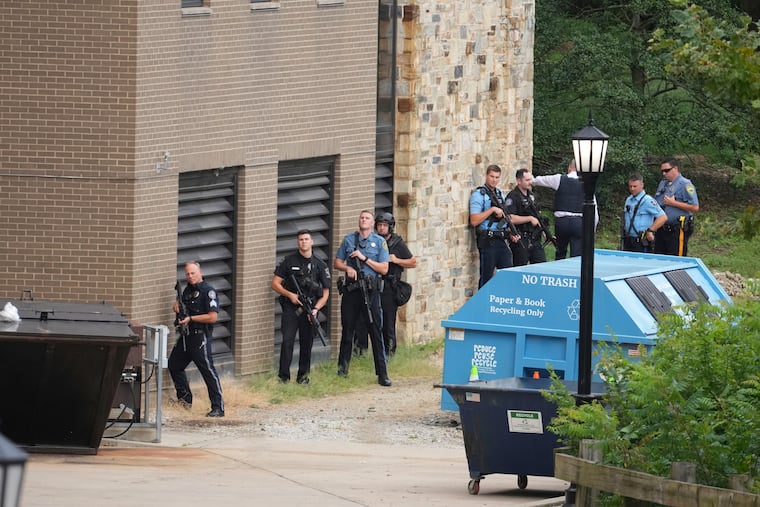
A day after a hoax shooting incident upended freshman orientation week at Villanova University, police continue to search for the suspect who they say made a bogus report of someone with an automatic weapon terrorizing the leafy suburban campus.
Officials said the emergency call to Villanova’s Department of Public Safety, which came shortly after 4:30 p.m. Thursday, included the sound of gunshots in the background. That triggered an immediate lockdown on the Catholic school grounds, where students and parents were attending Mass, resource fairs, and other opening day events. What was supposed to be a peaceful welcome to the fall semester descended into pandemonium as police officers and tactical units swarmed the campus.
Confusion spread during the ensuing hourlong manhunt for a shooter who did not exist. Responding officers at one point said they had identified not only a suspect — a 6-foot male — but also a gunshot victim, according to police scanner recordings. Law enforcement authorities and university leaders later said there were no injuries and described the incident as swatting, a “cruel hoax” that involves filing false reports of a crisis to induce panic.
Delaware County officials on Friday declined to release a transcript or audio of the 911 call recording that is now central to the police investigation. District Attorney Jack Stollsteimer also declined to answer questions Friday about the law enforcement response.
“They did an amazing job. Period,” Stollsteimer said in an email.
The Radnor Township police scanner broadcast a chaotic depiction of the response on campus between 4:30 p.m. and 6 p.m. SWAT units set up a perimeter around Scarpa Hall at the Charles Widger School of Law as officers began clearing the floors of the academic building. No signs of gunfire were found.
John Stayer was touring Villanova’s campus with his daughter, an incoming freshman, when police ushered them to shelter in a classroom nearby. He said he opened a police scanner app on his phone to learn more about the active shooter situation, and his ears perked up when he heard first responders describe a victim with a “GSW.”
Strayer, an emergency room physician from Seattle, Wash., immediately knew what that meant: gunshot wound.
But it soon became clear that no one was really hurt.
» READ MORE: Police scanner shows panicked response to Villanova shooting ‘hoax’
Strayer praised the swift and “massive” police response on campus. But he said he is confused about why officials have yet to address the erroneous report of a gunshot victim, given that the entire situation turned out to be bogus.
“Clearly someone said that, and there was a response to that, but after five minutes it was like nothing happened,” Strayer said. “They didn’t say anything about anyone being injured — or misidentifying someone who was injured.”
As the threat dissipated on campus, police appeared to turn their sights on finding the person responsible for the hoax. Commanders instructed police to search nearby parked vehicles and to look out for anyone with binoculars who might be watching from afar.
‘Swatting’ hoaxes on the rise
In the age of mass shootings, law enforcement agencies may struggle to distinguish real threats from the false alarms. Swatting incidents have risen sharply across the U.S. in recent years, from 400 in 2011, to more than 1,000 in 2019, according to an FBI estimate provided to the Anti-Defamation League.
Joseph Giacalone, a retired NYPD sergeant and criminal justice professor at Penn State Lehigh Valley, said the inspiration for swatting often begins on the internet, originating from a joke among friends or forum users.
“Unfortunately, it has become part of the culture that we see online,” Giacalone said. “However, from a law enforcement perspective, they have to take these very seriously. They’re coming prepared to have to use deadly force.”
Politically motivated swatting incidents are also increasing, targeting election workers, voting centers, religious institutions, and elected officials.
Meanwhile, the nature of swatting itself is evolving.
A report published in April by the National Association of Attorneys General found the technology involved in swatting is becoming more sophisticated, with artificial intelligence and data scraping tools providing perpetrators with an array of options to more accurately target victims and mask their identity.
AI-assisted vocal cloning and image manipulation can be exploited to impersonate individuals and create realistic emergency situations, according to the report.
It is unclear whether digital tools were used in the hoax report placed with police near Villanova. Authorities provided few details about the initial phone call that led to Thursday’s panic, aside from the description of gunfire in the background.
Giacalone said swatting investigations can be tedious. Police would likely scour cell phone tower records, the school’s Wi-Fi network, and university security cameras to search for digital or physical traces of a suspect.
“This is going to be painstakingly slow,” Giacalone added, citing the sheer number of people on campus who were connected to cellular and other communication networks.
The criminal justice professor suggested it was possible that the false report of an active shooter at University of Tennessee Chattanooga that came in around 1 p.m. Thursday may have inspired a copycat call in Pennsylvania just hours later. Investigators have not commented or provided information on whether there is a link between the two incidents.
“In a situation like this,” Giacalone said, “there will be serious implications if the individual or individuals are found.”
The FBI declined to comment on any possible connection between the two incidents.