Andrea L. Weiss, pioneering rabbi and celebrated Bible scholar at Hebrew Union College, has died at 60
In 2019, she was the first woman to ordain rabbis in the Reform movement.
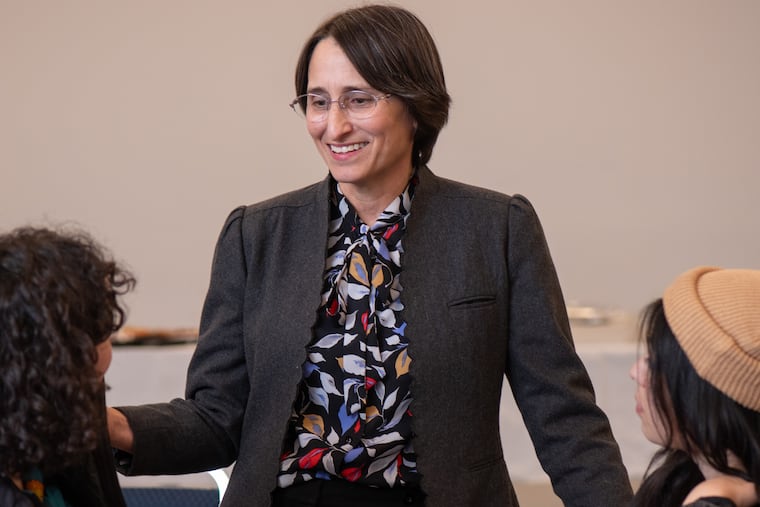
Andrea L. Weiss, 60, of Bala Cynwyd, pioneering activist rabbi and Hebrew Bible scholar, Head of Seminary and former provost at Hebrew Union College-Jewish Institute of Religion in New York, celebrated editor, writer, professor, researcher, and mentor, died Tuesday, March 3, of cancer at her home.
Ordained at Hebrew Union in 1993, Rabbi Weiss went on to become one of the few women rabbis to ordain other rabbis and cantors, and, in 2019, the first woman to ordain rabbis in the Reform movement. She was an expert on figurative language in the Hebrew Bible and served most recently as Head of Seminary and Rabbinical School Director at Hebrew Union.
She was inspired, she said often, to speak religious truth to political power and was adept at forging personal connections among people. She wrote, cowrote, and edited books and dozens of articles, and lectured in Philadelphia, New York, Jerusalem, and elsewhere about women’s views of the Torah, the evolving nature of religion, the teachings of the prophets, biblical metaphors, and other topics.
Her husband, Alan Tauber, said: “Andrea tried to live her beliefs both in her sacred and secular lives.” Her daughter, Rebecca, said: “She was a model for wholeheartedly pursuing mission-driven, passion-driven work.”
She joined Hebrew Union as an associate professor of Bible in 2000 and taught classes called the Poetry and Power of the Psalms, and the Literary Artistry of the Bible. In online tributes, former students noted her “mix of pushing for excellence and kindness” and “intellectual generosity, and the way she made students feel valued.”
Her daughter said: “She inspired this deep, lifelong love of reading and writing, of learning.”
As provost from 2018 to 2025, she obtained grants, raised funds, redesigned the curriculum, organized remote studies during the pandemic, and improved compensation for faculty. In a tribute, Hebrew Union president Andrew Rehfeld called her a “transformative presence.”
He said: “Her scholarship, vision, and fierce commitment to the formation of Jewish clergy have shaped this institution in ways that will endure for generations.”
She co-edited The Torah: A Women’s Commentary, and it won the Jewish Book Council’s 2008 Book of the Year Award. In 2017 and 2021, she and others organized what they named American Values, Religious Voices: 100 Days, 100 Letters. It was a monthslong interfaith email and letter-writing campaign that flooded President Donald Trump and President Joe Biden and other prominent political leaders with faith-based guidance on how to integrate political leadership and moral clarity.
“There are a number of people in our new government who approach their work with a strong religious sensibility,” she told The Inquirer in 2017, “and we thought this was an opportunity to remind them, and a wider audience, about what those traditions have to say about key issues.”
One time, she showed up at a Philadelphia parole office to register former detainees to vote. In 2016 , she collaborated with her husband and others to organize a youth baseball goodwill trip to Cuba.
She talked religion on podcasts and reviewed books. She was active with the Society of Biblical Literature and earned fellowships and awards from Hebrew Union and the University of Pennsylvania for academic excellence, interreligious involvement, and philosophy.
In a 2019 Good God podcast, she said: “As a Bible scholar, what draws me and why I dedicated my life to this text [is] because of its complexity, because of its artistry, the idea that there are so many different voices. … The Bible is an anthology that combines so many different perspectives, different voices, different kinds of literature.”
She earned a master’s degree in Hebrew Letters at Hebrew Union in Los Angeles in 1991 and a doctorate from the Department of Near Eastern Languages and Civilizations at Penn in 2004. Rabbi Rick Jacobs, president of the Union for Reform Judaism, said in an online post: “Rabbi Dr. Weiss exemplified what it means to be a rabbi, scholar, mentor, and friend.”
Other colleagues called her “a wonderful partner,” “quietly powerful” and “so open and human” in online tributes. One rabbi at Hebrew Union said: “Andrea was close to superhuman, with a will of steel and a heart of gold.”
Andrea Lynn Weiss was born Sept. 9, 1965, in San Diego. She earned a bachelor’s degree in English at the University of California, Berkeley in 1987 and briefly considered a law career before entering Hebrew Union in Los Angeles.
She transferred to the Hebrew Union campus in New York, met Alan Tauber through a mutual friend, and they married in 1996. They had a daughter, Rebecca, and a son, Ilan, and lived in Philadelphia and Brooklyn before settling in Bala Cynwyd.
Rabbi Weiss belonged to Congregation Beth Am Israel in Penn Valley. She enjoyed reading, cooking, and baking chocolate chip cookies, challah, and pastries, especially for her son’s afterschool snacks.
» READ MORE: Survivors give advice about mourning their loved ones, as told to The Inquirer’s obit writer
She used multicolored highlighters to edit her daughter’s high school essays and point out key biblical passages to college students and colleagues. She loved watching her son play baseball and embraced a fitness routine when she turned 50 so seriously that she could eventually out-plank many of her students.
In December, as her health failed, she wrote three goals in her personal notebook that her daughter found later. “To live with love and gratitude. To love with generosity. To experience joy and connection day in and day out for as many days as I am gifted.”
Her daughter said: “Not everyone gets to grow up with that kind of model.”
In addition to her husband, children, and father, Marty, Rabbi Weiss is survived by two brothers, a sister, and other relatives.
Services were held earlier.
Donations in her name may be made to the Rabbi Andrea Weiss Memorial Fund for Seminary Programs at Hebrew Union College, 1 W. Fourth St., New York, N.Y. 10012.