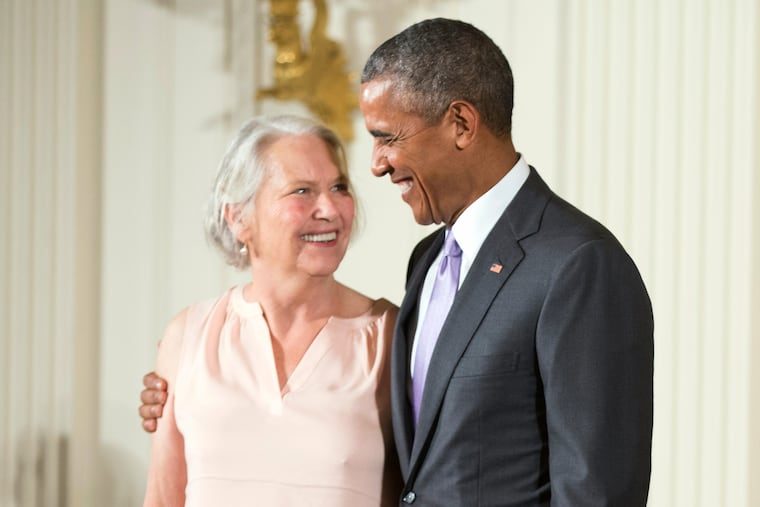
Ann Gitter, owner of iconic womenswear boutique Knit Wit and Philly fashion legend, has died at 78
Gitter introduced Philadelphia women to Badgley Mischka, Betsey Johnson, and Michael Stars before they were household names.

Ann Gitter, Philadelphia fashion icon and owner of the popular women’s clothing stores Knit Wit and Plage Tahiti, died at her Center City home on April 14 at age 78.
The cause was Lou Gehrig’s disease, a source close to the family confirmed.
Known for her all-black ensembles, waist-length blond braid, and perfectly trimmed bangs, Mrs. Gitter — along with business partners Donnie Davidow and Robert Brandt — introduced area women to Badgley Mischka and Betsey Johnson before the runway brands became red carpet staples and household names.
Central to the heartbeat of the Philadelphia fashion scene since the early 1970s, Mrs. Gitter gave women more sporty and professional choices as they moved beyond housecoats to haute couture through the 1980s.
“She left an indelible mark on Rittenhouse Row,” said Corie Moskow, executive director of Rittenhouse Row. “She defined the model of local independent retailers who made the neighborhood a destination for the luxury Philadelphia experience.”
In the late 1990s, Knit Wit was among the first Philadelphia specialty stores to carry premium denim brands like Seven for All Man Kind and Citizens of Humanity. Philadelphians who love JBrand’s waxed denim or Vince’s blousy tailored pastels can thank Gitter.
And as fashion moved in a more casual direction during the early aughts, she championed California-based Michael Stars’ T-shirts, turning the soft cotton gems into must-haves for Main Line moms who felt comfortable and chic in the easy-to-wear scoop and V-neck staples.
“She was so ahead of her time,” said Pam Katz, friend and former owner of the women’s boutique First Impressions. For decades, the two women carried many of the same brands in their respective stores, but maintained a close friendship despite being competitors.
“She had such an amazing eye. People came from New York to have private appointments with her. She would work all day and then style a closet. She dressed so many of us.”
Mrs. Gitter wasn’t afraid to break fashion rules or industry mores in an environment where salespersons can be snippy, silhouettes unkind, and prices astronomical. Shoppers of all ages and races felt welcome at Knit Wit.
She was among the area’s second-wave feminist boutique owners who came of age in the 1970s along with Katz, Joan Shepp, Toby Lerner, and Claire Dickson. These women turned their boutiques into successful businesses.
During the 1980s, she dressed women who climbed the corporate ladder. Gitter and her partners purchased Plage Tahiti on South 17th Street in 1982. The smaller women’s specialty store had a whimsical vibe, but the same comfy appeal. It closed in 2014.
In the 1990s, Mrs. Gitter was at the forefront of democratizing fashion, part of the movement to make high-end labels accessible to everyday people.
Fashion was her form of social justice.
“We marched together against guns, we marched for Black Lives Matter, we would have marched in No Kings, but she just wasn’t well,” said Joanne Davidow, Mrs. Gitter’s best friend and Donnie Davidow’s wife. “Business was important, but just as important were her feelings of what was right and what was wrong.”
Ann Gitter was born in Madison, Wis., on May 2, 1947, where her father, Lee Raden, an officer and navigator in the Army was stationed during the end of the Second World War.
Her family moved to Elkins Park in the 1950s. She graduated from Cheltenham High School and attended Temple University, graduating with a bachelor’s degree in business administration.
“While every other woman was studying to be teachers, she took business administration,” Joanne Davidow said, laughing.
During the late 1960s, Mrs. Gitter took a job managing Knit Wit back when it was located on 208 S. 17th St. The women’s boutique specialized in the era’s spunky knitwear separates for the working woman (think: Mary Tyler Moore). Mrs. Gitter was the buyer and store manager.
In 1970, the then-owner of Knit Wit, Aaron Frank, sold the business to Davidow and Brandt, two young, ambitious apparel entrepreneurs and owners of the popular and chic boutique Sweet Fanny Adams. They were looking to expand their portfolio.
“When we went to settlement, [Frank] pulled me and my partner Bob aside and said, ‘You’re getting more than a very pretty store, you are getting Ann Gitter. My advice to you is to make sure you keep her,’ ” Donnie Davidow said. “Within six months, we knew he was more than right and we made her partner.”
Mrs. Gitter went into overdrive bringing her customers little-known fashion brands with easy-to-wear-flare, including Philadelphia-born Willi Smith, whose colorful creations kicked off streetwear couture. She also introduced Philly to a young Betsey Johnson, whose fun collection was sold under the name Alley Cat.
Ann Gitter became the face of Knit Wit.
She married Stephen Gitter in 1970, two years after they met on a blind date. They were married for 56 years.
“When she first met me, she hated the way I dressed, particularly my shoes,” Stephen Gitter said. “She redressed me in bell-bottom pants, big, wide ties, and shirts with 19 or 20 buttons. She transformed me. It was an amazing transformation. I enjoyed it.”
The couple didn’t have children, but Mrs. Gitter was a mentor to many young women entrepreneurs.
Davidow, Brandt, and Mrs. Gitter moved Knit Wit to two Walnut Street locations — including their most well-known spot at 1718 that is now a part of the planned expansion of lululemon.
Over the years, there were Knit Wit stores in King of Prussia, Cherry Hill, Willow Grove, Ardmore, Bryn Mawr, and Margate.
In 2012, Mrs. Gitter was among the first Walnut Street specialty store owners to move to Chestnut Street when landlords on the city’s posh, high streets began tripling the rent, saying, “She refused to be store poor.”
Joan Shepp and Children’s Boutique later followed.
Mrs. Gitter closed her Center City Knit Wit in 2017, but remained in the area with seasonal pop-ups at 2044 Rittenhouse Square where she carried casual and athleisure brands Kerri Rosenthal, L’Agence, Autumn Cashmere, Three Dots, and of course, Michael Stars.
This year’s pop-up opened in early April, Knit Wit’s signature black and white balloons bouncing in the spring’s unseasonably warm wind.
“She had already bought all of the lines for fall,” said Joanne Davidow. “She never stopped. Philadelphia fashion is really going to miss her.”