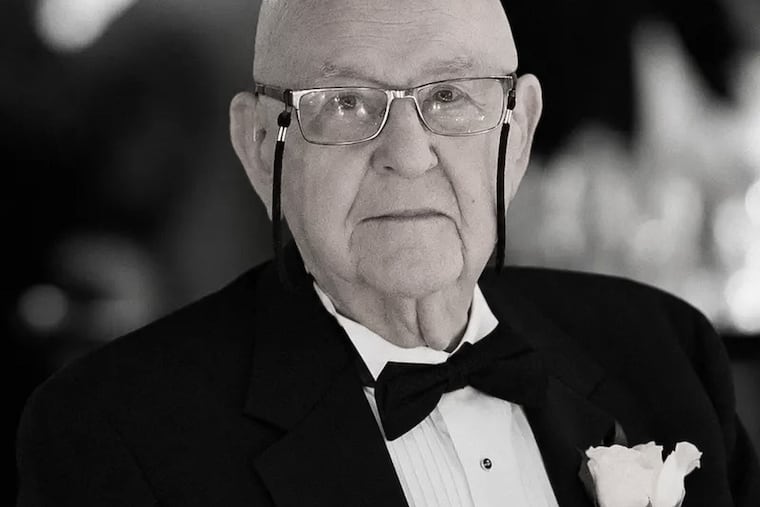
Arthur E. Humphrey, retired Lehigh provost, former Penn dean, and pioneering biochemical engineer, has died at 98
He studied single-cell protein, immobilized enzymes, and oxygen-enriched air, and held patents for several breakthroughs.
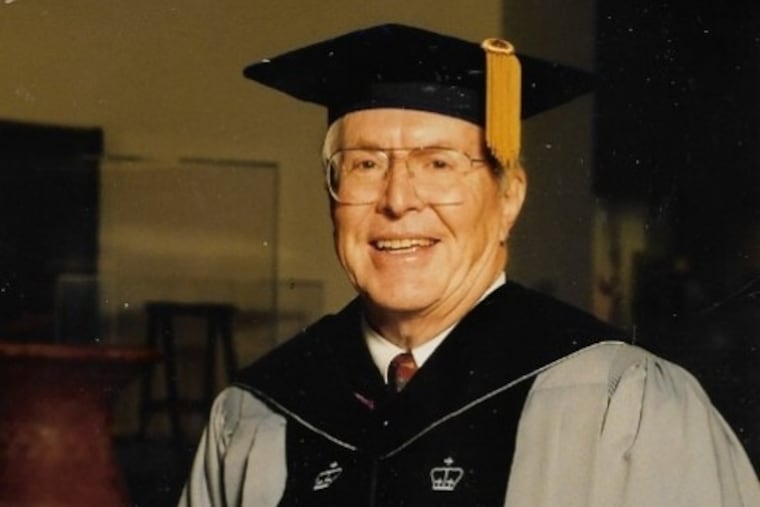
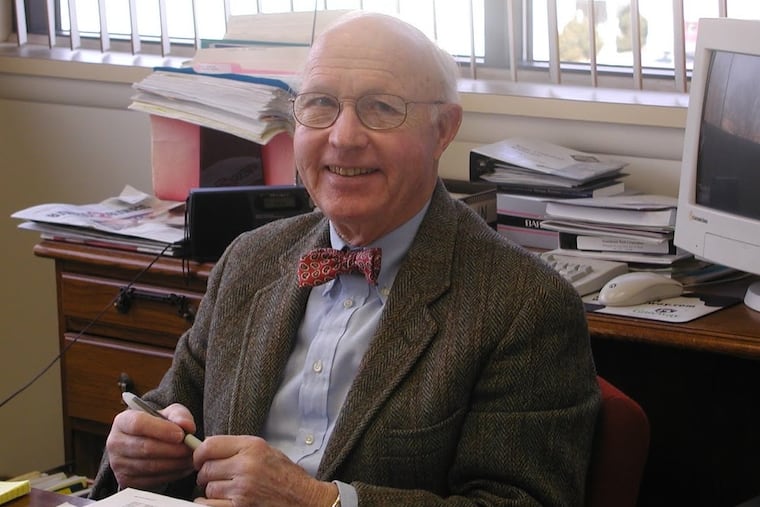
Arthur E. Humphrey, 98, formerly of Rose Valley, Delaware County, pioneering biochemical engineer, retired provost, vice president, and professor of chemical engineering at Lehigh University, former professor, department chair, and dean of what is now Penn Engineering at the University of Pennsylvania, retired professor at Pennsylvania State University, researcher, author, and mentor, died Saturday, March 21, of age-associated decline at Piper Shores retirement community in Scarborough, Maine.
Dr. Humphrey earned a doctorate in chemical engineering at Columbia University and spent more than 40 years, from 1953 to his retirement in 1997, as a professor, administrator, and expert in biochemical engineering at Penn, Lehigh, and Penn State. He was an innovative and popular provost and dean, and especially adept at providing pioneering biochemical research that improved food production, environmental sustainability, and industrial biotechnology.
In the lab, for government agencies and private firms, he studied single-cell protein, immobilized enzymes, oxygen-enriched air, and liquid fuels from renewable resources. He held patents for several breakthroughs.
With his students, he was more than a teacher, many of them said. “He saw things in you before you saw them yourself,” Stephen Tang, one of his doctoral students, said in an online tribute. “Pushed when you needed pushing, sheltered when you needed shelter, and connected you to others who became lifelong guides.”
Dr. Humphrey was recruited out of Columbia to Penn as a professor in 1953. He rose to director of the School of Chemical Engineering in 1961 and served as dean of engineering and applied science from 1972 to 1980.
He was praised by former Penn colleagues for merging new engineering programs into social and health-related curriculums. He supervised groundbreaking research projects and expanded the school’s local and global outreach.
“Dr. Humphrey,” former colleagues said in an online tribute, “was a pioneering figure in biochemical engineering and a transformative leader in higher education.”
He told Penn’s Almanac journal: “1973-74 will be a very important year for engineering, one in which I hope several dramatic changes will occur in the direction of engineering education.”
He left Penn in 1980 to be provost and vice president of academic affairs at Lehigh. He returned to the classroom in 1986 and was director of Lehigh’s center for molecular bioscience and biotechnology.
“Arthur’s impact on biochemical engineering cannot be overstated,” Lehigh president Joseph J. Helble said in a tribute. Other former colleagues said his “curiosity and generosity shaped generations of engineers and students around the world.”
Dr. Humphrey went to Penn State as a professor in 1992, was chair of its biotechnology institute, and retired in 1997. Penn established the Arthur E. Humphrey Professorship in his honor, and Lehigh created the Arthur Humphrey Distinguished Lecture Series in biomolecular engineering in 2016.
Dr. Humphrey also consulted for health and waste treatment organizations. He was on boards, committees, and panels, and was elected to the National Academy of Engineering in 1973. He lectured and taught around the world, and mentored hundreds of doctoral students and colleagues.
He cowrote the textbook Biochemical Engineering in 1965, and hundreds of his scholarly papers are published. He earned research and achievement awards from the Pennsylvania Society, the American Association of Engineering Societies, and other groups.
He was onetime president of the American Institute of Chemical Engineers, chair of President Richard Nixon’s Industrial Microbiology Joint Committee, and active with the American Chemical Society, the International Association of Microbiological Societies, and other groups.
In 2008, the American Institute of Chemical Engineers named him one of the 100 most distinguished chemical engineers of the modern era. However, said former Lehigh provost Mohamed El-Aasser, “what most people remember about Arthur was his humanity.”
Arthur Earl Humphrey was born Nov. 9, 1927, in Moscow, Idaho. The oldest of four boys, he was named after King Arthur by his father.
A lifelong outdoorsman, he enjoyed hiking, camping, canoeing, and biking. He was an Eagle Scout and a fire tower lookout, ran cross-country, and graduated high school at 16. Later, he hiked with the Philadelphia Trail Club and climbed Mount Fuji in Japan.
He went to the University of Idaho, earned bachelor’s and master’s degrees in chemical engineering, and chose science and academia over a tempting career in the Forest Service. He got his doctorate at Columbia in 1953 and a master’s degree in food technology from the Massachusetts Institute of Technology in 1960.
» READ MORE: Survivors give advice about mourning their loved ones, as told to The Inquirer’s obit writer
He knew Sheila Darwin from high school, and they married in 1951 and had daughters Andrea and Allyson. While he was teaching, they lived in Drexel Hill, Rose Valley, Bethlehem, Pa., and State College, Pa.
Dr. Humphrey and his wife liked to entertain, square dance, and travel the world together. He sang and played piano.
They split time between Maine and Arizona for years after he retired, and moved to Piper Shores about 20 years ago. His wife died in 2025.
In online tributes, friends and colleagues said Dr. Humphrey “lived life with intentionality and intensity” and was “practical, gracious, caring, and humble.” One friend said: “Art was a wonderful engineer and even a better person.”
His daughter Andrea said: “He had a heart of gold. He treated people the way he wanted to be treated.”
In addition to his daughters, Dr. Humphrey is survived by a grandson and other relatives.
A private celebration of his life is to be held later.
Donations in his name may be made to Penn’s Arthur E. Humphrey Professorship in Chemical and Biomolecular Engineering, Office of the Treasurer, Box 71332, Philadelphia, Pa. 19176; and the Piper Shores Endowment Fund, 15 Piper Rd., Scarborough, Maine 04074.