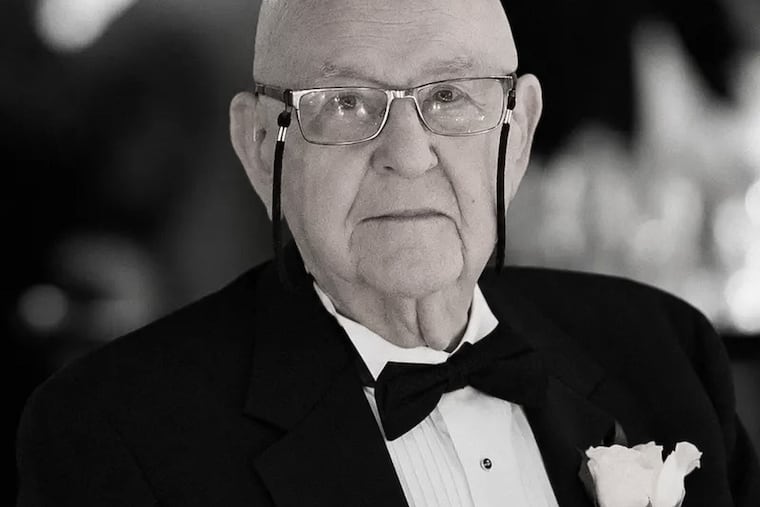
Dexter Wansel, Grammy-winning coproducer and Sound of Philly music icon, has died at 75
He wrote dozens of hit songs, developed groundbreaking synthesizer and symphonic keyboard sounds, and shared a Grammy Award with Lou Rawls in 1978.

Dexter Wansel started his music career as an 8-year-old backstage errand boy for some of music’s greatest stars at the old Uptown Theater on Broad Street. He ended it as one of those stars, an icon for the groundbreaking Sound of Philadelphia, and a prolific songwriter, arranger, and performer.
In between, over nearly 70 years, he wrote dozens of hit songs, developed synthesizer and symphonic keyboard sounds that set the stage for disco and hip-hop, and shared a Grammy Award in 1978 for arranging and coproducing Lou Rawls’ 1977 album, Unmistakably Lou.
In the 1970s and ’80s, he was a resident songwriter, artist, producer, and director of artists and repertoire for Kenny Gamble and Leon Huff’s famous Philadelphia International Records. He wrote, cowrote, and arranged songs at Sigma Sound Studios on North 12th Street and elsewhere for Rawls, the Jacksons, the Jones Girls, Teddy Pendergrass, Patti LaBelle, Phyllis Hyman, Jean Carn, Billy Paul, Dee Dee Sharp, the O’Jays, and others.
Between 1976 and 2021, he released 10 albums that fused jazz, funk, rock, disco, and rhythm and blues. When he was young, he spent time on a farm in Lewes, Del., and marveled at the nighttime sky. So he called his debut solo album Life on Mars.
“I’ve always liked the planets and the stars, even to this day,” he said in an online interview with Sounds Visual Media.
His 1976 song “Theme from the Planets” has been sampled by other artists more than 350 times, and he teamed with cowriter Cynthia Biggs to write LaBelle’s 1983 hit “If Only You Knew.” He played at the White House in 1979, and his name appears on dozens of gold and platinum records.
“I think that my forte lies in putting things together, to make things happen,” Mr. Wansel told the Baltimore Sun in 1978. “I seem to have a skill to get people to work together.”
On Sunday, May 31, Dexter Wansel died after a long illness. He was 75. The cause and location of his death have not been disclosed.
“The space man finally made it to Mars,” Mr. Wansel’s son, Pop, posted Monday on Instagram. “This guy loved everyone, and he taught me to do the same. … Keep sampling his music. He absolutely loved that.”
Mr. Wansel’s wife, Judy, and their family said in a tribute: “He’s at peace now.” Gamble and Huff said: “Dexter Wansel brought a new age sound to our record label. … Most importantly, Dexter was our dear friend, protégé, and great contributor to the Sound of Philadelphia.”
Born in 1950, Mr. Wansel grew up roaming backstage at the old Uptown Theater. His father was a drummer, and his stepfather and step-uncle produced many of the big music shows at the Uptown in the 1950s and ’60s.
Until he was 14, Mr. Wansel was tasked with delivering sandwiches and coffee backstage at the theater, and helping the artists, such as Miles Davis and Dizzy Gillespie, prepare for performances. He listened in on hundreds of rehearsals and shows, and was mentored by the theater’s celebrated bandleader, Harry “Doc” Bagby.
“He showed me my first keys on an organ,” Mr. Wansel told Sounds Visual Media.
He played the cello in junior high school, studied at Settlement Music School, and formed his first group with a few Roxborough High School classmates. He went into the Army when he was 17 and told the Daily News in 1977 that he honed his piano and keyboard skills playing with bands while stationed in China, Taiwan, and Texas.
After leaving the Army in 1970, Mr. Wansel played piano, keyboards, and synthesizer for recording sessions at Sigma Sound Studios. He toured and recorded with several groups in the early 1970s, and signed with Philadelphia International Records in 1975 as a songwriter, arranger, producer, and artist.
He formed Mars, his longtime band, in the 1970s and appeared for years at the Blue Moon Jazz Club, the old Robin Hood Dell East, the Academy of Music, the Tower Theater, and elsewhere in the region, across the country, and around the world. After leaving Gamble and Huff, he worked closely with Grover Washington Jr., Pendergrass, and his son, producer Andrew “Pop” Wansel.
Colleagues and fans called him an “inspiration,” a “master musician,” and “way ahead of his time” in Facebook tributes. Composer and producer King Britt said on X: “He was our hero, mentor, and guiding light … leaving behind a body of work that will continue to inspire generations to come.”
Dexter Gilman Wansel was born Aug. 22, 1950. He was named after musician Dexter Gordon, he told Sounds Visual Media, and grew so close to singer Rawls that his children called him Uncle Lou.
He routinely decried violence and poverty in his music, appeared on local TV shows, and stayed active with the Philadelphia Chapter of the old Black Music Association. He wrote a song about poet Kahlil Gibran and his book The Prophet, and his own novel, Shortwave, was published in 2011.
In 1978, he wrote Channel 10’s new TV newscast music theme. In 1992, he and other Black notables visited Ivory Coast in West Africa to celebrate its local Culturefest.
“Dexter Wansel was one of the most important composers and electronic music innovators in modern music, particularly within Black musical traditions,” Britt said on X.
Pop Wansel told The Inquirer in 2022 that his father “wasn’t just a cool dad. He was the coolest, just really mild-mannered, and patient, and uncompromising.”
» READ MORE: Survivors give advice about mourning their loved ones, as told to The Inquirer’s obit writer
In addition to his wife and children, Mr. Wansel is survived by other relatives.
Services have not been announced.